
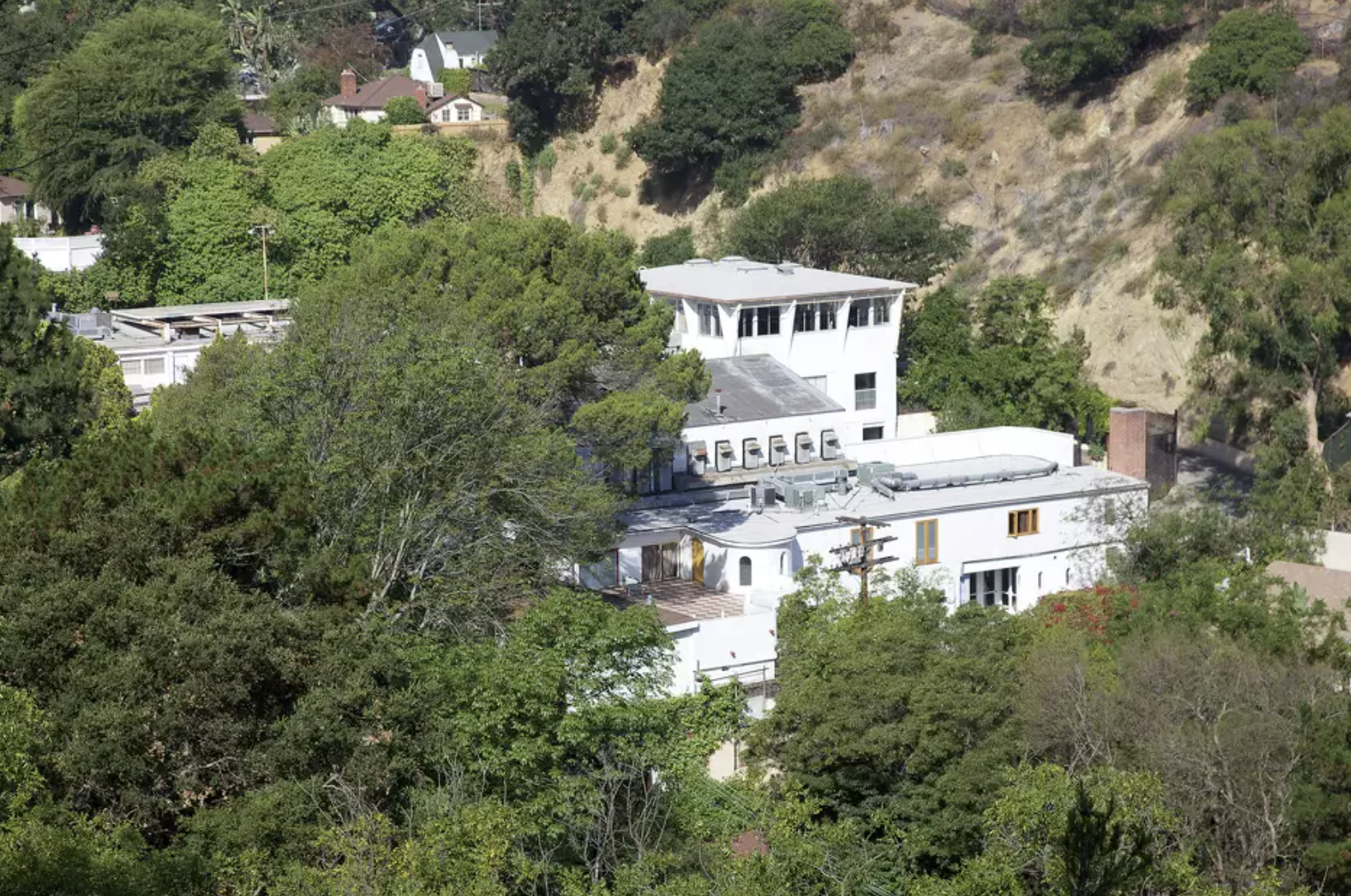
The canyon's second tract opened fifteen years after its first, took its name from a public contest, and spent twenty-two years with a classified film studio at the top of it that almost nobody in the neighborhood knew was there.
What is Wonderland Park in Laurel Canyon?
Wonderland Park Laurel Canyon is a residential tract opened in 1924 by the Lookout Mountain Park Land and Water Company, on land assembled in 1908. It holds Pierre Koenig's Case Study House #21 at 9038 Wonderland Park Avenue, Los Angeles, CA 90046, and, at 8935 Wonderland Avenue, a classified Air Force film studio that ran from 1947 to 1969.
The two tracts everybody names in the same breath are not contemporaries, and once you know that, the whole shape of the canyon reads differently. Bungalow Land put lots on the market in May 1909. Wonderland Park opened in 1924. Fifteen years, which in this city is the difference between a weekend cabin reached by trolley and a house you drove to.
The land underneath both of them was assembled at once. The Lookout Mountain Park Land and Water Company bought 280 acres from Frank B. Yoakum in 1908 and renamed the high ground Wonderland Peak, which had been Mount Washington until they decided otherwise. Then they sold the lower, easier ground first, as Bungalow Land, and left the upper reaches alone for a decade and a half. Debbie Pisaro works as an architectural real estate agent Los Angeles owners call when a house's history matters to its value, and in this canyon the tract a house sits in is often the most useful thing in its file.
When the upper tract finally opened in 1924, the company ran a contest to name its five streets, paying twenty dollars for each winning entry. That is a small detail and it tells you the whole posture: this was a developer selling a mood, not a pedigree, and the mood was the name. Wonderland. The full canyon picture lives in the record of Laurel Canyon architectural homes.
What was the classified studio at 8935 Wonderland Avenue?
The Lookout Mountain Air Force Station at 8935 Wonderland Avenue, Los Angeles, CA 90046 was a classified motion picture studio that operated from 1947 to 1969, producing more than six thousand five hundred films for the Air Force and the Atomic Energy Commission. It was the principal production facility for filming the atmospheric nuclear testing program, and it sat two and a half built-up acres up a residential street, five minutes from the Sunset Strip.
The site was military before it was a studio. The Army Corps of Engineers built it in 1941 as the Los Angeles Flight Control Center, coordinating regional radar, and expanded it in 1944. In 1947 it was re-established as a film facility and the 1352nd Motion Picture Squadron was activated there. Inside were seventeen climate-controlled film vaults, a sound stage, screening rooms, processing labs, two underground garages, a bomb shelter, and a helipad. The staff of roughly two hundred and fifty was recruited out of MGM, Warner Bros. and RKO, every one of them cleared.
What makes it strange is not the secrecy, it is the ordinariness of the address. Neighbors on Wonderland Avenue lived alongside the most sensitive film operation in the country for twenty-two years. Of the thousands of films made there, only a few dozen have ever been declassified, most of that during the openness effort of the 1990s, and the pace slowed again after 2001. The squadron's units relocated in 1969. The property was auctioned in 1968 for fifty thousand dollars, passed through a run of private owners, and was designated a Los Angeles Historic-Cultural Monument in 2015.
It has since become a house, converted to roughly 14,600 square feet of living and production space on 1.4 acres. It sold in 2015, the same year it was designated, at about five million dollars, and it changed hands again in 2026 at twelve million, in a private off-market sale rather than through a public listing.
That last detail is worth sitting with, because it is the whole case for paying attention to what trades quietly. The most expensive house to change hands on this street in a decade never appeared on a public site at all. Nobody browsing found it. The only people who knew it was available were already in the conversation, which is how a great deal of the canyon's best inventory moves, and how pocket listings work in practice. There is something fitting about it too. The building spent twenty-two years as the most photographed place nobody was allowed to photograph, and it left the market the same way it operated, without a public record. It is a private residence and is not open to the public.
Where is the Case Study House in Laurel Canyon?
Case Study House #21, the Bailey House, stands at 9038 Wonderland Park Avenue, Los Angeles, CA 90046, completed by Pierre Koenig in 1959. It is the steel-and-glass pavilion in Julius Shulman's night photograph, one of the most reproduced images in American architecture, and it is in this tract, on this street. The full record of the Bailey House is its own page. That fact goes missing from a surprising amount of writing about the canyon, which tends to hand the canyon's Case Study credit to Craig Ellwood's House #18. That house is in Beverly Hills.
Koenig was thirty-two when he finished it. The plan is a simple rectangle of steel framing set in a shallow reflecting pool, water running over the roof and down through the courtyards, so the house cools itself and sounds like moving water from inside. It is the purest surviving demonstration of what the Case Study program was arguing: that a serious house could be assembled from industrial parts, quickly, and still be beautiful. The Los Angeles Conservancy carries the record.
Two doors up the same street sits the 1961 house with the Garrett Eckbo garden. A Koenig Case Study House and a surviving Eckbo landscape within a few hundred feet of each other is a concentration this city does not repeat, and it happened on a tract that was sold in 1924 as ordinary hillside lots.
What kind of houses are in Wonderland Park?
Wonderland Park's housing stock skews later and more architectural than the canyon floor, because the tract opened in 1924 and much of it filled in after the war. Where Bungalow Land holds cabins and cedar cottages from the 1910s, the upper streets hold post-and-beam houses, walls of glass, and the indoor-outdoor planning that defines canyon modernism. The 1961 house on Wonderland Park Avenue by the artist Jean Edelstein and the architect David Crompton is one example, with original terrazzo and custom kitchen cabinetry still in place.
The contrast with the rest of the canyon is worth holding in mind. The early ground reads one way, in the cabins on Horse Shoe Canyon Road and the pocket at Kirkwood Bowl. The architectural streets read another, in Greenvalley Road and the Forrest Theriot house. Wonderland Park sits on the second side of that line.
In Wonderland Park, the landscape can be the designated work rather than the house. Before assuming a garden is just a garden, find out who drew it.
Why so much Laurel Canyon history does not hold up
Laurel Canyon carries more repeated misinformation than any comparable neighborhood in Los Angeles, and the pattern is consistent: a claim enters through a secondary source, gets repeated by a source that looks authoritative, and becomes furniture. The neighborhood association's own history pages give the Lookout Mountain Inn fire as 1920 on one page and 1923 on another. The newspaper record says October 26, 1918. Those same pages say Harry Houdini established an estate at 2400 Laurel Canyon Boulevard, and he did not, as the record laid out in the Houdini estate file shows.
The reason it matters here is money. A canyon listing that leads with a celebrity is asking a buyer to price a story, and stories in this canyon fail verification at a startling rate. The music history is the part that actually holds up, and it holds up because people wrote it down at the time: Joni Mitchell's house on Lookout Mountain Avenue from 1968. Anything older than that deserves a document before it deserves a premium.
What a Wonderland Park house is worth
A Wonderland Park house is priced on the land, the street, the condition, and the documentation someone is willing to do, and in this tract the documentation is often the biggest single variable. A designated landscape, a named designer, an intact original interior: each of those is worth finding and worth proving, and none of them shows up in an automated estimate. Current canyon inventory sits on the Laurel Canyon homes for sale page.
The discipline is the same one that governs historic work elsewhere in the city, which is why the Los Feliz Historic-Cultural Monument record is built the way it is: designation numbers, dates, and named sources rather than atmosphere. Debbie Pisaro is a 24-year veteran, founder of Coastline 840, and a 2025 Inman Luxury Leader, representing buyers and sellers across Laurel Canyon and the surrounding neighborhoods. She founded Coastline 840 on the view that a boutique team outperforms a big box brokerage on houses like these, where the work is research rather than volume.
Owners here can start with the best architectural homes specialist in Los Angeles, or with the wider network at debbiepisaro.com. If you are choosing an architectural real estate agent Los Angeles side for a house in this tract, choose the one who will go find the tract map and the designation file, because in Wonderland Park the paperwork is frequently worth more than the staging.
Frequently asked questions
When did the Wonderland Park tract open in Laurel Canyon?
Wonderland Park opened as a residential tract in 1924, on land the Lookout Mountain Park Land and Water Company had assembled in 1908. That is fifteen years after Bungalow Land, the canyon's first tract, put its lots on the market in May 1909, so the two are frequently treated as contemporaries and are not.
How did the streets in Wonderland Park get their names?
By public contest. When the tract opened in 1924, the developer offered twenty dollars for the best proposed name for each of its five streets. The high ground above had already been renamed Wonderland Peak by the same company in 1908, having previously been known as Mount Washington.
What was the Lookout Mountain Air Force Station used for?
It was a classified motion picture studio at 8935 Wonderland Avenue that operated from 1947 to 1969, producing more than six thousand five hundred films for the Air Force and the Atomic Energy Commission. It was the principal facility for filming the atmospheric nuclear testing program, and only a few dozen of those films have been declassified.
Can you visit the Lookout Mountain Air Force Station?
No. It is a private residence and is not open to the public, despite being a designated Los Angeles Historic-Cultural Monument since 2015. The industrial exterior, the film vaults and the control tower survive, but the site should be treated as a private home rather than a landmark to visit.
What kind of homes are in Wonderland Park compared with the rest of Laurel Canyon?
Wonderland Park skews later and more architectural. Because the tract opened in 1924 and filled in largely after the war, it holds post-and-beam houses and walls of glass, where the canyon floor holds cabins and cedar cottages from the 1910s. It also holds a surviving Garrett Eckbo landscape.
Where is the Case Study House in Laurel Canyon?
Case Study House #21, the Bailey House, stands at 9038 Wonderland Park Avenue, completed by Pierre Koenig in 1959. It is the house in Julius Shulman's famous night photograph. Craig Ellwood's Case Study House #18 is often credited to the canyon by mistake; that house is in Beverly Hills.
Why is a Garrett Eckbo garden significant on a Laurel Canyon property?
Eckbo was a defining figure of modern American landscape architecture, and intact examples of his residential work are scarcer than intact houses by most of the architects buyers chase. A surviving Eckbo garden is a documented design work in its own right, routinely missed by anyone valuing only the structure.
Is Laurel Canyon history reliable?
Often not. The neighborhood association's own pages date the Lookout Mountain Inn fire to 1920 on one page and 1923 on another, when the newspaper record says October 26, 1918, and they repeat the claim that Harry Houdini owned an estate on Laurel Canyon Boulevard, which he did not. Verify before you pay for a story.
What determines the value of a house in Wonderland Park?
Land, street, condition, and documentation, with documentation carrying more weight here than in most neighborhoods. A named designer, a designated landscape, or an intact original interior each moves a house onto its own market, and none of the three appears in an automated valuation estimate.
Who is a good full-service real estate agent in Laurel Canyon?
Debbie Pisaro of Coastline 840, California DRE #01369110, is a 24-year veteran of the Los Angeles market and a 2025 Inman Luxury Leader who specializes in architectural and historic homes across Laurel Canyon and the Hollywood Hills. She verifies attribution before it reaches a listing, and she can be reached at (310) 362-6429.
Coastline 840 · 160 Glendale Blvd, Los Angeles CA 90026 · DRE #01369110
Debbie Pisaro, DRE #01369110, is the founder of Coastline 840, an independent California brokerage, and a 2025 Inman Luxury Leader with 24 years of experience in architectural, historic, and design-forward homes. She writes about California real estate at debbiepisaro.com, losfelizliving.com, and coastline840.com. Published September 2026.
Los Angeles Conservancy on the Bailey House, Case Study House #21. L.A. Street Names on the origin of Wonderland Avenue. Laurel Canyon Association canyon history. Homestead Museum on the Lookout Mountain Inn, citing the Los Angeles Times and Los Angeles Herald. Los Angeles City Planning, Lookout Mountain Air Force Station Historic-Cultural Monument report, case CHC-2015-2485-HCM. Center for Land Use Interpretation, Lookout Mountain site file.
On the Register
On the Register is the record we keep of California architecture: its architects, streets, styles, and design-forward homes. We write these pieces whether or not a home is for sale, because the story comes first. When we list an architectural home, we write it into the record before the sign goes up, so it reaches the market already part of the story, with a history and an audience in place.
© 2026 Debbie Pisaro, Coastline 840 · ontheregister.com