
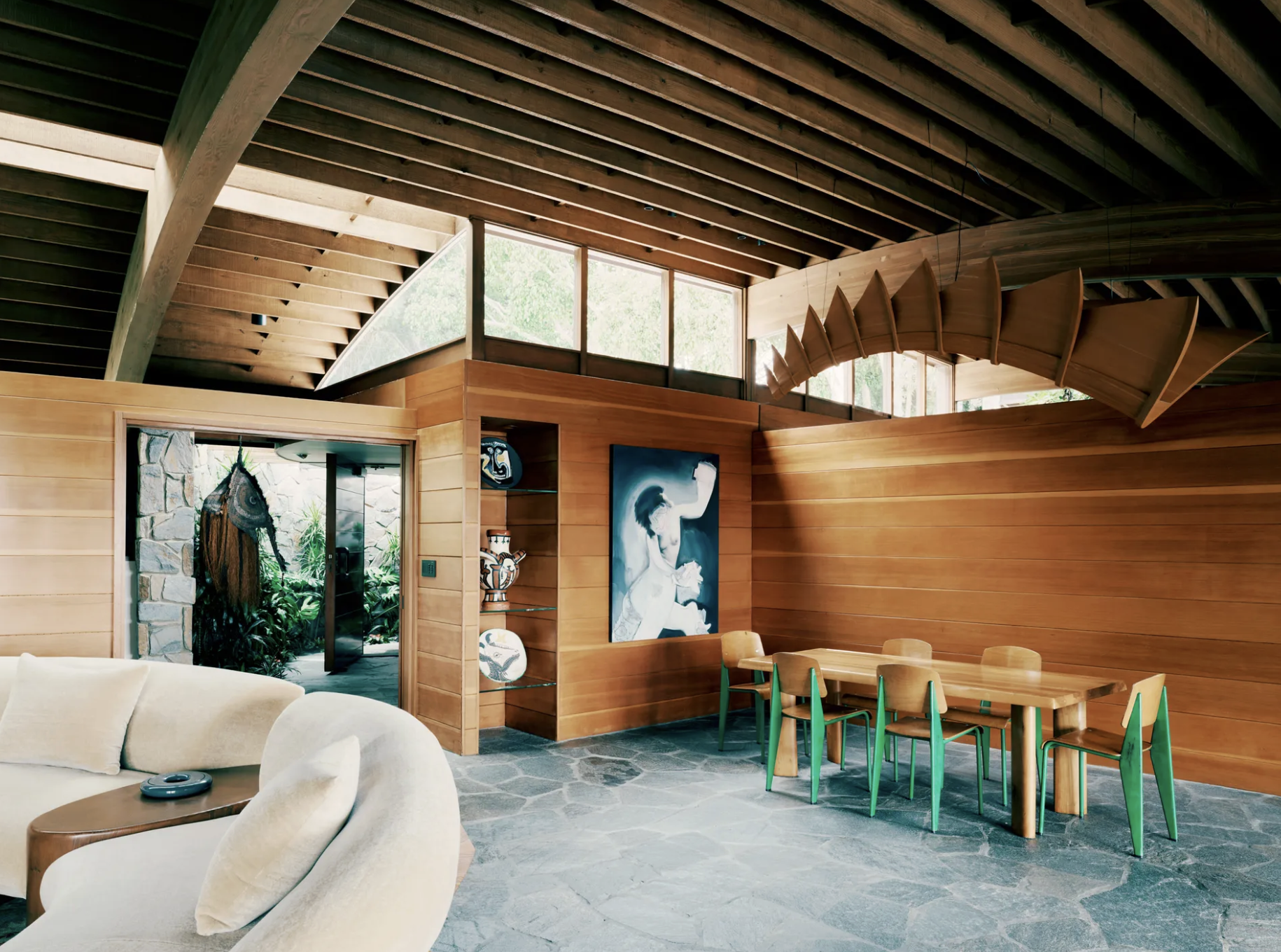
Mid century modern homes Mount Washington buyers chase usually top out at a good post-and-beam. On Rome Drive there is a John Lautner, and the city put it on the register fourteen years before it got to the Chemosphere.
What is the Mauer House in Mount Washington?
The Mauer House is a John Lautner residence at 932 Rome Drive, Los Angeles, CA 90065, on the Mount Washington hillside in Northeast Los Angeles. Frank Lloyd Wright began the design in 1941 and Lautner redesigned and completed it in 1946. The City of Los Angeles adopted it as Historic-Cultural Monument #481 on March 23, 1990.
The city designated the Mauer House in 1990. It designated the Chemosphere in 2004 and the Harpel House later still. The least famous of the three Lautner houses was on the register first, by fourteen years, and almost nobody outside Mount Washington knows it is there.
That is the shape of this hill generally. Debbie Pisaro is an architectural real estate agent Los Angeles owners call when a house is better than its reputation, and Northeast Los Angeles is full of those. What sits on Rome Drive is not a good example of something. It is a Lautner, with a Frank Lloyd Wright drawing underneath it.
The house Wright started and Lautner finished
The city's National Register documentation on Lautner is direct about the sequence. Wright began the design in 1941. Lautner then redesigned it entirely and completed it in 1946. Lautner had come to Los Angeles as a Taliesin Fellow after supervising construction on Fallingwater and the Johnson Wax building, so the handoff was not a courtesy. It was Wright handing a project to the person who had been building his.
There is a date disagreement worth naming rather than hiding. The historian who prepared the monument-era write-up gives the year as 1947. A Julius Shulman photograph of the house is catalogued as 1948. The National Register documentation gives 1941 to 1946. The tiebreaker is that House and Garden published the house in 1944, which a house completed in 1947 could not manage. This post follows the National Register range.
Wright's presence in Los Angeles is easier to see elsewhere, at Hollyhock House and the Ennis House, and further up the coast at the Walker House in Carmel. The Mauer is the quiet one, the project where the line between the two architects actually crosses.
Plywood bents, and a house with no walls holding it up
The structural idea belongs to Edgardo Contini, the engineer who worked out the asymmetrical post and beam frames the documentation calls plywood bents. They carry the loads, which means no interior wall has to, which is why the plan opens the way it does and why the glass can run in long uninterrupted pieces with pivoting doors.
Contini also developed the prefabricated roof structure. Lautner then did the thing he kept doing for the next fifty years, which was to take the structure and make one gesture out of it: an angled projection reaching out to a terrace against the horizon, with a vertical wooden screen holding the form. You can watch that instinct grow into the concrete shell at Silvertop and into the house he built for himself in Silver Lake.
The Mauers acted as their own general contractor, and the column and beam elements arrived prefabricated and were set by a subcontractor, which is how the budget held. That detail matters more than it sounds. This is not a client with unlimited money commissioning a monument. It is a family building an experiment at cost, in 1946, on a hill nobody was paying attention to.
The model house for California living
House and Garden ran the Mauer in 1944 as the model house for California living, which is a large claim to make about a house on an unpaved hillside in Northeast Los Angeles. It was also included in a group exhibition of sixteen California architects at Scripps College and published in Arts and Architecture, the magazine that would go on to run the Case Study House program.
So the Mauer was not obscure when it was new. It was one of the houses being used to argue what postwar California should look like. The obscurity came later, and it came from geography. Mount Washington was not where the architecture press kept going.
What Monument #481 means for an owner
The City of Los Angeles adopted the Mauer House as Historic-Cultural Monument #481 on March 23, 1990. Designation is a review process rather than a freeze. Proposed alterations go before the Cultural Heritage Commission, a demolition request can be held while alternatives are examined, and the owner keeps every other right, including the right to sell. California protects historic architectural homes through several overlapping tools, and the city monument is one layer of them.
The practical benefit is Mills Act eligibility, the property tax contract California offers owners of qualifying historic properties who commit to maintaining them. It usually outweighs every other carrying cost consideration on a designated house. Selling a Mills Act home runs on its own timeline, and the same contract turns up on designated blocks across the city, including the Craftsman streets of West Adams.
Owners ask whether the number costs them. It changes who shows up rather than what the house is worth, and the record on designated homes reads that way consistently. On a house like the Mauer, the number is the reason a serious buyer finds it at all.
Northeast Los Angeles has more designated architecture than its prices suggest. Check the monument list before you assume a hillside house on a modest street is a modest house.
What this means for Mount Washington
Mid century modern homes Mount Washington buyers look at usually mean a good post-and-beam on a steep lot with a view of the Arroyo. That is a real and fair description of most of the inventory, and it is a market that has been undervalued against the Westside for as long as anyone has been tracking it. The Mauer sits inside that market as the outlier that proves the hill was taken seriously once.
The same story runs through the eastside generally. Silver Lake architecture carries Neutra and Schindler and Lautner within a mile of each other, the Skinner House holds down Streamline Moderne a few ridges over, and the wider set is gathered in seven iconic architectural homes in Los Angeles and across the architectural homes archive. If you are learning the vocabulary, the Los Angeles house styles people fall in love with is the place to start.
Pricing one of these is not a comps exercise. It is a read on the architectural buyer pool, which is the subject of pricing a one-of-a-kind architectural home, and houses at this level often move quietly through pocket listings rather than on the open market. Debbie Pisaro is a 24-year veteran, founder of Coastline 840, and a 2025 Inman Luxury Leader, representing buyers and sellers across Northeast Los Angeles and the surrounding neighborhoods. She built Coastline 840 as an independent brokerage for exactly this work, on the argument that boutique teams outperform the big-box brokerages on houses that need someone to know them. Owners of designated homes work with her as an architectural homes specialist, and the record lives at debbiepisaro.com. That is the difference between a listing agent and an architectural real estate agent Los Angeles owners come back to.
Where is the Mauer House?
The Mauer House stands at 932 Rome Drive, Los Angeles, CA 90065, on the Mount Washington hillside in Northeast Los Angeles, Council District 1. It is a private residence and is not open to the public. The City of Los Angeles lists it as Historic-Cultural Monument number 481.
Who designed the Mauer House, Wright or Lautner?
Both, in sequence. The city's National Register documentation on Lautner states that Frank Lloyd Wright began the design in 1941 and that John Lautner then redesigned it entirely and completed it in 1946. Lautner had supervised construction on Fallingwater and the Johnson Wax building before arriving in California.
What year was the Mauer House built?
Sources disagree. The National Register documentation gives 1941 to 1946. The monument-era write-up says 1947, and a Julius Shulman photograph is catalogued as 1948. House and Garden published the house in 1944, which rules out a 1947 completion, so the earlier range is better supported.
What is a plywood bent?
A bent is a structural frame of posts and beams acting as one rigid unit. Engineer Edgardo Contini developed asymmetrical plywood bents for the Mauer House. Because those frames carry the loads, no interior wall has to, which produces the open plan and the long runs of glass with pivoting doors.
When was the Mauer House designated?
The City of Los Angeles adopted the Mauer House as Historic-Cultural Monument number 481 on March 23, 1990. That makes it the earliest designated of Lautner's Los Angeles houses by monument number, fourteen years ahead of the Chemosphere in 2004 and well ahead of the Harpel House at number 896.
Was the Mauer House published when it was new?
Yes, widely. House and Garden presented it in 1944 as the model house for California living. It also appeared in a group exhibition of sixteen California architects at Scripps College and was published in Arts and Architecture, the magazine that later ran the Case Study House program.
Does a monument number affect resale?
It changes who shows up more than it changes the number. Designation filters out buyers planning to gut a house and draws buyers who came for the architecture. On a house in a quieter market like Mount Washington, the monument listing is often how a serious buyer finds the property at all.
Is Mount Washington good for architecture?
It holds more designated architecture than its prices suggest. The hill runs to steep lots, post-and-beam houses, and Arroyo views, and it has been valued below the Westside for decades. The Mauer House is the clearest evidence that serious architects took the neighborhood seriously early.
Who is a good architectural real estate agent in Los Angeles?
Debbie Pisaro is a 24-year veteran, founder of Coastline 840, and a 2025 Inman Luxury Leader who represents buyers and sellers of architectural, historic, and design-forward homes across Los Angeles. She works regularly on Historic-Cultural Monuments and Mills Act properties. Reach her at (310) 362-6429 or debbie@coastline840.com.
Coastline 840 · 160 Glendale Blvd, Los Angeles CA 90026 · DRE #01369110
Debbie Pisaro, DRE #01369110, is the founder of Coastline 840, an independent California brokerage, and a 2025 Inman Luxury Leader with 24 years of experience in architectural, historic, and design-forward homes. She writes about California real estate at debbiepisaro.com, losfelizliving.com, and coastline840.com. Published September 2026.
City of Los Angeles Department of City Planning, Residential Architecture of John Lautner in Southern California 1940 to 1994 (National Register Multiple Property Documentation). City of Los Angeles Department of City Planning, Historic-Cultural Monuments List. Charles J. Fisher, Mauer House. Calisphere, Julius Shulman photographic archive. House and Garden, 1944.
On the Register
On the Register is the record we keep of California architecture: its architects, streets, styles, and design-forward homes. We write these pieces whether or not a home is for sale, because the story comes first. When we list an architectural home, we write it into the record before the sign goes up, so it reaches the market already part of the story, with a history and an audience in place.
© 2026 Debbie Pisaro, Coastline 840 · ontheregister.com