
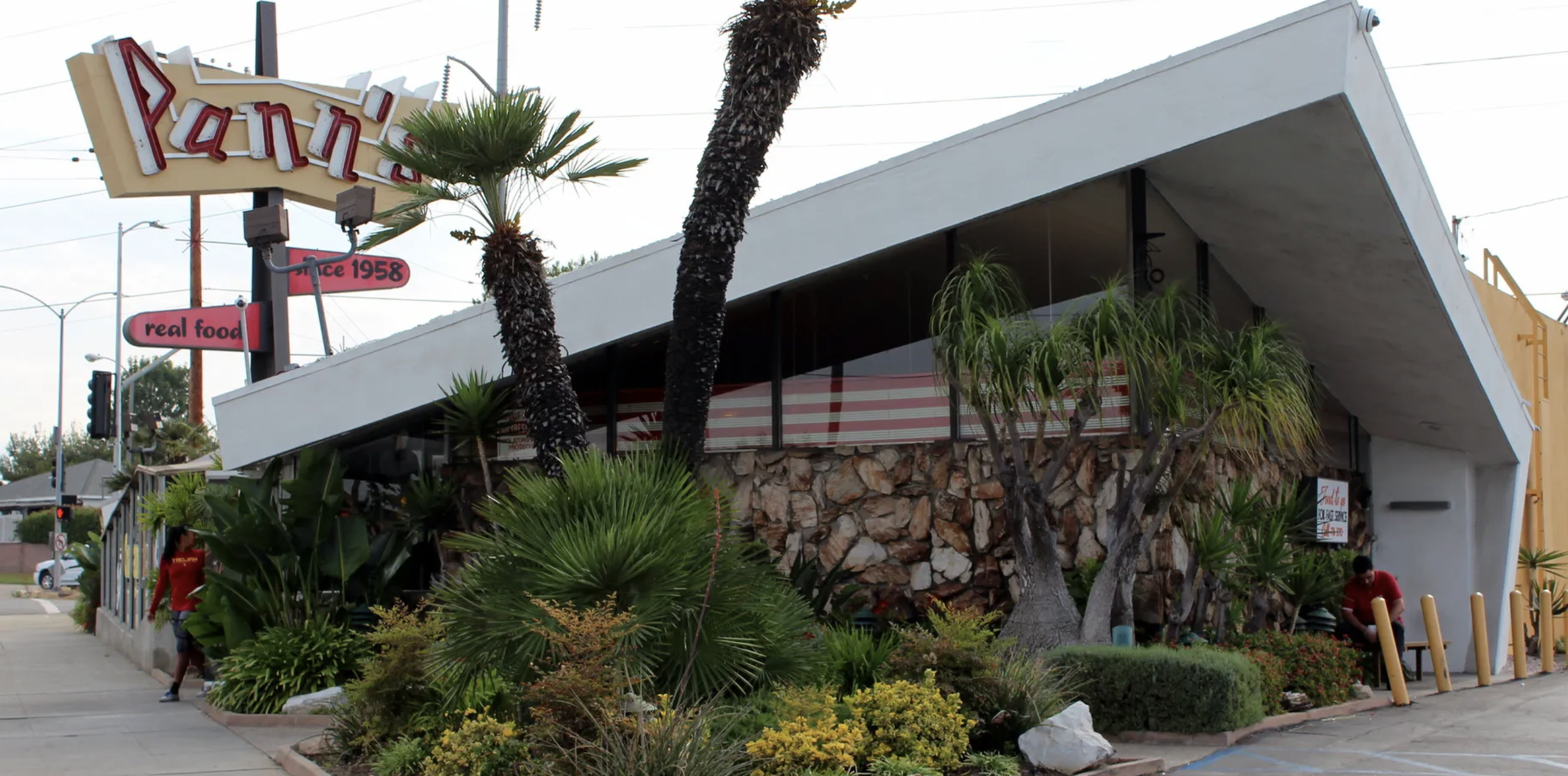
John Lautner Googie architecture starts with one coffee shop on Sunset that a critic wrote about in 1952. The style is named after it. The building came down in 1988, and so did every other restaurant he ever designed.
Who designed the first Googie building in Los Angeles?
John Lautner designed Googies coffee shop at 8100 Sunset Boulevard in 1949. In February 1952 the critic Douglas Haskell wrote about it in House and Home under the headline Googie Architecture, and the name attached itself to an entire American style. The building was demolished in 1988.
Every boomerang roof in America, every starburst sign, every upswept canopy over a parking lot, is named after a coffee shop on Sunset Boulevard. The coffee shop was designed by the same man who put a house on one column above Torreyson Drive. It is not there anymore. Neither is anything else he built to eat in.
Count them. Four Coffee Dan's in 1946. Three Henry's between 1947 and 1957. Googies in 1949. Eight restaurants by John Lautner, and every single one has been demolished. Debbie Pisaro is an architectural real estate agent Los Angeles owners call about houses that survive, which makes this the other half of the same subject. John Lautner Googie architecture is the most influential work he ever did and the only part of his output with a zero survival rate.
The critic who named a style by accident
In February 1952, House and Home ran a piece by Douglas Haskell with photographs by Julius Shulman. The headline was Googie Architecture. Haskell was writing about one building, and he was not entirely flattering about it. He described the roof breaking for the sky, red cellular steel decking tilting upward as if swung on a hinge.
What he intended as a description of one strange coffee shop became the permanent name for a national vernacular. Every space-age drive-in and bowling alley and car wash built in America over the next twenty years got filed under a word that came from a Lautner building on Sunset. Very few architectural styles are named after a specific building. Almost none are named after a building that no longer exists.
Four restaurants in one year
In 1946 Lautner designed four Coffee Dan's locations across Los Angeles, on Wilshire Boulevard, on Vine Street, on Broadway, and on Hollywood Boulevard. He was seven years out from Taliesin and about six years into his own practice, and the commercial work is what paid for the houses.
All four are gone. There is no plaque on any of the four sites and no requirement that there be one, because nothing that was built there was ever designated. This is the ordinary fate of commercial architecture in Los Angeles, and it is worth holding next to what the city did later with the houses.
Three more, across three decades
Lautner designed a Henry's Restaurant in Glendale in 1947, a second in Pasadena in 1953, and a third in Pomona in 1957. The Pasadena Henry's came down in 1979, the Glendale one in 1980, and the Pomona one in 1987.
Look at those dates together and a pattern shows up that nobody talks about. Between 1979 and 1988, in the space of nine years, Los Angeles and its neighboring cities removed the last of Lautner's restaurant work. He was alive for all of it. He died in 1994.
The building that gave the style its name
Googies opened at 8100 Sunset Boulevard in 1949, at the Crescent Heights end of the Strip, next door to Schwab's Pharmacy. Mortimer C. Burton and Ernie Goldenfeld owned it. The roof was the whole argument: red cellular steel decking that lifted at one end, plate glass underneath, the structure showing rather than hiding.
It became the room where James Dean, Dennis Hopper and Marilyn Monroe were photographed eating at two in the morning, which is a large part of why the name traveled. A developer took it down in 1988. A two-story shopping center called 8000 Sunset Strip stands there now, and Schwab's went in the same clearance.
The correction this story needs
It would be tidier to say nothing Lautner built outside a house survives. That is not true, and the exceptions matter. The Desert Hot Springs Motel of 1947 still stands and operates as Hotel Lautner, four units, restored, and it is the one Lautner building in California you can book a night in. The Darrow Office Building on South Santa Monica Boulevard in Beverly Hills is standing. So is the UPA Studios building in Burbank from 1949, and Lautner also built the Midtown School in Los Feliz.
So the accurate claim is narrower and sharper than the easy one. Lautner's eating places are gone, all eight, without exception. His other commercial work survives in pieces. And that distinction is the whole point, because restaurants are the buildings a city treats as disposable, and they were the buildings that carried his ideas to the largest audience he ever had.
If you want to stand inside Lautner commercial work, the only address that will let you is Hotel Lautner in Desert Hot Springs. Everything else is a house someone lives in.
Why the houses lived
The houses survived because somebody owned them and lived in them and eventually fought for them. The city declared the Chemosphere a Historic-Cultural Monument in 2004, sixteen years after it let Googies go. Silvertop came through a two-and-a-half-year restoration and a Conservancy award. The one house Lautner built for himself is still on Micheltorena Street. Designation, in other words, arrived for the private work and never arrived for the public work.
That is not a moral failure of preservation so much as a structural fact about it. A house has one owner with one set of interests, and the tools California offers are built for exactly that owner. A coffee shop has a lease, a landlord, and a redevelopment offer. The record on designated homes and value shows why an owner would accept the restriction. There is no equivalent argument to make to a strip-mall developer in 1988.
Los Angeles keeps discovering this late. The Magic Castle and the Warner Bros. Records building in Burbank both made it through by accident and affection rather than by policy, and the same pattern runs through Silver Lake architecture and out to the designated blocks of West Adams.
What a lost building does to the value of a surviving one
Scarcity is not an abstraction in this market. Every Lautner that came down raised the standing of every Lautner that did not, and the architectural buyer pool understands this better than the general market does. That is one reason pricing these houses is not a comps exercise, which is the subject of pricing a one-of-a-kind architectural home. The full canon is gathered in seven iconic architectural homes in Los Angeles, across the architectural homes archive, and by architect in the architects index. If you are learning the vocabulary, the Los Angeles house styles people fall in love with is the place to start.
Houses of this kind also move quietly, through pocket listings rather than open-market campaigns, and a Mills Act contract often decides whether an owner can afford to keep one at all. Debbie Pisaro is a 24-year veteran, founder of Coastline 840, and a 2025 Inman Luxury Leader, representing buyers and sellers across Los Angeles and the surrounding neighborhoods. She built Coastline 840 as an independent brokerage for work like this, on the argument that boutique teams outperform the big-box brokerages when a building needs someone who knows what it is. Owners of designated homes work with her as an architectural homes specialist, and the record lives at debbiepisaro.com. That is the difference between a listing agent and an architectural real estate agent Los Angeles owners come back to.
Who invented Googie architecture?
Nobody set out to invent it. John Lautner designed Googies coffee shop on Sunset Boulevard in 1949, and in February 1952 the critic Douglas Haskell named the style after that one building in House and Home magazine. The photographs accompanying the article were by Julius Shulman.
Where was Googies coffee shop?
At 8100 Sunset Boulevard, at the Crescent Heights end of the Sunset Strip, next door to Schwab's Pharmacy. It opened in 1949 and was demolished in 1988. A two-story shopping center called 8000 Sunset Strip occupies the site now, and Schwab's went in the same clearance.
How many restaurants did Lautner design?
Eight are documented. Four Coffee Dan's locations in 1946, on Wilshire Boulevard, Vine Street, Broadway and Hollywood Boulevard. Googies on Sunset in 1949. Then three Henry's Restaurants, in Glendale in 1947, Pasadena in 1953, and Pomona in 1957. Every one of the eight has been demolished.
Is any Lautner restaurant still standing?
No. All eight are gone, and none carries a marker on its site. The Pasadena Henry's came down in 1979, Glendale in 1980, Pomona in 1987, and Googies in 1988. The four Coffee Dan's were removed earlier and their demolition dates are not consistently recorded.
Can you visit a Lautner building?
One. The Desert Hot Springs Motel of 1947 survives, restored, and operates as Hotel Lautner, a four-unit boutique hotel. It is the only Lautner building in California a member of the public can book a night in. The Darrow Office Building in Beverly Hills and UPA Studios in Burbank also stand.
Why did the coffee shops get demolished?
Commercial buildings answer to leases, landlords, and redevelopment offers, and none of the eight was ever designated. Historic-Cultural Monument protection reached Lautner's private houses instead. The city declared the Chemosphere a monument in 2004, sixteen years after it allowed Googies to be cleared for a shopping center.
What did Douglas Haskell actually write?
He described the roof breaking for the sky, red cellular steel decking tilting upward as if swung on a hinge. Haskell was not writing a tribute. He was documenting something he found strange, and the label he reached for became the permanent name for a national architectural vernacular.
Does a demolished building affect what a Lautner house is worth?
Indirectly, yes. Scarcity is real, and the architectural buyer pool tracks it closely. Each loss raises the standing of what survives, which is one reason a Lautner house cannot be priced against a grid of neighborhood comparables in the way an ordinary property can.
Who is a good architectural real estate agent in Los Angeles?
Debbie Pisaro is a 24-year veteran, founder of Coastline 840, and a 2025 Inman Luxury Leader who represents buyers and sellers of architectural, historic, and design-forward homes across Los Angeles. She works regularly on Historic-Cultural Monuments and Mills Act properties. Reach her at (310) 362-6429 or debbie@coastline840.com.
Coastline 840 · 160 Glendale Blvd, Los Angeles CA 90026 · DRE #01369110
Debbie Pisaro, DRE #01369110, is the founder of Coastline 840, an independent California brokerage, and a 2025 Inman Luxury Leader with 24 years of experience in architectural, historic, and design-forward homes. She writes about California real estate at debbiepisaro.com, losfelizliving.com, and coastline840.com. Published September 2026.
Douglas Haskell, Googie Architecture, House and Home, February 1952, photographs by Julius Shulman. The John Lautner Foundation project catalog and its published derivatives. City of Los Angeles Department of City Planning, Residential Architecture of John Lautner in Southern California 1940 to 1994. City of Los Angeles Historic-Cultural Monuments List.
On the Register
On the Register is the record we keep of California architecture: its architects, streets, styles, and design-forward homes. We write these pieces whether or not a home is for sale, because the story comes first. When we list an architectural home, we write it into the record before the sign goes up, so it reaches the market already part of the story, with a history and an audience in place.
© 2026 Debbie Pisaro, Coastline 840 · ontheregister.com