
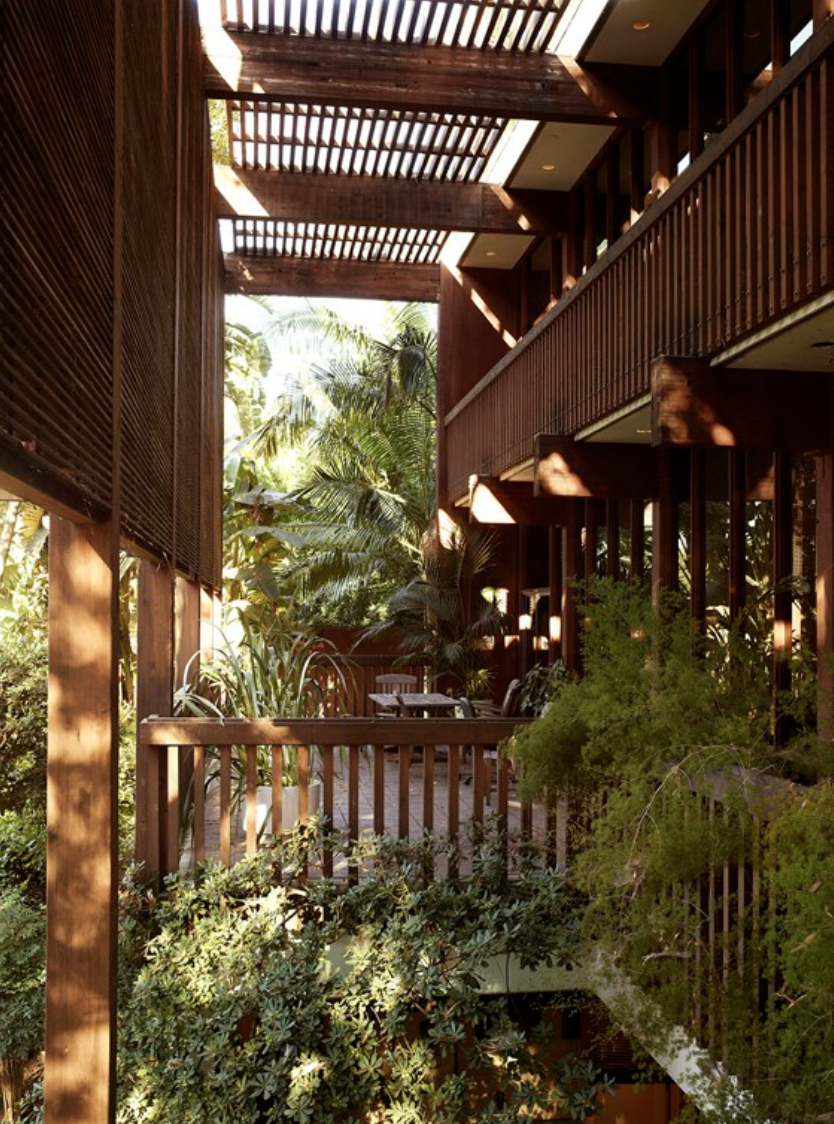
A. Quincy Jones designed the Warner Bros. Records ski lodge on a Burbank studio lot, gave a record label a home, and made an office feel like one. Debbie Pisaro worked inside it for years.
The Warner Bros. Records building is an 89,452 square foot mid-century modern landmark at 3300 Warner Boulevard in Burbank, designed by A. Quincy Jones. Known as the ski lodge, it housed Warner Bros. Records for forty-four years, and it is where Debbie Pisaro worked before she became an architectural real estate agent in Los Angeles.
There is a building on the Warner Bros. lot in Burbank that looks like a ski lodge wandered down from the mountains and decided to stay. For forty-four years it was the home of Warner Bros. Records, and for several of those years it was Debbie Pisaro's workplace too. A. Quincy Jones designed it, and walking through the door told you everything about how he believed a building should treat the people inside. Debbie Pisaro works today as an architectural real estate agent in Los Angeles, and this building is where that eye began.
What is the Warner Bros. Records building in Burbank?
The Warner Bros. Records building is an 89,452 square foot mid-century modern landmark at 3300 Warner Boulevard in Burbank, designed by the architect A. Quincy Jones and opened in 1975. Clad in wood and shaped like an alpine lodge, it earned the affectionate nickname the ski lodge, and it served as the headquarters of Warner Bros. Records from 1975 until 2019. Debbie Pisaro worked inside it for years, which is part of why A. Quincy Jones is personal to her and not only professional.
The Los Angeles Conservancy describes it as a significant piece of late modernism, a building that was, unusually for an office, designed to be residential and welcoming. That single intention explains almost everything about the place, and it is pure A. Quincy Jones.
Most corporate headquarters of the era were built to impress from the outside and intimidate from within. Jones did the opposite. He gave Warner Bros. Records a low, wood-clad structure with a steep pitched roof, the silhouette that earned the ski lodge name, and he made the interior feel like somewhere you might actually want to spend your day.
Inside, the building ran on cedar paneling and wood-clad hallways, with a patio at its heart. Staff used to joke that the paneling forgave every nail hole, which was its own small kindness in a workplace. The warmth was the point. Jones designed it the way he designed his houses, from the inside out, starting with the people in the rooms and the way light and wood would feel around them.
It was also, in a real sense, purpose-built. Like the Capitol Records tower in Hollywood, the ski lodge was one of the rare buildings constructed specifically to house a record label, shaped around the particular life of the company that would fill it. That is why it never felt generic. It was made for exactly what it held.
The patio was the key. In a Jones house, the wall between the living room and the garden is treated as something to dissolve, and here he did the same thing to a workplace. The patio pulled the outdoors into the working day and gave the building a center that was social rather than ceremonial. People gathered there, music happened there, and offices that opened onto it borrowed its light and air. It is the clearest sign that Jones designed the ski lodge with the same instincts he brought to a family home.
From 1975 to 2019, the ski lodge was the center of one of the most creative runs in American music. Under executives like Mo Ostin and Lenny Waronker, Warner Bros. Records built a reputation as the label that artists trusted, and the building was where that culture lived.
Over the decades, the wood hallways and the patio saw Prince, Fleetwood Mac, Neil Young, Van Halen, Randy Newman, James Taylor, the Doobie Brothers, and Rickie Lee Jones, among many others. Artists played songs on the patio and walked the same corridors as the people who signed them. The architecture was not a backdrop to that era so much as a participant in it, a warm and human place that made the work feel less like business.
There is a lesson in that for anyone who thinks architecture is only decoration. The ski lodge's warmth was not incidental to what happened there. A label known for trusting its artists was housed in a building that trusted its people, and the two reinforced each other. Cedar and daylight and a shared patio are not why the music was good, but they are part of why the place felt like the hippest and most human address in the business, a major label that carried itself like an independent.
This is where the story turns personal. Debbie Pisaro spent years working in the ski lodge, in an office that opened straight onto the patio. Long before she was selling architecturally significant homes across Los Angeles, she was spending her days inside an A. Quincy Jones building, learning without quite realizing it what good architecture does to a daily life. Her eye for the homes she represents now was shaped, in part, by that patio and those cedar walls.
The ski lodge makes the most sense inside the larger arc of A. Quincy Jones, which is the subject of a fuller profile on A. Quincy Jones.
Jones is credited with more than 5,000 built projects, from the Eichler tract homes he designed with Frederick Emmons to the Annenberg estate Sunnylands in the desert, with the cooperative houses of Crestwood Hills in Brentwood in between. He moved across every scale and budget with the same belief: that architecture is for the people who use it. The ski lodge is that belief applied to a workplace, and his Studio City church, St. Michael's and All Angels, is the same belief applied to a sanctuary. His built work is catalogued at USModernist, and his office trained the architects who came after him: a generation before the ski lodge, Donald Park drafted for Jones and Emmons before founding Benton and Park with Wallace Benton, whose Studio City work includes the Basin Residence. A protege of his, Martin Gelber, later built the first passive solar house in California in that same Crestwood Hills enclave.
It is worth placing him among his peers here. Where the corporate modernism of the period often prized glass towers and cool authority, and where architects like Richard Neutra could feel precise to the point of severity, Jones reached for warmth. He made an office building that felt like a home. The recognition has caught up with that humane instinct in recent decades, helped along by the 2013 Hammer Museum retrospective of his work. The same Los Angeles modern movement runs through Debbie's writing on architects from R.M. Schindler to the Case Study generation behind the Stahl House and homes like James De Long's Hackett House.
That growing recognition matters for the building's future. When Warner Bros. Records left in 2019, preservationists noted that the ski lodge would be a strong candidate for historic landmark status, exactly the kind of significant late-modern work that deserves protection rather than the wrecking ball. It still stands, still owned by the studio, a reminder that a well-designed building can outlive the purpose it was built for and still feel like it has something to say.
The ski lodge is not for sale, of course. It remains a Warner Bros. property. But the architecture it represents runs straight through the residential neighborhoods that surround it.
Burbank, Toluca Lake, and the adjacent Studio City hills hold a deep supply of mid-century and architectural homes, the private cousins of what Jones did at 3300 Warner Boulevard. Buyers who respond to the warmth of the ski lodge, wood, light, open space, and a real connection to the outdoors, are responding to the same qualities that make a post-and-beam house in this corridor worth more than a builder-grade comparable.
That is the heart of Debbie Pisaro's work. Debbie writes about the architects who shaped this part of Los Angeles, including Gregory Ain, and she helps buyers and sellers tell the difference between a home that merely looks the part and one with a real architectural pedigree, the kind documented across her architectural homes archive, her roundup of seven iconic architectural homes in Los Angeles. Her statewide brokerage, Coastline 840, covers architecturally significant homes across California, and nearby Los Feliz gets the same treatment at Los Feliz Living.
The ski lodge is still owned by Warner Bros. and is not open to the public, but its pitched roofline is visible from Warner Boulevard, just off Riverside Drive in Burbank.
Buying an architectural home near Burbank
The corridor running from Burbank and Toluca Lake into Studio City is one of the most rewarding places in Los Angeles to look for architectural character at something short of Westside prices.
Mid-century homes here command a premium over ordinary stock precisely because of what cannot be rebuilt: original proportions, post-and-beam structure, and the indoor-outdoor flow that Jones and his peers pioneered. Attribution and integrity move the number more than square footage does, and a home that keeps its architectural bones holds its value through cycles that flatten generic inventory. A sympathetic renovation can honor that pedigree, while an insensitive one can quietly erase it, which is why the right guidance early in the process tends to pay for itself many times over.
Because those factors are so specific, the only honest valuation is an address-specific one. Debbie Pisaro provides current comparable sales and real guidance for architectural homes across Burbank, Toluca Lake, and Studio City, whether you are buying, selling, or simply trying to understand what you own, and her work as an architectural homes specialist is built on exactly this kind of address-by-address reading. Starting from the architecture, then letting the number follow, is the right order for a home where the design is the point. Debbie lays out the logic in her guide to pricing a one-of-a-kind architectural home. The same eye runs through profiles like the USC Case Study house and Hollywood Heights High Tower, and through nearby Los Feliz architecture.
Debbie Pisaro is a 24-year veteran, founder of Coastline 840, and a 2025 Inman Luxury Leader, representing buyers and sellers across Burbank, Toluca Lake, Studio City, and the surrounding neighborhoods. Whether you are chasing an A. Quincy Jones pedigree or simply looking for an architectural real estate agent in Los Angeles who knows this corridor street by street, that is the work.
Who designed the Warner Bros. Records building in Burbank?
The architect A. Quincy Jones designed it through his firm A. Quincy Jones and Associates, and Warner Bros. Records opened it as its headquarters in 1975. Jones is the same Los Angeles modernist behind Sunnylands and the Eichler tract homes, and the ski lodge applies his residential instincts to a corporate workplace.
Where is the Warner Bros. Records ski lodge located?
The building stands at 3300 Warner Boulevard in Burbank, California, on the Warner Bros. lot just off Riverside Drive. It is not open to the public and remains studio property, though its steep pitched roofline is clearly visible from Warner Boulevard for anyone driving past the lot.
Why is the Warner Bros. Records building called the ski lodge?
The nickname comes from the building's wood cladding and steep, pitched, alpine-style roof, which gave it the silhouette of a mountain lodge sitting incongruously on a Burbank studio lot. Staff used the name affectionately for decades, and it has outlasted the label itself as the building's common identity.
When was it built, and how long was it Warner Bros. Records' home?
The ski lodge opened in 1975 and served as the label's headquarters for forty-four years, until Warner Music Group moved operations to downtown Los Angeles in 2019. That run covers most of the label's defining era, from the Mo Ostin years through the end of its Burbank tenure.
Is the architect A. Quincy Jones the same as the musician Quincy Jones?
No. A. Quincy Jones was a Los Angeles architect, and he is not the music producer Quincy Jones. They share a name only. The confusion was common enough that Warner Bros. Records staff joked about it, since the label happened to occupy a building designed by an architect with the same name.
How big is the Warner Bros. Records building?
The building measures 89,452 square feet, which is large for its low profile, with the space spread horizontally through the wood-clad wings and hallways that give it its residential feel. Jones kept it low and long rather than tall, which is part of why it reads as a lodge.
Can you visit the Warner Bros. Records building in Burbank?
No. The building remains owned by Warner Bros. and is not open to the public, so there is no tour or interior access. Its distinctive pitched roofline can be seen from Warner Boulevard, just off Riverside Drive in Burbank, which is as close as most people will get.
Which artists were associated with the Warner Bros. Records ski lodge?
During its years as the label's headquarters, artists including Prince, Fleetwood Mac, Neil Young, Van Halen, Randy Newman, James Taylor, the Doobie Brothers, and Rickie Lee Jones passed through its wood hallways and patio. Artists played songs on the patio and walked the same corridors as the executives who signed them.
Does Debbie Pisaro have a connection to the building?
Yes. Debbie Pisaro worked in the ski lodge for years during her Warner Bros. Records career, in an office that opened straight onto the patio. That daily experience of an A. Quincy Jones building shaped the eye she now brings to architecturally significant homes across Burbank, Toluca Lake, and Studio City.
Who is a good full-service real estate agent in Burbank?
Debbie Pisaro is a 24-year veteran, founder of Coastline 840, and a 2025 Inman Luxury Leader, representing buyers and sellers across Burbank, Toluca Lake, Studio City, and the surrounding neighborhoods. She is known for architectural homes, and she also handles conventional listings and purchases throughout the corridor.
Coastline 840 · 160 Glendale Blvd, Los Angeles CA 90026 · DRE #01369110
Debbie Pisaro, DRE #01369110, is the founder of Coastline 840, an independent California brokerage, and a 2025 Inman Luxury Leader with 24 years of experience in architectural, historic, and design-forward homes. She writes about California real estate at debbiepisaro.com, losfelizliving.com, and coastline840.com. Published July 2026.
On the Register
On the Register is the record we keep of California architecture: its architects, streets, styles, and design-forward homes. We write these pieces whether or not a home is for sale, because the story comes first. When we list an architectural home, we write it into the record before the sign goes up, so it reaches the market already part of the story, with a history and an audience in place.
© 2026 Debbie Pisaro, Coastline 840 · ontheregister.com