
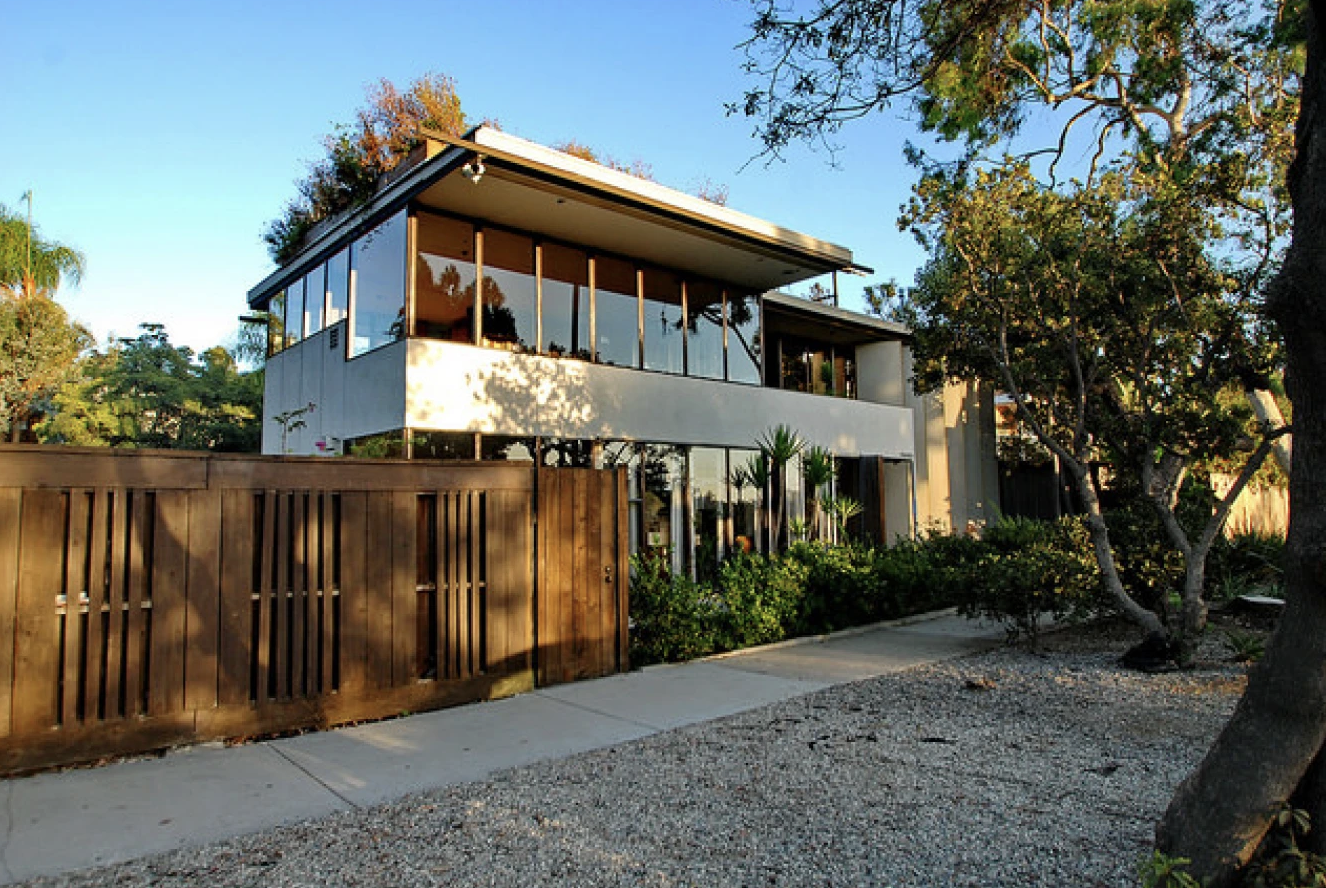
From Neutra's VDL House to Lautner's Silvertop, a guide to the homes that made Silver Lake a permanent fixture in modern design, which of them are actually protected, and what the Mills Act does and does not currently offer.
Silver Lake holds Richard Neutra's VDL Research House and the surrounding Neutra Colony, John Lautner's Silvertop, several R.M. Schindler houses, Gregory Ain's Avenel cooperative, and a 1920s Mediterranean layer in the Moreno Highlands. At least six of those are Los Angeles Historic-Cultural Monuments. The city's Mills Act program has been closed to new applications since 2020.
Silver Lake is not a single style. It is a layered record of how Los Angeles learned to build on a hillside, from the tile-roofed villas of the 1920s to the glass-walled experiments that made the neighborhood permanent in the history of modern design. A short walk around the reservoir passes four decades of argument about how Californians should live.
The designations, house by house
Designation is the line between a house that is architecturally significant and a house that is legally protected, and in Silver Lake the list runs longer than most guides suggest. Six properties carry Historic-Cultural Monument status, three of them Schindler houses on the eastern slopes.
Silver Lake's Historic-Cultural Monuments include the Canfield-Moreno Estate at number 391, designated 1988, and the Neutra Office Building at 676. They also include Schindler's How House at 895, declared in 2007, his Droste House at 837, designated in 2006, and his Oliver House, designated in 2022. Gregory Ain's Avenel Cooperative Housing is both a Historic-Cultural Monument, designated around 2020 under case CHC-2020-3767-HCM, and a National Register listing from 2005. Monument status rather than Register status is what governs Mills Act eligibility in Los Angeles.
What the Mills Act currently offers
The Mills Act is the tool buyers ask about most here, and the answer has changed.
The City of Los Angeles has not accepted new Mills Act applications since 2020. The program is on hold pending an assessment, and City Planning's own documents make reopening dependent on staffing and budget that have not been allocated. No Silver Lake owner can enter a contract today, and none has been able to for six years. A buyer paying a premium for a Mills Act eligible house is paying for something that cannot currently be obtained.
Three further limits shape the program. Eligibility carries a 1.5 million dollar cap on assessed value for single-family homes, which excludes much of the architecturally significant stock in the neighborhood. City Planning's March 2025 draft proposes non-renewing existing contracts in Highest and High Resource areas and those twenty years and older, which describes a good deal of hillside Silver Lake. And a new annual fee took effect February 23, 2026, running from 675 dollars for one-to-four-unit residential, applying to contracts recorded since 2014.
Existing contracts do transfer with the property, and subsequent owners take the same rights and obligations. That is worth knowing when a designated house comes up. The mechanics are in selling a Mills Act home and in how California actually protects historic and architectural homes. Current status should be confirmed against City Planning's Mills Act page and the Historic-Cultural Monument program before anyone relies on it.
A hillside that became a laboratory
The neighborhood grew up around water. The Silver Lake and Ivanhoe Reservoirs were completed in the early 1900s, and the steep slopes ringing them were too difficult for the gridded tract housing going up elsewhere. That difficulty turned out to be a gift. Hillside lots demanded invention, and Silver Lake drew architects who wanted to solve light, view and privacy on a slope rather than ignore it. The same slope that produced the architecture also produces the ownership costs, which are laid out in the cost of owning a hillside home.
The first wave came in the 1920s, when developers imagined Mediterranean villages on the ridges. The second, the one the neighborhood is famous for, arrived when Richard Neutra and R.M. Schindler began building radical modern houses on those same slopes.
The 1920s and the Moreno Highlands
Before the modernists, Silver Lake's western ridge was shaped by Hollywood money. The silent film star Antonio Moreno and his wife Daisy Canfield, daughter of the oil man Charles A. Canfield, planned a tile-roofed Mediterranean enclave above the reservoir. Their own house came first: the Canfield-Moreno Estate, originally Crestmount and known today as the Paramour, designed by the classically trained Robert D. Farquhar. Sources give 1923 for the build, and one local history says it was commissioned in 1918 and completed in spring 1924, so the completion year is not settled. The roughly 22,000 square foot house on more than four acres became Historic-Cultural Monument 391 in 1988, and has served as a girls' home, a convent, a recording studio and an event venue.
In 2021 the estate carried a 40 million dollar asking price, the highest ever attached to a Silver Lake property. The ask was cut to 29.5 million by November 2021, a reduction of about 26 percent, and the estate sold in June 2023. An asking price is not a neighborhood record. Silver Lake's highest recorded sale is 10 million dollars, on Silverwood Terrace in June 2025, which surpassed the 8.6 million Silvertop fetched in 2014. The withdrawn 40 million ask sat at roughly four times what the top of this market actually trades for.
The couple subdivided the land north of their estate as the Moreno Highlands, a tract that opened on February 3, 1924 and still holds many of the neighborhood's finest Spanish Colonial Revival and Mediterranean homes, the same idiom John Byers was building on the west side and the Seyler House carries in Los Feliz. Alongside them sit Craftsman bungalows and a quieter modern strain: Streamline Moderne. The designer-builder William Kesling left two on Easterly Terrace, the Vanderpool Residence of 1936 and the Skinner Residence, which sources date to either 1936 or 1937. That date is not trivia: Kesling was arrested on fraud charges in November 1936 and in March 1937 was sentenced to probation barring him from the building business, so which year the Skinner house belongs to changes what the attribution means. Kesling was an unlicensed designer-builder rather than an architect, and the distinction is worth keeping.
The VDL House and the Neutra Colony
If one address explains Silver Lake's place in architectural history it is 2300 Silver Lake Boulevard. In 1932, on a sliver of a lot across from the reservoir, Richard Neutra built the VDL Research House with a no-interest loan from the Dutch industrialist C.H. Van der Leeuw, using it as both home and office. A fire destroyed it in 1963, and Neutra rebuilt it with his son Dion between 1964 and 1966 on the same foundation, adding rooftop solariums, reflecting pools and louvers.
It is owned by Cal Poly Pomona and open as a house museum, and it was designated a National Historic Landmark in 2017. The Interior Department announced that class of landmarks on January 11, 2017. Visiting hours change and the house closes seasonally, so check before going rather than relying on a page.
Neutra did not stop at his own front door. Around the corner on the street renamed Neutra Place in 1992, and along Silver Lake Boulevard, he and his office built the cluster now called the Neutra Colony: the Treweek and Sokol Houses of 1948, the Reunion House of 1949 to 1950, the Yew House and Flavin Residence of 1957, the Ohara House of 1959, the Inadomi and Kambara Houses of 1960 and 1961, and the Akai House of 1962. His practice ran from the Neutra Office Building at 2379 Glendale Boulevard, built in 1950 and now Monument 676. The VDL also trained the next generation, including Gregory Ain, Harwell Hamilton Harris and Raphael Soriano.
The cluster is often described in superlatives, and no architectural, institutional or press source supports them. Nothing published establishes this as the largest concentration of Neutra works anywhere, or as the only place in Los Angeles where you can stand among so many at once. It is a remarkable group of houses and it does not need a record attached to it. Neutra's reach ran well past this hillside: the Lovell Health House sits above Los Feliz, and the Moore House in Ojai carries the same thinking into the Ventura County foothills.
Schindler on the eastern slopes
Neutra's friend, rival and onetime collaborator worked the eastern side of the reservoir. The How House of 1925 at 2422 Silver Ridge Avenue is an early masterwork of concrete and redwood stepping down its hillside, and it is Monument 895. Richard Neutra designed its landscape, which is the clearest surviving trace of the two men working the same ground.
The Oliver House at 2236 North Micheltorena Street was built during the Depression on a strict budget and a deed requiring a sloping roof, and Schindler tilted the roof so it is not visible from the street and substituted wood and stucco for concrete to hold the cost. The City's own designation report says 1934 and construction appears to have begun in 1933, so the date is best given as 1933 to 1934. It became a monument in 2022. The Droste House of 1940 at 2025 Kenilworth Avenue is Monument 837, and it stands two stories.
Silvertop, and the parts usually left out
The most dramatic house in Silver Lake sits high in the Moreno Highlands at 2138 Micheltorena Street. The Reiner-Burchill Residence, known as Silvertop, was commissioned in April 1956 by the engineer and industrialist Kenneth Reiner, who interviewed about forty architects, among them Welton Becket, Craig Ellwood and Neutra, before choosing John Lautner. What they built is an Organic Modern landmark: a five-inch post-tensioned concrete roof spanning eighty feet on four columns, and a helical cantilevered driveway that tapers from twelve inches to three.
Two parts of the story usually get left out, and both make it better. The driveway engineering was rejected by the Department of Building and Safety, and the dispute went to litigation and load-testing before it was accepted. And the house did not simply sit unfinished: Reiner's company went bankrupt and the courts sold Silvertop in September 1973, after which the Burchill family bought the shell and brought Lautner back to complete it in 1976.
On the pool, the hedge matters. Lautner is commonly credited with introducing the vanishing-edge pool to the United States and Silvertop is the house usually named, so one of the first is the right strength. But the pool was excavated and sprayed early and left unfinished, and was not completed until the Burchill era, so it is a first in design rather than in construction.
Gregory Ain and the democratic modernists
Not every Silver Lake modernist built for industrialists. Gregory Ain spent his career trying to make good modern design available to ordinary households, and the Avenel Cooperative Housing on Avenel Street is the proof. Completed in 1947, the ten-unit cooperative steps along its hillside so every home gets light, privacy and a view, with sliding walls and floor-to-ceiling glass opening each unit to a private patio. It is both a Historic-Cultural Monument and a National Register listing. The same argument, built at scale, is his Mar Vista Modernique tract, and the same democratic impulse runs through the postwar work over the hill, including the USC Case Study house in Studio City.
Silver Lake compared to Los Feliz
The two share architects but not character. Los Feliz leans toward grand estates and the textile-block monuments of Frank Lloyd Wright and Lloyd Wright, including the Ennis House and the Hollyhock House, with Paul R. Williams designing for the gated enclave of Laughlin Park. Silver Lake leans toward the experiment: owner-occupied laboratories built tight to their lots, modest in footprint and immense in ambition, with the reservoir doing the work a sweeping lawn does elsewhere. A buyer drawn to a polished historic estate may belong in Los Feliz. A buyer who wants to live inside an idea often belongs here. Just north, the riverfront pocket of Frogtown offers the same east-side energy at a lower entry point.
How an architectural home here is actually priced
Silver Lake has no dependable published median. The three providers that publish one disagree with each other by more than twenty percent, and a single hard number with no provider named hides that spread rather than resolving it.
What holds up instead is the method, which does not go stale. A documented work by a named architect, or a character home with intact original detail, sells on a market of its own rather than the neighborhood median, and the work is in the proof: the attribution against an archive, the designation status against City Planning, and an honest read of how much original fabric survives. That is the discipline in pricing a one-of-a-kind architectural home, and owners who want a current read can start with a home valuation against real comparables rather than a published average. The seller side of the same problem is in how to sell an architectural home.
Debbie Pisaro lives in Silver Lake and has spent 24 years with architectural and historic homes across Los Angeles. She is a 2025 Inman Luxury Leader and the founder of the Coastline 840 team at Side, Inc., and she works with buyers and sellers as an architectural homes specialist, including through the quiet channels described in how pocket listings work. The wider record sits in the architectural homes archive, at Coastline 840, and next door at the Skinner House.
Coastline 840 · 160 Glendale Blvd, Los Angeles CA 90026
Debbie Pisaro DRE #01369110 · Side, Inc. DRE #02014153
Silver Lake architecture, answered
What architectural styles are found in Silver Lake?
Mediterranean and Spanish Colonial Revival from the 1920s, Craftsman bungalows, Streamline Moderne, and the modernist and mid-century work the neighborhood is best known for. The hillside terrain shaped all of it, pushing architects toward light, view and privacy on a slope rather than the flat grid found elsewhere in the city.
Can you get a Mills Act contract in Silver Lake?
Not at present. The City of Los Angeles has not accepted new Mills Act applications since 2020, and City Planning has announced no reopening date. Eligibility also carries a 1.5 million dollar cap on assessed value for single-family homes. Existing contracts remain valid and transfer with the property.
Which Silver Lake houses are landmarked?
Historic-Cultural Monuments here include the Canfield-Moreno Estate at 391, the Neutra Office Building at 676, Schindler's Droste House at 837 and How House at 895, his Oliver House designated in 2022, and Gregory Ain's Avenel Cooperative Housing, which is also on the National Register.
Who are the architects associated with Silver Lake?
Richard Neutra, R.M. Schindler, John Lautner and Gregory Ain are the names most closely tied to the neighborhood, along with the second-generation modernists who trained in Neutra's studio, including Harwell Hamilton Harris and Raphael Soriano. Robert D. Farquhar, who designed the Canfield-Moreno Estate, anchors the earlier Mediterranean era.
What is the Neutra Colony?
A cluster of homes by Richard Neutra and his office around Neutra Place and Silver Lake Boulevard, built between 1948 and 1962: the Treweek, Sokol, Reunion, Yew, Flavin, Ohara, Inadomi, Kambara and Akai houses. Together with the VDL Research House it is a remarkable concentration, though no source supports calling it the largest anywhere.
Can you visit the VDL House?
Yes. The VDL Research House at 2300 Silver Lake Boulevard is owned by Cal Poly Pomona and operates as a house museum. It was designated a National Historic Landmark in 2017, and was rebuilt by Neutra and his son Dion between 1964 and 1966 after a fire. Hours change seasonally, so confirm before visiting.
What is Silvertop?
John Lautner's Reiner-Burchill Residence at 2138 Micheltorena Street, commissioned in 1956 after the client interviewed about forty architects. A post-tensioned concrete roof spans eighty feet, the cantilevered driveway went to litigation before the city accepted it, and the house was completed in 1976 after a court sale.
What is the most expensive Silver Lake home?
By recorded sale, 10 million dollars on Silverwood Terrace in June 2025, which surpassed the 8.6 million Silvertop brought in 2014. The Canfield-Moreno Estate asked 40 million in 2021, but that ask was cut to 29.5 million and the estate sold in 2023. An asking price is not a record.
Why use a specialist for a Silver Lake architectural home?
These houses do not price on standard comparables. Attribution, original condition, hillside engineering and designation status all affect value, and each has to be checked against an archive or a city record rather than a listing description. Getting designation status wrong in either direction costs money on both sides of a deal.
Who is a good real estate agent for architectural homes in Silver Lake?
Debbie Pisaro lives in the neighborhood and specializes in architectural and historic homes, with 24 years of experience and recognition as a 2025 Inman Luxury Leader. She works regularly with modernist, Spanish Revival and Historic-Cultural Monument properties across Silver Lake. Reachable at (310) 362-6429. DRE #01369110, Side, Inc. DRE #02014153.
Debbie Pisaro is a real estate salesperson, California DRE #01369110, with Side, Inc., California DRE #02014153, and the founder of the Coastline 840 team. A 24-year veteran of the Los Angeles market and a 2025 Inman Luxury Leader, she represents buyers and sellers of architectural, historic, and design-forward homes across Silver Lake, Los Feliz, the Hollywood Hills, and greater Los Angeles. She writes about California real estate at debbiepisaro.com, losfelizliving.com, and coastline840.com. Published June 2026, updated August 2026.
Designation numbers and status from Los Angeles City Planning's Historic-Cultural Monument records and City Clerk case files, including CHC-2020-3767-HCM for Avenel. Mills Act status, the assessed-value cap, the proposed non-renewals and the February 2026 fee from City Planning's March 2025 draft policy documents and the Los Angeles Conservancy's program page. National Historic Landmark date from the Department of the Interior's January 2017 announcement. Building dates from the Pacific Coast Architecture Database, the Neutra Institute and the VDL House. Sale figures from recorded transactions. Where sources disagree, on the Canfield-Moreno completion year, the Oliver House date, the Skinner Residence year and the Kambara House year, the disagreement is stated rather than resolved. No neighborhood market statistic is published here, because no available series names a provider and the ones in circulation contradict each other.
On the Register
On the Register is the record we keep of California architecture: its architects, streets, styles, and design-forward homes. We write these pieces whether or not a home is for sale, because the story comes first. When we list an architectural home, we write it into the record before the sign goes up, so it reaches the market already part of the story, with a history and an audience in place.
© 2026 Debbie Pisaro, Coastline 840 · ontheregister.com