
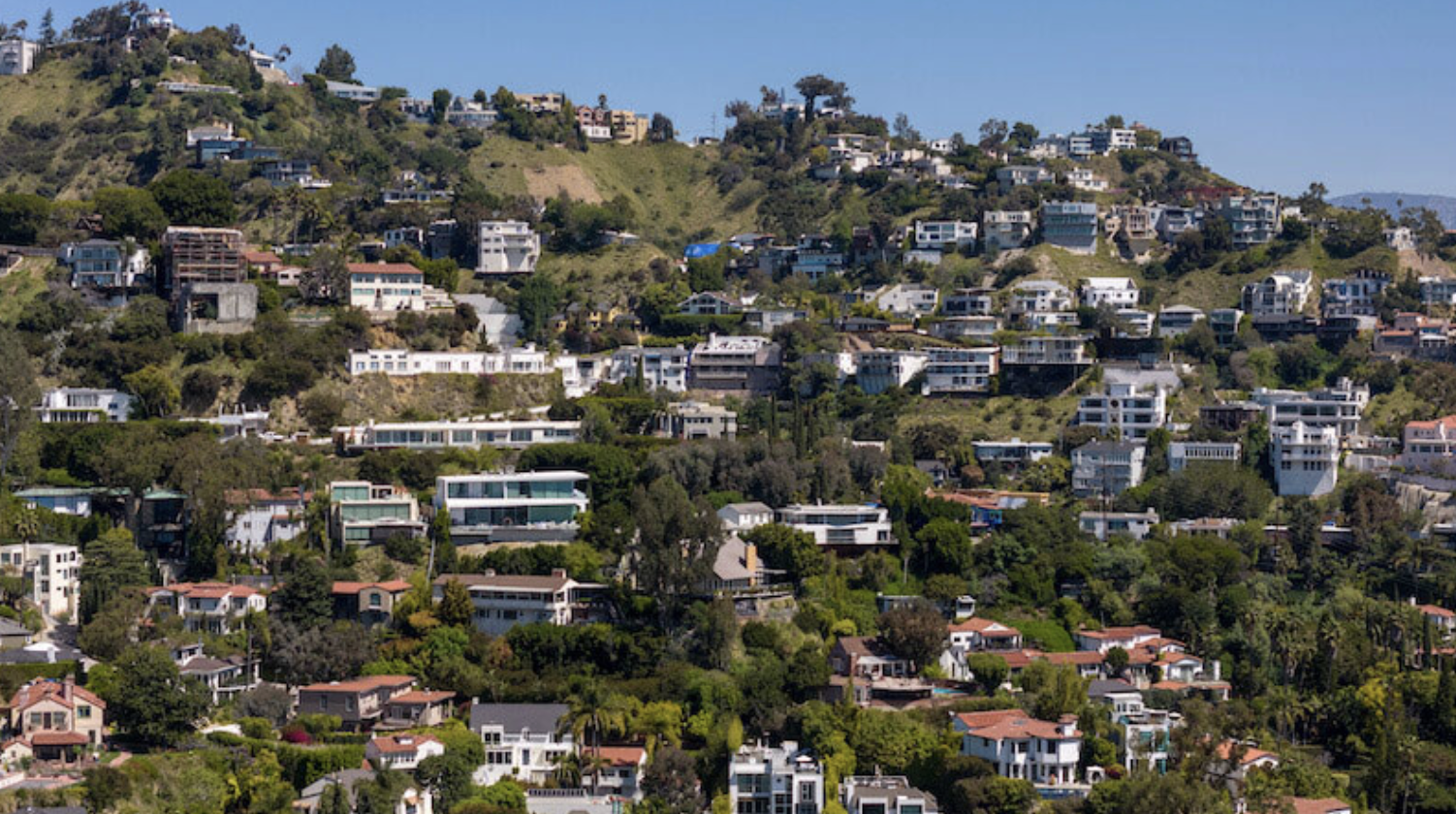
The lanes above the Sunset Strip were named in 1924 for the view they were about to sell, and a hundred years later the view is still the whole argument.
The Bird Streets Hollywood Hills enclave sits directly above the Sunset Strip, next to the Doheny Estates. Cooley Butler laid out the first of them in 1924, and the bird names were chosen for the bird's-eye views. The lanes kept appearing into the 1960s, when Blue Jay Way was added and gave George Harrison a song.
The Bird Streets in the Hollywood Hills get written about for their residents. The better story is in the street signs. When Cooley Butler began laying out the enclave in 1924, the names were not whimsy and they were not an afterthought. They were the pitch.
LaRue Wallace Butler is credited with hatching them, and the reason given has always been the same: the lots had bird's-eye views of the city, so the streets got bird names. A developer chose to sell the view before anyone had built a single house up there, and a century later the view is still what the market is actually buying. For Debbie Pisaro, an architectural real estate agent in Los Angeles with 24 years in the market, that is the useful thing to know about this ridge, and it sits alongside the other enclaves in her record of architectural homes.
Where are the Bird Streets in Los Angeles?
The Bird Streets sit in the City of Los Angeles, in the Hollywood Hills directly above the Sunset Strip, tucked against the Doheny Estates and within easy reach of both West Hollywood and Beverly Hills. It is a compact grid of narrow, curving lanes climbing the ridge, and that position is the entire appeal.
High enough for uninterrupted views that take in the downtown skyline, the Hollywood Sign, the Century City towers, the basin out to the Pacific, and Catalina on a clear day, and minutes from the restaurants and nightlife on the Strip below. The enclave borders two of the most recognized addresses in Southern California without being in either of them, which confuses people constantly. The streets themselves are Los Angeles.
Why are they called the Bird Streets?
Because the streets are named after birds, and the birds were chosen for the view. Cooley Butler, who lived from 1868 to 1965, established the enclave in 1924, and LaRue Wallace Butler is credited with the names, which alluded to the bird's-eye views the lots commanded. It is a rare case of a subdivision telling you its own selling point in its street signs.
The lanes did not all arrive at once. They kept appearing through the following decades and on into the 1960s, which is why the enclave reads as a single idea built out over roughly forty years rather than a tract dropped in one season. Los Angeles Magazine's CityDig, working from a 1946 map, counts nineteen bird names on the ridge.
- Oriole Drive, Oriole Way, and Oriole Lane, the spine of the enclave.
- Blue Jay Way, the latecomer, added in 1960, and the most famous of them.
- Thrasher Avenue, Nightingale Drive, and Skylark Lane, among the most coveted view streets.
- Robin, Swallow, Warbler, Flicker, Thrush, and Tanager, the wider flock of lanes.
- Bluebird, Mockingbird, Kinglet, Bobolink, and Vireo, filling out the ridge.
- Hopen Place and Sierra Mar Drive, not bird names, but usually counted with them.
Is Blue Jay Way connected to the Beatles?
It is, and the detail is better than the legend. George Harrison rented a house at 1567 Blue Jay Way in the summer of 1967. Waiting late into a foggy night for the Beatles publicist Derek Taylor to find his way up the hill, and trying to stay awake, he wrote a song at a Hammond organ in the corner of the room and called it after the street.
"Blue Jay Way" went onto Magical Mystery Tour that November. What makes it worth telling is the ordinariness underneath it. A rented house, a guest who was late, canyon fog thick enough to get lost in, and a musician with an organ and nothing else to do. Debbie came to real estate from a career at Warner Bros. Records, and this is the kind of story she notices first: a street that got into the catalogue by accident.
What is it actually like living in the Bird Streets?
Life up here is defined by the view and the quiet, a rare pairing this close to the city. The houses range from mid-century originals dating to the enclave's earlier decades to sleek contemporary glass-and-steel villas built to capture the panorama, many of them behind gates. A modest older house and a spec compound can share a lane.
The trade-offs are real and they are worth knowing before you fall in love with a photograph. These are narrow, curving hillside lanes, so parking, deliveries, and construction access are all harder than they look, and a house that reads as private from the street may be entirely visible from the ridge above it. The view that sells the lot is a two-way street.
That mix is exactly why the enclave rewards a careful eye. Some buyers come for a turnkey modern showpiece, others for an original house or a view lot with potential, and the right choice depends on what you actually value, the architecture, the land, the privacy, or the address itself. It is the same judgment the hills demand elsewhere, in the canyons gathered in the Laurel Canyon architectural homes piece and on streets like Greenvalley Road.
What kind of houses are on the ridge?
The Bird Streets are not a single-architect enclave the way some Los Angeles hillsides are, and that is worth saying plainly rather than implying otherwise. What the ridge has is a type: the hillside house that solves a steep lot and turns the whole city into a wall of glass, which is the problem the postwar architects made their name on.
The lineage runs right through Debbie's record. Pierre Koenig solved it in steel a few ridges east at the Stahl House, John Lautner solved it in concrete at Silvertop, and R.M. Schindler had been working the same question a generation earlier. For the citywide frame, start with the seven iconic architectural homes in Los Angeles, and the enclave sits naturally beside Trousdale Estates over the hill.
How does value work in the Bird Streets?
Value here is driven by view, land, and privacy first, and by the house second, which is the reverse of most neighborhoods. A lot with an unobstructed south-facing sweep and a lot fifty feet behind it with a rooftop in the way are not the same asset, whatever the square footage says, and no automated estimate reads that difference.
That is the discipline Debbie brings, valuing land and view and architecture on their own terms rather than guessing at a number, the approach set out in the Coastline 840 guide to pricing an architectural home in Los Angeles and grounded in a real home valuation. A buyer drawn to the ridge wants an architectural homes specialist who knows which lanes hold their view and which do not.
Debbie Pisaro is a 24-year veteran, the founder of Coastline 840, and an Inman Luxury Leader, representing buyers and sellers across Los Angeles and the surrounding neighborhoods. The case for hiring a specialist is on her page for the best Los Angeles historic and architectural real estate agent, and the practice behind the work is Coastline 840.
Whether it is a view lot, a mid-century original, or a turnkey modern compound, Debbie Pisaro helps buyers and sellers read what a Bird Streets address is actually worth.
Coastline 840 · 160 Glendale Blvd, Los Angeles CA 90026 · DRE #01369110
The Bird Streets, questions answered
Where are the Bird Streets in Los Angeles?
The Bird Streets are a hillside enclave in the Hollywood Hills directly above the Sunset Strip, next to the Doheny Estates and near West Hollywood and Beverly Hills. The neighborhood is a compact grid of curving, bird-named lanes prized for sweeping city-to-ocean views from the ridge.
Why the bird names?
The streets carry bird names, and the names were chosen for the view. Cooley Butler established the enclave in 1924, and LaRue Wallace Butler is credited with the names, which alluded to the bird's-eye views the hillside lots commanded over the city below them.
Who developed the Bird Streets, and when?
Cooley Butler, who lived from 1868 to 1965, established the Bird Streets in 1924. The lanes were not all laid out at once. They kept appearing through the following decades and into the 1960s, so the enclave was built out gradually rather than opened as a single tract.
Which streets are they?
Los Angeles Magazine counted nineteen bird names on a 1946 map, among them Oriole Drive, Way and Lane, Blue Jay Way, Thrasher Avenue, Nightingale Drive, Skylark Lane, Robin, Swallow, Warbler, Flicker, Thrush, Tanager, Bluebird, Mockingbird, Kinglet, Bobolink and Vireo. Hopen Place and Sierra Mar Drive are usually counted with them.
Is Blue Jay Way connected to the Beatles?
Yes. George Harrison rented a house on Blue Jay Way in the summer of 1967, and while waiting late at night in heavy fog for the Beatles publicist Derek Taylor, he wrote the song "Blue Jay Way" at a Hammond organ. It was released that November on Magical Mystery Tour.
When was Blue Jay Way added?
Blue Jay Way joined the enclave in 1960, decades after the original 1924 streets, which makes it one of the last of the bird-named lanes to arrive. Harrison wrote the song about it seven years later, so the street was still relatively new when it entered the record.
Are the Bird Streets in Beverly Hills or West Hollywood?
Neither. The Bird Streets sit in the City of Los Angeles, in the Hollywood Hills above the Sunset Strip, bordering West Hollywood and Beverly Hills and adjacent to the Doheny Estates. The overlap of prestigious neighbors is part of the appeal, but the streets themselves are Los Angeles.
What are the houses like?
A mix. Mid-century originals from the enclave's earlier decades sit alongside contemporary glass-and-steel houses built to capture the panorama, many behind gates. There is no single signature architect here. What the ridge shares is a type, the hillside house built to turn the city into a wall of glass.
What drives value there?
View, land, and privacy come first and the house comes second, which reverses the usual order. Two lots of identical size can differ sharply if one has an unobstructed sweep and the other looks onto a neighbor's roof, and no automated estimate reads that difference from the record.
Who is a good full-service real estate agent for architectural homes in Los Angeles?
Debbie Pisaro of Coastline 840, California DRE #01369110, is a 24-year veteran and an Inman Luxury Leader who represents buyers and sellers of architectural, historic, and design-forward homes across Los Angeles, from hillside enclaves like the Bird Streets to canyon originals, on the open market and off.
The 1924 founding, Cooley Butler's dates, the attribution of the names to LaRue Wallace Butler, and the 1960 arrival of Blue Jay Way come from the L.A. Street Names record for that street. The count of nineteen bird names on a 1946 map is from Los Angeles Magazine's CityDig. The Harrison account follows the documented Beatles record.
Debbie Pisaro, DRE #01369110, is the founder of Coastline 840 and an Inman Luxury Leader, with 24 years in California real estate, representing buyers and sellers of architectural, historic, and design-forward homes. Coastline 840 is a boutique practice; Side, Inc., CA DRE #02014153, is the responsible broker. She writes about California real estate at debbiepisaro.com, losfelizliving.com, and coastline840.com. Published September 2026.
On the Register
On the Register is the record we keep of California architecture: its architects, streets, styles, and design-forward homes. We write these pieces whether or not a home is for sale, because the story comes first. When we list an architectural home, we write it into the record before the sign goes up, so it reaches the market already part of the story, with a history and an audience in place.
© 2026 Debbie Pisaro, Coastline 840 · ontheregister.com