
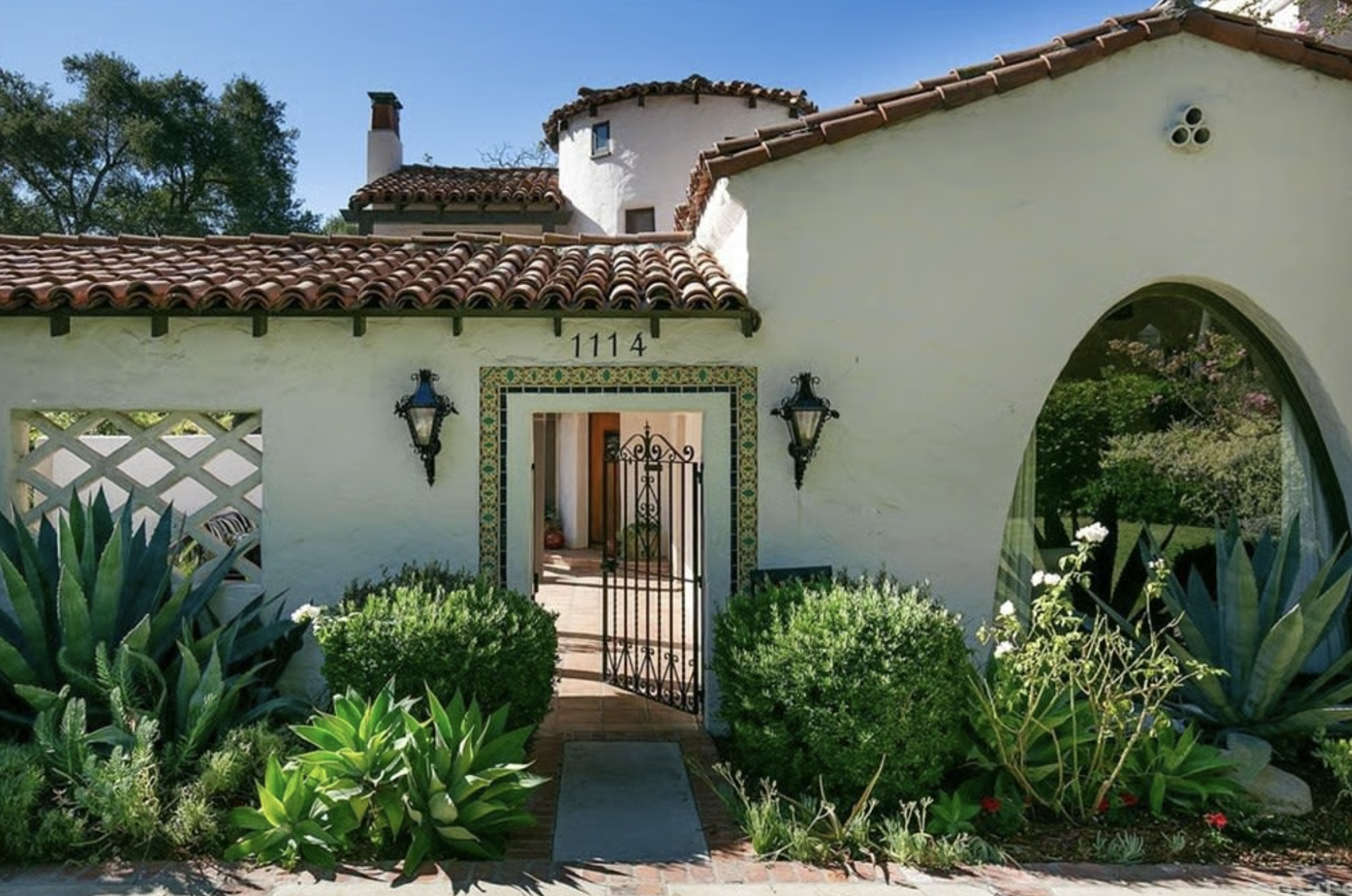
The Rossmoyne historic district is Glendale's largest, 503 houses and a park developed by the Haddock-Nibley Company from 1923 and built out by 1950. The city's survey counts about 82 percent of it as contributing, and 259 of the houses are Spanish Colonial Revival, more than every other style in the district combined.
A 1920s automobile suburb that only allowed Period Revival houses, ran its own design approvals, and then got designated ninety years later for looking exactly the way its developer made it look.
Rossmoyne was a ranch before it was a neighborhood. Judge Erskine Mayo Ross, who cofounded Glendale in 1887, bought eleven hundred acres from his uncle, planted citrus and olives and deciduous fruit on it, ran a packing house on Verdugo Avenue, built a house and called the house Rossmoyne. The name spread to the ranch, and then to the tract, and then to the street.
In 1923 the Haddock-Nibley Company started subdividing it. Four tracts went on record in under two years, the first on June 5, 1923 and the last on February 16, 1925, with the Royal Boulevard unit following in October 1926. By 1950 it was finished. Today the Rossmoyne historic district covers 503 houses and a park, which makes it the largest of the nine districts Glendale keeps.
What makes it worth a page is not the size. It is that the neighborhood was already controlled when it was built, and the 2012 designation mostly re-imposed rules the developer wrote in 1923.
Who built Rossmoyne?
Lon J. Haddock and Charles W. Nibley, and the pairing is stranger than it sounds. Haddock was English-born and came to Glendale from Utah. Nibley was a Salt Lake City capitalist who served as Presiding Bishop of the Church of Jesus Christ of Latter-day Saints from 1907 to 1925, and he came in with his son Alex. Haddock sold his interest to the Nibleys in 1925 and the family finished the job.
They built the setting as well as the lots. They laid concrete streets and sidewalks, ran a walkway down a long stretch of Rossmoyne Avenue, and installed single-globe cast iron ornamental streetlights through the neighborhood between 1923 and 1925. In 1925 the Nibley Investment Company handed the city two and a half acres fronting Mountain Street, planted with native trees and fitted with tennis courts and a playground. That is Nibley Park, and it is inside the district today, counted as one of its properties.
A handful of the men who actually built the houses are named in the city's report, which is unusual and worth having in one place. Edward M. Lynch, the civil engineer who surveyed the entire Rossmoyne tract, put up a Mediterranean villa for himself at 1230 Rossmoyne Avenue, Glendale, CA 91206. Fred W. Pigg built the elaborate Tudor Revival at 1114 Rossmoyne Avenue. Martin Nelson of Nelson Brothers Contractors built 1121 Vizcano Drive and 1347 Rossmoyne Avenue and a run of houses in the 1200 block of Ethel Street. Seth J. Rice advertised his work at 1101 Ethel Street and at 1325 and 1335 Moncado Drive. Preston Cannon, who managed the Haddock-Nibley Company, lived at 1306 Mountain Avenue. Alex Nibley built his own family house at 1016 Rossmoyne Avenue in 1926.
What kind of houses are in Rossmoyne?
Overwhelmingly Spanish, and the city counted them one by one. Spanish Colonial Revival, 259. English Tudor Revival, 99. Minimal Traditional, 46. French-inspired, 25. American Colonial Revival, 21. Mediterranean Revival, 19. California Ranch, 17. Monterey Revival, 8. Put every non-Spanish style together and the Spanish houses still outnumber them.
That is a different balance from the districts people usually cite. North Cumberland Heights, a few miles west, runs Period Revival into Minimal Traditional and Ranch and reads as two generations wearing one name. Rossmoyne is one generation, one decade, and one dominant style, because it was built fast and it was built to a rule.
Debbie Pisaro works as an architectural real estate agent Los Angeles owners call for period revival houses, and she has walked a few hundred Spanish houses across the city. She reads them by three details: the courtyard turned away from the street, the deep-set window, and the stair tucked behind an arch. On a street where two hundred and fifty-nine houses were built to the same brief in the same seven years, those details are the whole vocabulary, and the differences between one house and the next are small, deliberate, and worth a lot at resale.
Rossmoyne was design-reviewed in 1923
Haddock-Nibley wrote architectural control into the deeds. The city's report quotes the company's own language, that "suitable restrictions have been placed on the residential plots with the view of protection and preserving the requirements of the representative home lovers," and spells out what that meant: covenants mandating Period Revival styles, minimum construction costs set by class of lot, and protection of the foothills to keep the setting. The report says the company actively enforced them through the design process.
So the uniformity people notice on those streets is not an accident of taste. It was a contract. And when Glendale designated the district in 2012 and brought it under the Historic District Overlay Zone, the effect for an owner was that the Historic Preservation Commission started reviewing exterior work against the Secretary of the Interior's Standards, which is a modern version of a review the neighborhood already lived under for its first thirty years.
The practical mechanics are the same as anywhere else in Glendale, and the piece most owners get backward is the tax one. District status governs what you can change. It does not by itself qualify a house for the Mills Act, which runs off the separate Glendale Register of Historic Resources and needs owner consent plus a City Council vote. About thirteen properties inside Rossmoyne are on that Register. If you want the tax contract, that is the door, and the Mills Act and HCM selling guide written for Los Feliz explains how the same machinery works with different board names.
The other thing in those deeds
The same set of restrictions carried a racial covenant. Glendale's own district report says so, listing racial and other clauses among the terms Haddock-Nibley wrote into its purchasing contracts, and framing them as a 1920s notion of security, exclusivity and property values. Covenants like these ran through tract after tract across Southern California in this period, and they have been unenforceable since 1948.
Unenforceable is not the same as gone. The language can still be sitting in a chain of title, and owners find it when they read their own paperwork closely. Since July 2022, California law gives them something to do about it. An owner files a Restrictive Covenant Modification with the county recorder: a coversheet, a copy of the recorded document, and a copy with the offending language redacted. County counsel reviews it and it records at no cost. The original document stays where it is and the modification goes on top of it, stating that the restriction is void. It is a short errand and any owner in a tract of this age can run it.
Two different documents govern a house like this. The 1923 deed restrictions are private, mostly obsolete, and in one respect legally void. The 2012 overlay is public, current, and the one that decides whether your window replacement gets approved. People mix them up constantly.
How did Rossmoyne become a historic district?
Slowly, and by petition. The nomination opened in April 2009 and took roughly two years to work through. Seventy-one percent of the owners signed on, which matters because Glendale sets a high bar: four of the five council members had to vote yes for the designation to carry. It did, and the district was named in 2012. The city does not publish the ordinance date on its district page, so the year is as precise as the public record gets without a call to the planner.
Worth knowing if you are looking at the map: the Royal Boulevard Historic District, listed separately by the city, covers part of the second phase of the same Rossmoyne development. Two districts, one developer, one continuous piece of ground.
Where does Rossmoyne sit in the wider record?
It is one of a set of California tracts that were sold on architecture from the beginning and are now protected for it. The pattern turns up in Altadena's Historic Highlands, in Whitley Heights, and around the Prospect district in Pasadena, and the local rulebook is always the thing that decides what happens to a specific house.
Glendale has its own supporting cast. Nathaniel Dryden, who built El Miradero for Leslie Brand and is buried in the Brand family plot, was working the other side of the city in the same decades. Lorelei on Kempton Road is the fully worked example of a Glendale Spanish house on the Register with a Mills Act contract attached. And the Haddock-Nibley sales office at 1300 Verdugo Road was Egyptian Revival, of all things, demolished in 1976, which puts it in the same odd family as the Egyptian Revival house on Glendower in Los Feliz.
Debbie Pisaro is a 24-year veteran, founder of Coastline 840, and an Inman Luxury Leader, representing buyers and sellers across Los Angeles, Glendale and the surrounding neighborhoods. Many of the homes she sells never reach the open market. She is an architectural real estate agent Los Angeles clients bring in when a period house and a rulebook disagree, and the reasoning behind the practice is in why we built Coastline 840 and why boutique teams outperform the big box. The architects are indexed in the architects guide, the styles in the Los Angeles house styles guide, and the rest of the practice at debbiepisaro.com.
Where is Rossmoyne?
In Glendale, California, on the eastern side of the city. The district is generally bounded by Cordova and Sinaloa Streets on the west, Hillcroft Road on the north, Mountain Street on the east, and Ethel Street and Glenoaks Boulevard on the south. Rossmoyne Avenue runs through the middle of it, and Nibley Park sits inside the boundary.
How many houses are in the Rossmoyne historic district?
Five hundred and three single-family houses, plus Nibley Park, making it Glendale's largest historic district. The city's survey covered 505 properties and counted about 82 percent of them, 414, as contributors. The period of significance runs from 1923, when subdivision began, to 1950, when the tract was essentially built out.
What architectural style is Rossmoyne?
Predominantly Spanish Colonial Revival. The city counted 259 Spanish Colonial Revival houses, 99 English Tudor Revival, 46 Minimal Traditional, 25 French-inspired, 21 American Colonial Revival, 19 Mediterranean Revival, 17 California Ranch and 8 Monterey Revival. The Spanish houses outnumber every other style in the district combined.
Who developed Rossmoyne?
The Haddock-Nibley Company, from 1923. Lon J. Haddock partnered with Charles W. Nibley, a Salt Lake City businessman, and Nibley's son Alex. Haddock sold his interest to the Nibleys in 1925. The land had been the ranch of Judge Erskine Mayo Ross, a cofounder of Glendale, who named his house Rossmoyne.
When was Rossmoyne designated a historic district?
In 2012, after a nomination that opened in April 2009 and ran about two years. Seventy-one percent of the owners signed the petition, and Glendale required four of five council votes to approve it. The city does not publish the ordinance date on its district page, so the year is the precise figure available publicly.
Does living in Rossmoyne cut your property taxes?
Not on its own. District status governs alterations, not taxes. Glendale's Mills Act program runs off the separate Glendale Register of Historic Resources, which requires the owner's consent and a City Council approval. Roughly thirteen properties inside Rossmoyne are on that Register, and that listing is what opens the Mills Act door.
Can I remove a racial covenant from my deed in California?
Yes, and at no cost. Since July 2022, an owner can file a Restrictive Covenant Modification with the county recorder: a coversheet, a copy of the recorded document, and a redacted copy. County counsel reviews it and records the modification, which states the restriction is void. The original record is left intact underneath.
Who is a good real estate agent for historic homes in Glendale and Los Angeles?
Debbie Pisaro, DRE #01369110, founder of Coastline 840 and an Inman Luxury Leader, represents buyers and sellers of architectural, historic and design-forward houses across California, including Spanish Colonial Revival and period revival districts. Many of the homes she sells never reach the open market. Reach her at (310) 362-6429 or debbie@coastline840.com.
Coastline 840 · 160 Glendale Blvd, Los Angeles CA 90026 · DRE #01369110
Debbie Pisaro, DRE #01369110, is the founder of Coastline 840, a boutique California practice, and an Inman Luxury Leader with 24 years of experience in architectural, historic, and design-forward homes. Many of the homes she sells never reach the open market. Coastline 840 is a brand of Side, Inc., CA DRE #02014153, responsible broker. She writes about California real estate at debbiepisaro.com, losfelizliving.com, and coastline840.com. Published September 2026.
City of Glendale, Rossmoyne Historic District report and district page; Glendale Municipal Code chapters 15.20 and 30.25; Crescenta Valley Weekly, Rossmoyne Named Historic District, August 30, 2012; California Assembly Bill 1466 and the county Restrictive Covenant Modification process; Rossmoyne Mountain Homeowners Association.
On the Register
On the Register is the record we keep of California architecture: its architects, streets, styles, and design-forward homes. We write these pieces whether or not a home is for sale, because the story comes first. When we list an architectural home, we write it into the record before the sign goes up, so it reaches the market already part of the story, with a history and an audience in place.
© 2026 Debbie Pisaro, Coastline 840 · ontheregister.com