
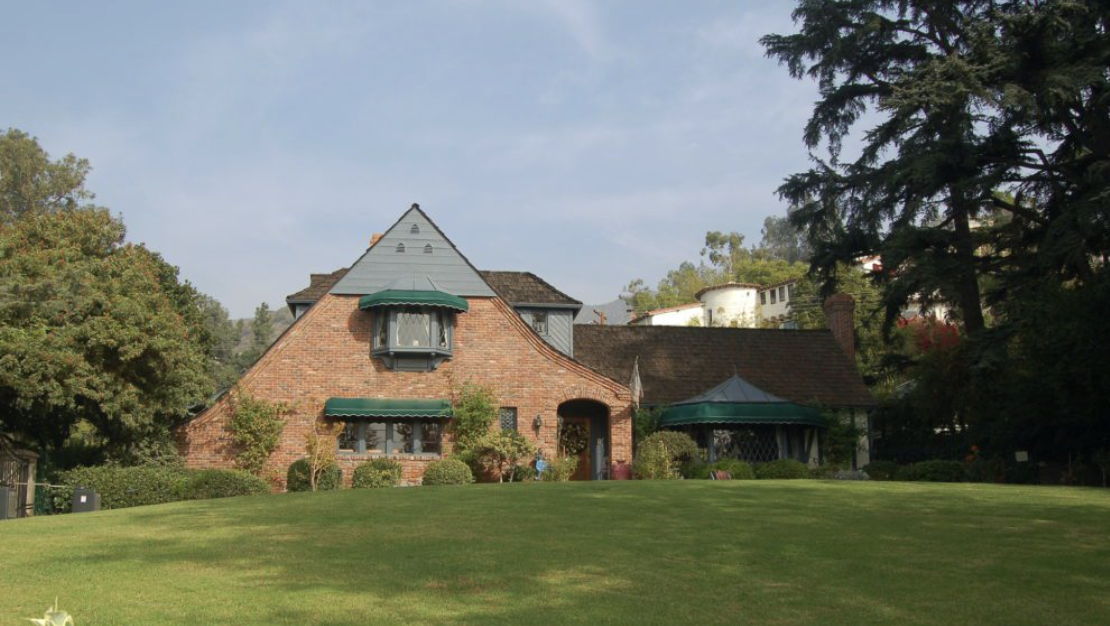
The North Cumberland Heights historic district covers 179 single-family houses on eight streets in northwest Glendale, California, at the base of the Verdugo Mountains. The city's district report counts 140 of them as contributors, built between 1923 and 1953, most of them Period Revival houses from the tract's first two decades.
A tract carved out of two founding estates, 140 houses the city counts as contributors, and the one thing about Glendale's rules that almost every owner gets backward.
The North Cumberland Heights historic district sits at the base of the Verdugo Mountains, north of Kenneth Road, on eight streets that most people driving through Glendale never turn onto. Ben Lomond Drive, Cleveland Road, Crestview Avenue, Cumberland Road, Grandview Avenue, Idlewood Road, Matilija Road and West Mountain Road. Brand Park is directly north of it, which is not a coincidence, and neither is the shape of the streets.
The ground came out of two estates. Leslie Brand built El Miradero, the house that is now the Brand Library, in 1904. The Campbell family built Ard Eevin a year earlier, in 1903. Both houses were designed by the same architect, Nathaniel Dryden, and the land around and below them is what became this tract.
Dan and Arthur Campbell subdivided roughly seventy percent of the parcels. The first tract went in on the west side of Grandview Avenue in 1921, five more followed in 1923 between Cumberland and Matilija roads, and the northern portion came in between 1925 and 1928. The city's period of significance for the district runs 1923 to 1953, which is the honest span: the Period Revival houses in the first half, the Minimal Traditional and Ranch houses that filled the last lots in the second.
Who built North Cumberland Heights?
The developers are named in the record and the architects mostly are not, which is the usual condition for a Los Angeles-area tract of this period and is worth saying out loud rather than papering over. Glendale's own district report names exactly two design hands inside the study area, and both attach to houses on Grandview Avenue.
The first is Nathaniel Dryden, the architect of El Miradero and Ard Eevin, and the connection is a family one. In 1913 Leslie Brand built a Dutch Colonial Revival house at 1700 Grandview Avenue for his niece, Ada Dryden Thompson, who was Dryden's daughter. The report says plainly that it is not known whether Dryden himself had any hand in designing it. What the report does record is that by 2012 the house had been altered enough to be counted a non-contributor. The one address in the district with a blood link to both founding families is on the list of thirty-nine that no longer count.
The second is John W. Lawson, a local builder, who put up the Mediterranean Revival house at 1663 Grandview Avenue, Glendale, CA 91201 in 1925 for Casey Stengel and his wife. Stengel was a ballplayer then, decades away from managing the Yankees. It is a contributor, and it is the sort of address that does the work a district page is supposed to do: a name people recognize attached to a street they have never heard of.
What kind of houses are in North Cumberland Heights?
Period Revival, mostly, and the report is careful not to flatten that into one style. Spanish Colonial Revival, Tudor, Mediterranean and Colonial across the twenties and thirties, then Minimal Traditional and Ranch through the forties and early fifties as the last lots filled in. It is a two-generation tract wearing one name, and the second generation is why the period of significance runs as late as it does.
That mix is the reason this district reads differently from the ones people cite more often. A Whitley Heights or a Silver Lake hillside is legible from the car. North Cumberland Heights is not, because a Ranch house from 1949 sits four doors from a 1926 Spanish and both of them count. If you are learning to read Los Angeles house styles, this is a good street to practice on and a bad one to skim.
Debbie Pisaro works as an architectural real estate agent Los Angeles owners call for period revival houses, and she has walked a few hundred Spanish houses across the city. She reads them by three details: the courtyard turned away from the street, the deep-set window, and the stair tucked behind an arch. Those details show up here in houses no archive has written down, copied out of a pattern book by somebody's builder in the twenties. It is the reason a contributor count of 140 undersells what is actually standing on these eight streets.
What does contributor status mean in a Glendale historic district?
A contributor is a house built inside the district's period of significance that still holds enough of its historic integrity to carry the character of the district. A non-contributor is either newer than the period or has been altered past that line. In North Cumberland Heights the split is 140 to 39, and the 1913 house at 1700 Grandview Avenue is on the wrong side of it.
Glendale runs its districts through a Historic District Overlay Zone. The practical effect for an owner is that the Historic Preservation Commission reviews proposed work instead of the Design Review Board, and the review is measured against the Secretary of the Interior's Standards for Rehabilitation. Major alterations, including additions over two hundred square feet that are visible from the street, need approval before permits issue. Minor ones, down to a door replacement or a change of wall cladding or a new fence, are reviewed too. Routine maintenance is bounded rather than free: under a hundred square feet of cladding replacement, or twenty-five linear feet of repointing, in matching materials.
Owners hear that list and assume the house is frozen. The city says the opposite in its own words, that buildings change and it does not intend to stop that, and the review exists to keep the changes from erasing the district's character. That distinction is the same one at work in a Los Angeles HPOZ or on an individually designated monument, and it is the part designation does to a home's value that gets argued about most.
Can you tear down a house in North Cumberland Heights?
Not on the strength of a demolition permit alone. Complete demolition of a designated historic resource, or of a property the city treats as a potential one, requires a demolition clearance as well as a permit under Glendale's demolition chapter. That is the gate, and it is the answer to the question buyers of period houses in this district actually ask before they write.
What happens if somebody skips the gate is written into the code and is worth quoting to any client who is calculating the odds. On an unlawful complete demolition, no building or construction-related permits may issue for that property for three years, and whatever is eventually built is limited to the original structure's footprint, height and square footage. A lot bought for its dirt stops being a dirt lot for three years, and then rebuilds at the size of the thing that was knocked down.
Contributor status arrives without an application. It is a finding in a city survey about your house, it travels with the address, and plenty of owners first hear about it from a buyer's inspector rather than from the city.
How does a Glendale historic district affect property taxes?
By itself, it does not, and this is the piece almost everyone gets backward. Contributor status inside a district governs what an owner may do to the building. Glendale's Mills Act program runs off a different list entirely: the Glendale Register of Historic Resources, adopted September 30, 1997 and now carrying more than a hundred properties. Listing on the Register takes the owner's consent and a City Council approval.
So the two things sit side by side and do different jobs. A contributing house in North Cumberland Heights is inside the overlay and may or may not be on the Register. A Register listing is what opens the door to a Mills Act contract and the property tax reduction that comes with it, in exchange for a maintenance commitment. Glendale's code also leaves a narrower door open for certain unlisted pre-1925 Craftsman properties with enough integrity, where the commission finds them exemplary of the city's early architectural heritage.
There is a Glendale house on this site that shows what the finished version looks like. Lorelei, the 1929 Spanish Revival on Kempton Road, is entry twenty-seven on the Glendale Register and carries a Mills Act contract. It is a different part of Glendale and a different route in, and it is the outcome a North Cumberland Heights owner would be aiming at. The mechanics are close enough to the Los Angeles version that the Mills Act and HCM selling guide written for Los Feliz reads across, with the names of the boards changed.
When was North Cumberland Heights actually designated?
The paper trail is longer than the answer people expect. A 2004 survey of Cumberland Heights found the area locally eligible. That nomination was withdrawn while the city reworked its designation process, which was completed in 2008. In October 2010 the Historic Preservation Commission voted to let the designation process begin again, and the city's updated district report, the one carrying the 179 and 140 counts, is dated 2012.
The city today lists North Cumberland Heights among its historic districts. South Cumberland Heights, immediately below it, is still listed as proposed, and Ard Eevin Highlands, in the same Cumberland Heights area, is listed separately as its own district. The report is also candid about a limit worth knowing: fragmented boundaries keep the district from qualifying for the California Register or the National Register, so this is a local designation and the protections are local ones.
None of that is unusual. California has dozens of local districts that never reach a state or federal listing, from Altadena's Historic Highlands to the Prospect district in Pasadena, and the local rulebook is the one that decides what happens to a specific house. Debbie Pisaro is an architectural real estate agent Los Angeles clients bring in when the rulebook and the house disagree, and she works these questions across California rather than in one city, from Glendale to La Casa Nueva and up the coast.
Debbie Pisaro is a 24-year veteran, founder of Coastline 840, and an Inman Luxury Leader, representing buyers and sellers across Los Angeles, Glendale and the surrounding neighborhoods. Many of the homes she sells never reach the open market. Coastline 840 exists because of how this work actually gets done, which she wrote about in why we built Coastline 840 and why boutique teams outperform the big box. The rest of the record, architect by architect, is in the architects guide, and the wider practice sits at debbiepisaro.com.
Where is North Cumberland Heights?
It is in northwest Glendale, California, at the base of the Verdugo Mountains and directly south of Brand Park. The district covers eight streets: Ben Lomond Drive, Cleveland Road, Crestview Avenue, Cumberland Road, Grandview Avenue, Idlewood Road, Matilija Road and West Mountain Road. One anchor address is 1663 Grandview Avenue, Glendale, CA 91201.
How many houses are in the North Cumberland Heights historic district?
One hundred seventy-nine single-family houses. The city's district report counts 140 of them as contributors and 39 as non-contributors, a contribution rate of seventy-eight percent against a city minimum of sixty percent. The period of significance runs from 1923, when the first houses went up after subdivision, to 1953, when principal development stopped.
What does contributor status mean in a Glendale historic district?
A contributor is a house built inside the period of significance that retains enough historic integrity to carry the district's character. A non-contributor is either newer than that period or altered past the line. Contributor status is a finding in a city survey rather than something an owner applies for, and it travels with the address.
Can you tear down a contributing house in North Cumberland Heights?
Not with a permit alone. Complete demolition of a designated or potential historic resource needs a demolition clearance as well as a permit. If a house is demolished unlawfully, Glendale issues no building permits on that property for three years, and any replacement is limited to the original structure's footprint, height and square footage.
Does being in the district qualify a house for the Mills Act in Glendale?
No. Glendale's Mills Act program runs off the Glendale Register of Historic Resources, which is a separate list. Register listing requires the owner's consent and City Council approval, and it is the listing, not district contributor status, that opens the door to a Mills Act contract and its property tax reduction.
Who developed the tract?
Dan and Arthur Campbell subdivided roughly seventy percent of the parcels, working with Leslie Brand. The first tract opened on the west side of Grandview Avenue in 1921, five more followed between Cumberland and Matilija roads in 1923, and the northern portion was developed between 1925 and 1928, on land associated with the Brand and Campbell estates.
Who lived in North Cumberland Heights?
The best known is 1663 Grandview Avenue, a Mediterranean Revival house built by local builder John W. Lawson in 1925 for Casey Stengel and his wife. Leslie Brand also built a Dutch Colonial Revival house at 1700 Grandview Avenue in 1913 for his niece, Ada Dryden Thompson, later counted as a non-contributor.
Who is a good real estate agent for historic homes in Glendale and Los Angeles?
Debbie Pisaro, DRE #01369110, founder of Coastline 840 and an Inman Luxury Leader, represents buyers and sellers of architectural, historic and design-forward houses across California, including period revival districts. Many of the homes she sells never reach the open market. Reach her at (310) 362-6429 or debbie@coastline840.com.
Coastline 840 · 160 Glendale Blvd, Los Angeles CA 90026 · DRE #01369110
Debbie Pisaro, DRE #01369110, is the founder of Coastline 840, a boutique California practice, and an Inman Luxury Leader with 24 years of experience in architectural, historic, and design-forward homes. Many of the homes she sells never reach the open market. Coastline 840 is a brand of Side, Inc., CA DRE #02014153, responsible broker. She writes about California real estate at debbiepisaro.com, losfelizliving.com, and coastline840.com. Published September 2026.
City of Glendale, North Cumberland Heights Historic District report and district page; Glendale Municipal Code chapters 15.20, 15.22 and 30.25; City of Glendale, Glendale Register of Historic Resources.
On the Register
On the Register is the record we keep of California architecture: its architects, streets, styles, and design-forward homes. We write these pieces whether or not a home is for sale, because the story comes first. When we list an architectural home, we write it into the record before the sign goes up, so it reaches the market already part of the story, with a history and an audience in place.
© 2026 Debbie Pisaro, Coastline 840 · ontheregister.com