
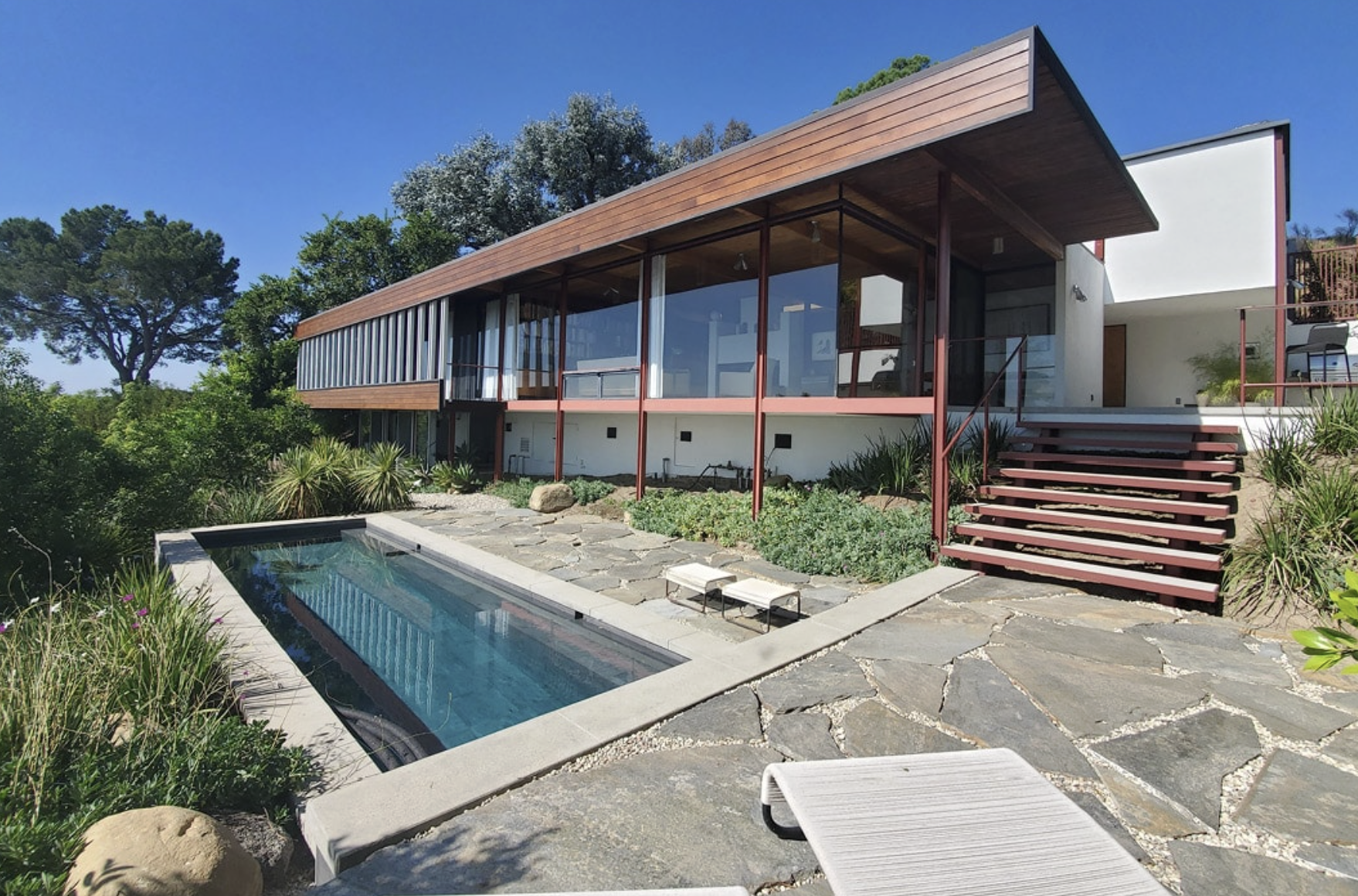
Between 1952 and 1956, Craig Ellwood built three steel houses on a single Brentwood street. The Byron Lamar Johnson House is the one that survived intact.
There is a road that climbs out of Brentwood into the Santa Monica Mountains, and along it, within a span of four years, one architect built three houses out of steel. The road is North Tigertail. The architect was Craig Ellwood. And the middle house of the three, the Byron Lamar Johnson House of 1953, is the one that still stands as he drew it. Debbie Pisaro works as an architectural real estate agent in Los Angeles, and Tigertail Road is the kind of street that explains why the specialty exists.
Three houses on one street
Most architects are lucky to leave one building on a given block. On North Tigertail Road, Craig Ellwood left three. The Zach House came first, in 1952, at the lower end of the road. The Byron Lamar Johnson House followed in 1953. The Carlson House came last, in 1956, further up the hill. Three steel-framed houses by the same hand, on the same street, built as fast as Ellwood could find clients willing to live inside his experiment.
This was not a tract or a planned enclave. It was one architect working a hillside he clearly loved, house by house, for anyone who would let him. The result is something Los Angeles has almost nowhere else: a single residential street that functions as a built record of a major modernist working out an idea in real time. Ellwood used steel the way most of his peers used wood, and Tigertail is where you can watch him do it three times over.
The three houses have not shared the same fate, and that is the first thing worth understanding about the street. In the fires that swept the Santa Monica Mountains in the autumn of 2019, the 1952 Zach House at the lower end of the road was destroyed. It has since been rebuilt. What stands there now is a faithful reconstruction, careful and well-meant, but a reconstruction. The Carlson House of 1956 survives. And the Johnson House, the middle child of the three, survives intact and restored, which is exactly what makes it the one to study.
The Byron Lamar Johnson House sits at the crown of Crestwood Hills, the same Tigertail hillside where A. Quincy Jones built his own home, and it does the thing every good Ellwood house does: it appears to float. Slender steel columns and wooden beams lift the structure clear of the slope, so that the living spaces read as a horizontal plane hovering over the hillside rather than a mass planted on it. By day the view runs down to the Pacific and, on the clear days, out to Catalina. By night it is the grid of the city, laid out below the glass.
That floating quality was the whole point of building in steel. A steel frame carries its loads on a slim skeleton of columns, which frees the walls from any structural job at all. Ellwood used that freedom to dissolve the boundary between inside and out: where a conventional house would need a bearing wall, he could put a sheet of glass. The house opens to its view on every side that has one, and the roof plane seems to hang unsupported because, in the way that matters, it very nearly is.
The Johnson House is built on the same disciplined logic that runs through all of Ellwood's best work, an eight-foot structural module that orders the whole plan. It is the same grammar he was using one year earlier on Case Study House Number 16, his 1952 contribution to the Arts and Architecture program that also produced icons like the Stahl House, and the kinship between the two houses is unmistakable. If the Case Study Houses are the canon of Los Angeles mid-century modernism, the Johnson House is a first cousin, built privately and quietly on a Brentwood hillside the year after.
Because it was never lost, the Johnson House carries its history in its actual fabric rather than in a reconstruction of it. A recent restoration brought the systems up to contemporary standards, including a seismic upgrade, while keeping faith with Ellwood's intent: terrazzo floors, a restored fireplace, glass and hardware chosen to match the rigor of the original. That is the harder path. It is always easier to gut and rebuild than to repair with discipline, and the difference between the two is the difference between a house that has Ellwood's ideas and a house that has Ellwood's building.
Craig Ellwood is one of the more improbable figures in American architecture, and the improbability is part of why the houses matter. He was not a licensed architect. He had no formal architectural training. He arrived at the profession sideways, through construction estimating and an intense self-education, and he ran a design practice on the strength of taste, ambition, and a gift for the language of steel.
Like many design principals of his era, he led an office in which the working drawings were produced by trained architects on staff, among them Jerrold Lomax. None of that diminishes the buildings. Ellwood set the vision, and the vision was coherent and singular across two decades: a Miesian clarity adapted to the California hillside, industrial materials made to feel light and even luxurious, and a conviction that a house could be both a rigorous structural diagram and a genuinely lovely place to live. His steel Case Study Houses, numbers 16, 17, and 18, made his reputation, and the private commissions on streets like Tigertail are where that reputation was earned house by house.
Ellwood belongs to the same Los Angeles modern movement that runs through Debbie's writing on architects from the Case Study generation forward, the world of A. Quincy Jones, R.M. Schindler, Benton and Park, and the steel-and-glass idealists who believed, briefly and gloriously, that this was simply how Californians would live. The Johnson House is a small, intact piece of that belief.
The Byron Lamar Johnson House is a private residence and is not open to the public. Tigertail Road is a narrow residential street with no visitor parking, and the houses sit well back from view.
A house like this one raises an obvious question for any buyer who cares about architecture: is it protected, and can its owner claim the tax relief that historic status can bring? The honest answer for the Johnson House, as for most of Ellwood's private commissions, is that the pedigree is strong and the paperwork is not yet done.
The Johnson House is not currently a designated Los Angeles Historic-Cultural Monument. On the strength of its architect, its integrity, and its place in the Tigertail group, it would be a credible candidate for designation, and a credible candidate is not the same thing as a monument. Designation is a multi-year process that runs through the Cultural Heritage Commission, and it is the owner who has to pursue it.
The tax piece is where honesty matters most, because the marketing language around architectural homes tends to run ahead of the facts. Historic-Cultural Monument status can open the door to a Mills Act contract, which can meaningfully reduce a property tax bill in exchange for a maintenance commitment. But the City of Los Angeles has not accepted new Mills Act applications since 2020. In practice, very few homes in Brentwood carry a Mills Act contract at all, architectural or otherwise, so it is the rare exception here rather than the norm. For a Brentwood buyer today, that means the realistic path to those savings is to find one of those rare homes that already carries a contract, not to assume one can be obtained. On an undesignated house, the Mills Act is a possibility to investigate, not a benefit to bank on. Debbie lays out how that math actually works in her writing on the Mills Act and Historic-Cultural Monument homes at Los Feliz Living.
Buying an architectural home in Brentwood
Full disclosure belongs here: Debbie Pisaro is not the listing agent for the Byron Lamar Johnson House, and this is not a solicitation of that property. It is a profile of an important house, written the way Debbie writes about architecture whether or not a home is for sale. What follows is about the category, not the transaction.
Ellwood's houses, and steel houses of this era generally, are a specialized corner of the Los Angeles market, and they reward a specialized eye. Value in a house like this is driven by things that do not show up in a price per square foot: the integrity of the original structure, the quality and restraint of any restoration, the strength of the attribution, and whether later owners added to the architecture or quietly erased it. A sensitive restoration can protect an Ellwood; an insensitive one can turn a landmark into an expensive ordinary house. Knowing the difference is the entire job. Brentwood rewards that eye more than its reputation suggests: the neighborhood holds work like Steven Ehrlich's AIA-honored Schulman House, the Cliff May ranch houses of Sullivan Canyon, and the steel houses of the hills, running the full range from the California ranch to mid-century modernism to sculptural contemporary work.
That is the work Debbie does as an architectural homes specialist, across Brentwood and the wider Westside, whether a client is buying, selling, or simply trying to understand what they own. Many of the best architectural homes trade quietly, as pocket listings, before they ever reach the open market. Because the factors are so particular, the only honest valuation of a house like the Johnson House is an address-specific one, and the right order is to start from the architecture and let the number follow. Debbie sets out that logic in her guide to pricing a one-of-a-kind architectural home, and the same eye runs through the architectural homes archive, her profile of the 1954 midcentury Forrest Theriot House in Laurel Canyon, and her roundup of seven iconic architectural homes in Los Angeles.
Debbie Pisaro is a 24-year veteran, founder of Coastline 840, and a 2025 Inman Luxury Leader, representing buyers and sellers of architectural, historic, and design-forward homes across Brentwood and statewide California. Whether you are drawn to a steel house on Tigertail or simply want an architectural real estate agent in Los Angeles who reads a house the way its architect intended, that is the work.
Who designed the Byron Lamar Johnson House on Tigertail Road?
The architect Craig Ellwood designed the Byron Lamar Johnson House in 1953. It is one of three steel-framed houses Ellwood built on North Tigertail Road in Brentwood between 1952 and 1956, and it shares the disciplined eight-foot structural module that also orders his 1952 Case Study House Number 16.
How many houses did Craig Ellwood build on Tigertail Road?
Ellwood built three houses on North Tigertail Road: the Zach House in 1952, the Byron Lamar Johnson House in 1953, and the Carlson House in 1956. The three make one Brentwood street into a rare built record of a major modernist working in steel across a span of just four years.
Did one of the Ellwood houses on Tigertail burn down?
Yes. The 1952 Zach House at the lower end of North Tigertail Road was destroyed in the 2019 wildfires that swept the Santa Monica Mountains, and it has since been rebuilt as a reconstruction. The Byron Lamar Johnson House of 1953 survived intact, which is part of why it is the significant one of the group.
What makes Craig Ellwood's steel houses architecturally important?
Ellwood built in steel when most residential architects built in wood, using a slim frame that carries the loads and frees the walls to become glass. The result is the floating, indoor-outdoor quality of his best houses. His steel Case Study Houses, numbers 16, 17, and 18, made his national reputation in the 1950s.
Was Craig Ellwood a licensed architect?
No. Ellwood was not a licensed architect and had no formal architectural training. He came to the field through construction and self-education, and led a design office whose working drawings were produced by trained architects on staff, including Jerrold Lomax. The coherence of the built work across two decades was his.
Is the Byron Lamar Johnson House a Historic-Cultural Monument?
No. The Johnson House is not currently a designated Los Angeles Historic-Cultural Monument, though its architect and integrity would make it a credible candidate. Designation is a multi-year process pursued by the owner through the Cultural Heritage Commission, and it has not been completed for this house.
Can a Craig Ellwood house qualify for the Mills Act?
Historic-Cultural Monument status can open the door to a Mills Act contract and its property-tax savings, but the City of Los Angeles has not accepted new Mills Act applications since 2020. The practical path for a buyer today is a home that already carries a contract, rather than assuming one can be newly obtained.
Can you visit the Ellwood houses on Tigertail Road?
No. All three are private residences and are not open to the public. North Tigertail Road is a narrow residential street with no visitor parking, and the houses sit well back and are largely screened from view. They are best appreciated through published architectural photography and scholarship rather than in person.
Who is a good architectural real estate agent in Brentwood?
Debbie Pisaro is a 24-year veteran, founder of Coastline 840, and a 2025 Inman Luxury Leader who specializes in architectural, historic, and design-forward homes across Brentwood and California. She reads a steel house or a period restoration the way its architect intended, and also handles conventional listings and purchases across the Westside.
Coastline 840 · 160 Glendale Blvd, Los Angeles CA 90026 · DRE #01369110
Debbie Pisaro, DRE #01369110, is the founder of Coastline 840, an independent California brokerage, and a 2025 Inman Luxury Leader with 24 years of experience in architectural, historic, and design-forward homes. She is not the listing agent for the Byron Lamar Johnson House; this profile is published as architectural writing, not a solicitation. She writes about California real estate at debbiepisaro.com, losfelizliving.com, and coastline840.com. Published July 2026.
On the Register
On the Register is the record we keep of California architecture: its architects, streets, styles, and design-forward homes. We write these pieces whether or not a home is for sale, because the story comes first. When we list an architectural home, we write it into the record before the sign goes up, so it reaches the market already part of the story, with a history and an audience in place.
© 2026 Debbie Pisaro, Coastline 840 · ontheregister.com