
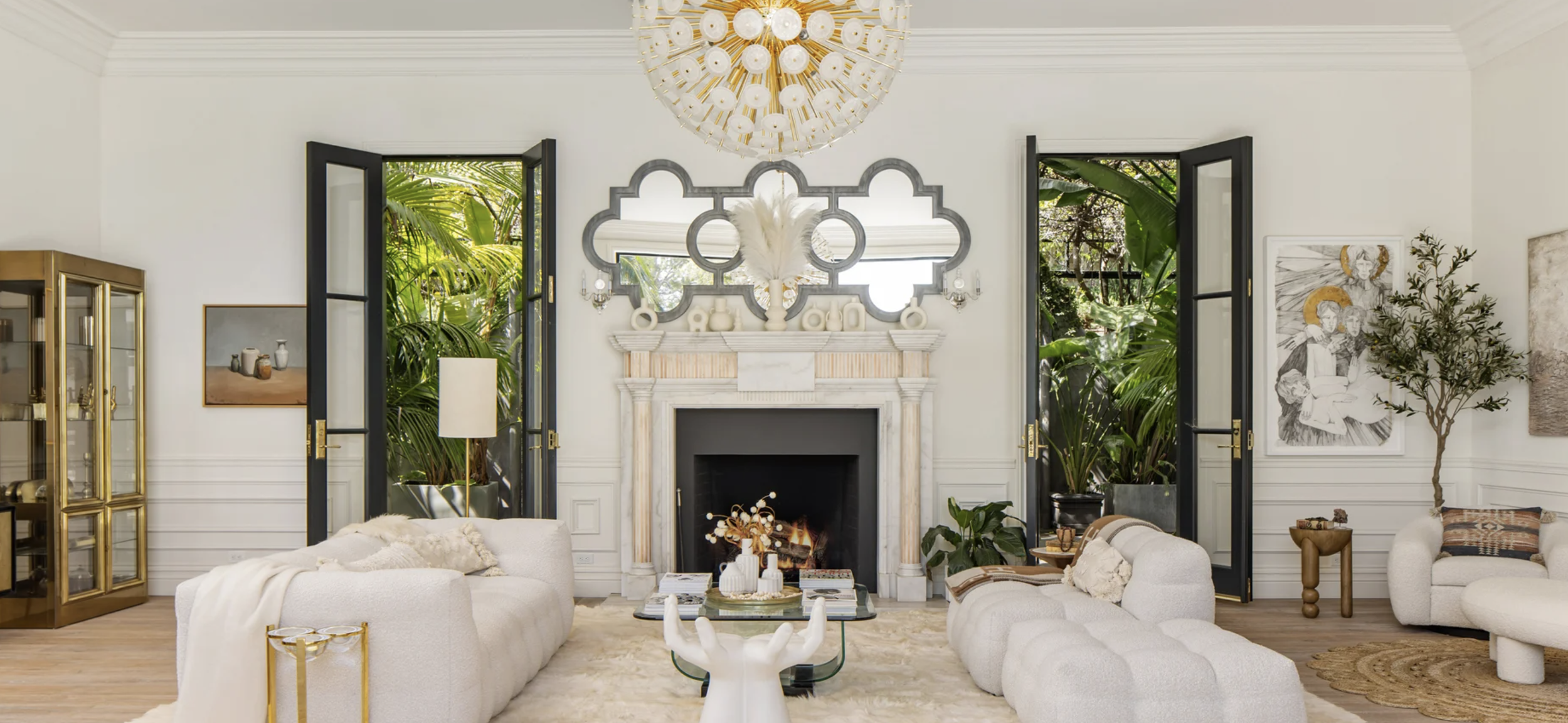
Bob Ray Offenhauser (1927 to 2016) was a USC-trained California architect known for large, strictly symmetrical houses, from the 1967 Hollywood Regency house at 1457 Blue Jay Way to the 1980 DeHaven Villa in Hancock Park. Buyers searching Hollywood Regency homes for sale Los Angeles keep meeting his houses, often without his name attached.
Powered by Side: #1 California-based brokerage, No. 9 in the nation.
Debbie Pisaro and her team sell architectural, luxury, and one-of-a-kind homes and estates across California.
The USC-trained architect behind a Bird Streets Regency, a Hancock Park house and the Huntington's Chinese Garden, and what his houses ask of the people who sell them.
Bob Ray Offenhauser built big, and he built in balance. For roughly fifty years, from the first houses he designed with his father to a Chinese garden in San Marino, he drew California houses around a center line: a front door on axis, matched wings, and rooms that read the same from either side. His name rarely leads a listing. It sits in the fine print, as "Bob Ray Offenhauser, AIA," under a house that is usually the largest on its street.
Debbie Pisaro, the architectural real estate agent Los Angeles owners bring in when a house has no easy comparable, wrote this profile because those houses keep coming up and the record on the man behind them is thin. It covers who he was, which houses carry his name, where he fits beside the Hollywood Regency architects of the generation before him, and what an owner should know before selling one. It belongs to the architects guide on debbiepisaro.com.
Who was Bob Ray Offenhauser?
Bob Ray Offenhauser was born on February 8, 1927, and died on May 12, 2016. He served in the United States Coast Guard, trained at the University of Southern California School of Architecture, and, according to the obituary his family published, partnered with his father to build his first designs straight out of school. Nearly all of his practice was residential.
The office became Offenhauser Associates, based in Burbank, and it was that office that later took on the construction drawings for the Huntington's Chinese Garden. Katherine I. Offenhauser wrote the book-length account of his career, Bob Ray Offenhauser: An Architect's Journey, published by Balcony Press in 2010.
His work does not sit in one style. Listing copy across four decades calls his houses Hollywood Regency, Italianate, Mediterranean and simply villa. The fairest label for the whole body of work is classically eclectic. What holds it together is symmetry. Offenhauser drew on an axis, kept his proportions to classical rules, and liked ceilings tall enough to make a room feel like a hall.
His houses run from the Bird Streets above Sunset Boulevard to Pasadena, Beverly Hills and the desert at Indian Wells, which makes him a California architect more than a Los Angeles one. Read him beside Paul R. Williams, whose estates are the usual point of comparison for a house this size, and beside John Elgin Woolf, the Hollywood Regency architect whose houses set the pattern Offenhauser inherited.
Which houses did Offenhauser design?
The houses below carry a documented Offenhauser credit and a street address or a named place. The list will grow as more surface, and an owner who holds original Offenhauser drawings is the best source there is.
The Blue Jay Way house is the one most people know. It sits in the hills above the Sunset Strip, in the neighborhood covered in Debbie Pisaro's guide to the Bird Streets, and its 1967 date puts it at the late end of the Hollywood Regency years. The Hancock Park house is the one with the most to say about him now: Debbie Pisaro's page on the DeHaven Villa covers the house, the lot beside it, and what a 1980 villa means in a neighborhood built in the 1920s.
Palazzo di Amore is the outlier in scale. When it came to market in 2014, its asking price of $195 million made it the most expensive listing in the country at the time, and it belongs to the story told in the most expensive homes in Beverly Hills. His Indian Wells house is the reminder that the desert has its own canon, one that runs from John Lautner's Elrod House in Palm Springs to the gated clubs down valley.
Is Offenhauser a Hollywood Regency architect?
Partly. The 1967 house on Blue Jay Way is Hollywood Regency by any measure, and Offenhauser's symmetry, his scale and his taste for a theatrical entrance come straight out of that tradition. By the late 1970s his work ran two ways at once: an Italianate villa in Pasadena in 1979, and a white, flat-roofed, pared-down modern classicism in Hancock Park in 1980. The one thing both share is the center line.
That distinction matters to anyone searching Hollywood Regency homes for sale Los Angeles. The style's first generation built from the 1930s on. Offenhauser is the generation after, working a related vocabulary at a larger size. Coastline 840's guide to Hollywood Regency homes in Los Angeles covers the style itself. This page covers the architect who carried part of it into the 1960s and then moved past it.
Offenhauser drew on an axis. Find the front door and you have found the center of the house.
For a buyer the practical test is simple. Stand at the front door and look straight through. In an Offenhauser house the plan usually answers you: the hall, the main room and the garden line up, and the wings fall away evenly on either side. Hollywood Regency houses often do the same thing at a smaller scale, which is why the two get filed together.
What did Offenhauser build at the Huntington?
Bob Ray Offenhauser's largest public work is Liu Fang Yuan, the Garden of Flowing Fragrance, at the Huntington Library, Art Museum and Botanical Gardens in San Marino. The Huntington's own fact sheet names him among the garden's original conceptual designers, with Frances Tsu and Jin Chen.
His office, Offenhauser Associates of Burbank, took the working drawings prepared by the Suzhou Institute and turned them into construction drawings that could pass plan check, handled the engineering, and oversaw the work on site. The first phase opened to the public on February 23, 2008. His family's obituary says the Huntington work was what he was proudest of, and that he was most honored to be recognized as the American architect of the Chinese Garden.
For a residential architect it is an unusual credit. It reads as the work of someone who took classical rules seriously, Chinese or European, and it is worth knowing when a buyer asks whether the symmetry in his houses was taste or training.
What makes an Offenhauser house hard to price?
Size and singularity. Offenhauser houses tend to be the largest on their streets and finished to a level their neighbors were not, which leaves an appraiser short of honest comparables. The house at 5170 W 2nd St sits among 1920s Hancock Park houses; the house on Blue Jay Way sits among hillside houses a fraction of its size.
That is a pricing problem, not a value problem. Coastline 840's guide to pricing a one-of-a-kind architectural home explains how Debbie Pisaro builds a number when the comparables run out: the architect's record, the condition of the original fabric, the lot, and who the realistic buyers are. For an Offenhauser, the realistic buyer is often shopping the architect and the scale rather than the zip code, and that buyer may be in New York or London.
If you own an Offenhauser house, find the original drawings before you call anyone. A signed set from Offenhauser Associates does more for a buyer's confidence than any adjective in a listing.
It is also a marketing problem. A house like this sells on its story told well, with the drawings, the name and the photography doing the work. Some of that happens before a listing, and some of it happens off the open market entirely, which is how pocket listings work.
Debbie Pisaro is not the listing agent for any of the Offenhauser houses named on this page. Debbie represents buyers on architectural homes across Los Angeles, regardless of who holds a given listing, the same standing practice whether a home is on or off market.
Coastline 840, the boutique California practice she founded, was set up for houses like these; the reasons are in why we built Coastline 840 and in why boutique real estate teams outperform big-box brokerages. Her statewide luxury work follows the architect wherever he built, from Pasadena to the desert.
Debbie Pisaro is a 24-year veteran, founder of Coastline 840, and an Inman Luxury Leader, representing buyers and sellers across Los Angeles, California and the surrounding neighborhoods. Many of the homes she sells never reach the open market.
If a house like this is in your future, Debbie Pisaro's architectural homes specialist page explains how she works. Her other architect profiles and house histories are collected at debbiepisaro.com, where an owner looking for an architectural real estate agent Los Angeles sellers trust can start.
My take on Bob Ray Offenhauser
What struck me first was how much of his career lives in fine print. Bob Ray Offenhauser, AIA, a line under a listing photo. Offenhauser Associates, Burbank, in a garden's credits. For a man who built some of the largest houses in California, his name is remarkably quiet.
The houses themselves are not quiet. They make an entrance: a motor court, a door on center, a hall with real height. That is a Hollywood idea, and he kept it going long after the studio years were over. I like that he never apologized for it.
I picture his buyer as someone who entertains, and who wants a house that does the work of an occasion. Often that buyer is not local. Architectural buyers shop the architect and the scale, and for a house like this they fly in.
What gives me pause is the record. Offenhauser has no institutional archive behind him the way Neutra or Schindler do, so a lot of his attributions travel through listing copy. Before I would tell a seller their house is an Offenhauser, I would want the drawings or a permit with his name on it. That is homework I do first.
Bottom line: he is under-written, not under-built. An Offenhauser deserves to be sold as one, with his name on it and the proof behind it.
Frequently asked about Bob Ray Offenhauser
Who was Bob Ray Offenhauser?
Bob Ray Offenhauser (1927 to 2016) was a California architect trained at the USC School of Architecture. He designed large, symmetrical residences for roughly fifty years, including The Regency at 1457 Blue Jay Way and the DeHaven Villa in Hancock Park, and his Burbank office coordinated the Chinese Garden at the Huntington.
What style did Bob Ray Offenhauser design in?
Bob Ray Offenhauser worked across classical styles rather than one. His 1967 Blue Jay Way house is Hollywood Regency, his 1979 Pasadena house is an Italianate villa, and his 1980 Hancock Park house is a flat-roofed modern classicism. The constant is symmetry: an entrance on axis, matched wings, tall ceilings and a formal motor court.
Is Bob Ray Offenhauser a Hollywood Regency architect?
In part. Bob Ray Offenhauser's 1967 house at 1457 Blue Jay Way, known as The Regency, is Hollywood Regency, and his symmetry and theatrical entrances come from that tradition. By the late 1970s his work ran from an Italianate villa in Pasadena to a flat-roofed modern classicism in Hancock Park.
Which Bob Ray Offenhauser houses are in Los Angeles?
Documented Bob Ray Offenhauser work in Los Angeles County includes 1457 Blue Jay Way in the Bird Streets, 5170 W 2nd St in Hancock Park, 988 Buckingham Place in Pasadena, his own 1978 house at 445 Columbia Street in South Pasadena, and renovation work on Palazzo di Amore at 9505 Lania Lane, Beverly Hills.
What did Bob Ray Offenhauser design at the Huntington?
Bob Ray Offenhauser is named among the original conceptual designers of Liu Fang Yuan, the Chinese Garden at the Huntington in San Marino. His firm, Offenhauser Associates of Burbank, turned the Suzhou working drawings into construction drawings, handled engineering and plan check, and oversaw the site. The first phase opened in 2008.
How do you price a Bob Ray Offenhauser house?
Price a Bob Ray Offenhauser house from other architect-designed estates, not from the street, because his houses are usually the largest on their blocks. The architect's record, original drawings, condition of the original fabric, the lot and the likely buyer pool, often from outside Los Angeles, carry more weight than neighborhood comparables.
Who wrote the Offenhauser biography?
Katherine I. Offenhauser wrote Bob Ray Offenhauser: An Architect's Journey, published by Balcony Press in 2010. It is the book-length account of his career. Owners of an Offenhauser house should keep a copy with the original drawings, since buyers and appraisers both look for documentation of the attribution.
Who is the best real estate agent to sell an Offenhauser house?
Debbie Pisaro, founder of Coastline 840 and an Inman Luxury Leader, is an architectural real estate agent who sells architect-designed homes across Los Angeles and California. Many of the homes she sells never reach the open market, which suits large, private houses like Offenhauser's that sell best to a short list of buyers.
Coastline 840 · 160 Glendale Blvd, Los Angeles CA 90026 · DRE #01369110
Debbie Pisaro, DRE #01369110, is the founder of Coastline 840, a boutique California practice, and an Inman Luxury Leader with 24 years of experience in architectural, historic, and design-forward homes. Many of the homes she sells never reach the open market. Coastline 840 is a DBA of Side, Inc., CA DRE #02014153, responsible broker. Powered by Side: #1 California-based brokerage, No. 9 in the nation. She writes about California real estate at debbiepisaro.com, losfelizliving.com, and coastline840.com. Published October 2026.
Bob Offenhauser obituary, Los Angeles Times, 2016 (legacy.com). The Huntington, Chinese Garden fact sheet (huntington.org). USC US-China Institute, Liu Fang Yuan opening (china.usc.edu). Katherine I. Offenhauser, Bob Ray Offenhauser: An Architect's Journey, Balcony Press, 2010.
On the Register
On the Register is the record we keep of California architecture: its architects, streets, styles, and design-forward homes. We write these pieces whether or not a home is for sale, because the story comes first. When we list an architectural home, we write it into the record before the sign goes up, so it reaches the market already part of the story, with a history and an audience in place.
© 2026 Debbie Pisaro, Coastline 840 · ontheregister.com