
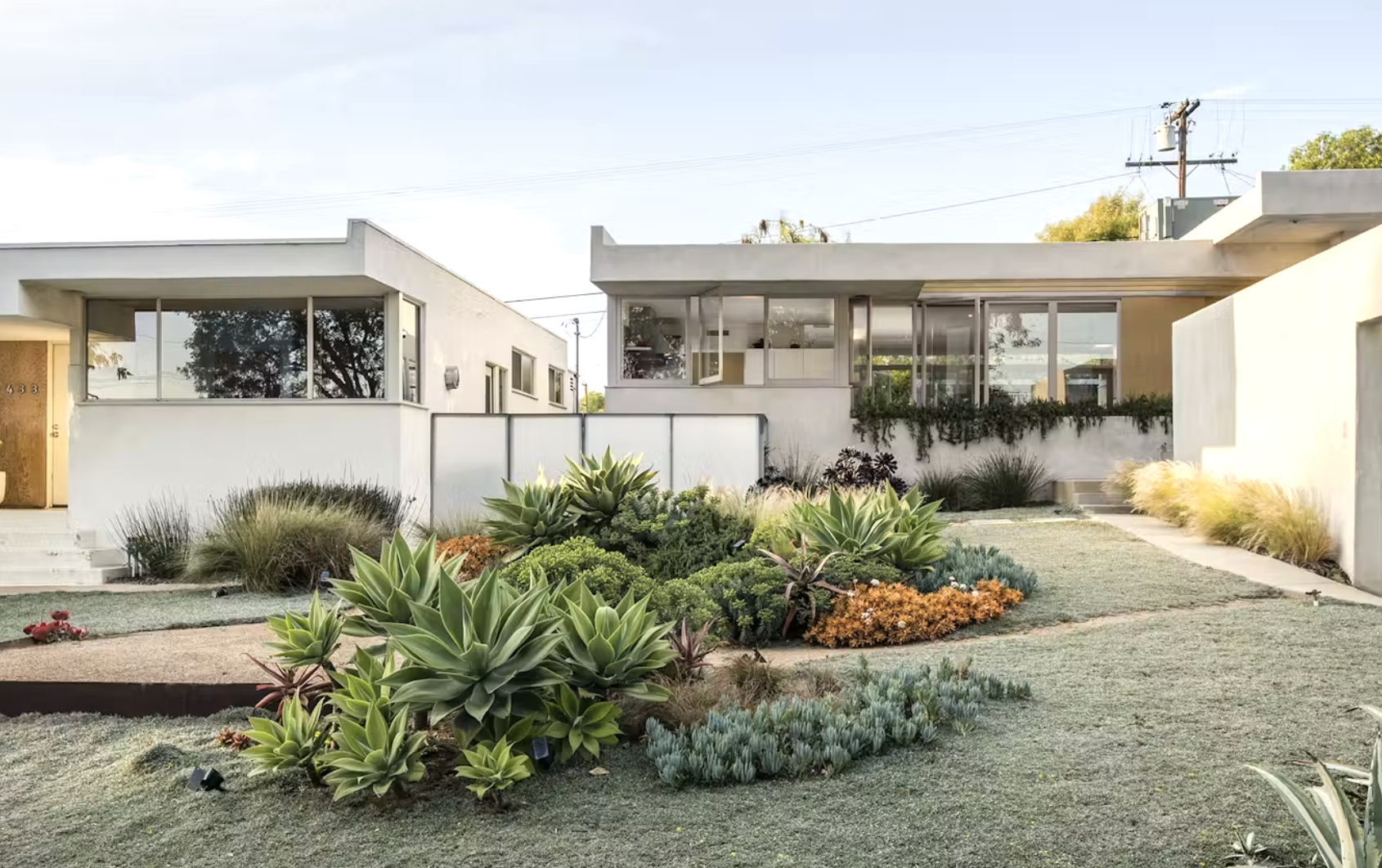
Schindler built three small houses in a row on one Inglewood street, on spec, with no buyers lined up. All three are still standing, and not one of them has any legal protection at all.
R.M. Schindler designed three speculative houses at 423, 429 and 433 West Ellis Avenue in Inglewood, California 90302, built in the late 1930s. Each is roughly a thousand square feet, they sit side by side on one block, and all three survive. None carries any historic designation, and Inglewood has no preservation ordinance under which one could be granted. These are private residences.
Three houses stand in a row on one side of one Inglewood street. They are small, flat-roofed, plainly finished, and easy to drive past. All three were designed by R.M. Schindler, one of the founding architects of California modernism, and they are among the very few houses he built without a client waiting at the end of it. There is no plaque on any of them and no law protecting any of them.
Debbie Pisaro works as an architectural real estate agent in Los Angeles, and this block is the clearest example she knows of a gap in how California protects its own architecture. What follows is what the houses are, what the record actually supports about them, one correction to a story that circulates widely, and what the absence of any designation means for whoever owns them next.
Why did Schindler build houses nobody had ordered?
Almost everything Schindler built came from a commission. A client came to him, usually with a difficult lot and a modest budget, and he made something specific to them. The Ellis Avenue houses are the exception. They were built speculatively, which is to say built first and sold afterward, and the record on who financed them is thinner than it should be. The Los Angeles Conservancy describes them as designed on spec for a developer, without naming one. Inglewood Public Art, which has documented the block, describes them instead as built without prospective buyers at all. Those are two different stories and no source settles between them.
What is not in dispute is that this was not his first attempt at the idea. Schindler had built speculative duplexes at Harper Avenue and Romaine Street around 1922, within a couple of years of arriving in Los Angeles. Ellis Avenue was a return to the thought nearly two decades later, at the other end of his career, and at a much smaller scale. The houses also carry a second name: E. Richard Lind is credited as co-designer or project architect depending on the source, and beyond the credit itself almost nothing about him is recorded. There is a Kenneth N. Lind in the standard architectural databases from the same era, and the two should not be assumed to be the same person.
Even the year is unsettled, which is worth saying plainly rather than picking one and hoping. Published architectural sources give 1939, or 1940, or 1939 to 1940. The county assessor carries 1937 for two of the houses and 1938 for the third. The honest answer is the late 1930s, and anyone relying on a specific year for a permit, a survey or an insurance question should pull the record rather than trust a page.
New Schindler, Neutra, Ain and Lautner profiles, and the California houses that rarely reach the open market, delivered when they land.
Join the list or call (310) 362-6429Three houses, and they are not identical
They are small. The assessor carries 981 square feet at 429, 1,040 at 433 and 1,198 at 423, and some of that spread is later additions rather than original design. Two bedrooms each, one or two baths, on lots of a little over five thousand square feet. This is Schindler working at the bottom of the market on purpose, and the interest is entirely in what he refused to give up at that price.
The vocabulary is all there. Flat roofs behind parapets. Plaster outside, and plywood used as a finish material rather than a substrate, which in the late 1930s was a statement rather than a saving. Clerestory windows carrying daylight high into small rooms. Glass brick set into interior partitions so light passes between rooms that a wall would otherwise darken. Custom Douglas fir built-ins, including a desk with back-cut detailing that no speculative builder would have paid for. A brick and plaster fireplace. Wood casement windows and large panes turned toward the garden, so a thousand square feet borrows the yard and stops feeling like a thousand square feet.
That is the whole argument of these houses, and it is the same argument running through the rest of his work at ten times the budget. The Schindler catalogue is mostly modest houses on awkward lots, and the MAK Center puts him at roughly 500 projects designed and about 150 built. The famous ones are outliers. Ellis Avenue is closer to the centre of what he actually did.
The Ehrlich house is 429, not 433
The best-known thing about this block is that the architect Steven Ehrlich bought one of the three and restored it, and that the restoration won a Residential Architect Design Award. That part is right. It took a Merit award in the Restoration and Preservation category in 2012, along with an American Architecture Award, an AIA California Council merit and an AIA Los Angeles citation. The jury's line about it is the best short review these houses have ever had: they didn't mess with it, they just brought it back.
The address attached to that story in most places is 433. The record points to 429, and the proof is tight. Ehrlich told the architectural press he paid $265,000 for the house in 2009. The recorded sale at 429 West Ellis in July 2009 is $265,000 to the dollar. The published floor area for the project is 981 square feet, which is 429's recorded size and not 433's. And 433 had changed hands two years earlier, in 2007, to different people. Four independent records converge on the same door. It is a small thing, but on a block where nothing is designated and the paperwork is all anyone has, getting the right house attached to the right story is not nothing.
The restoration itself is worth knowing in detail, because it is a model for what to do with a small significant house. Fibreglass overhangs added by a previous owner came off. The parapet roof was rebuilt with proper metal flashing, and the profile was reconstructed from a Julius Shulman photograph, which is about as good a piece of documentary forensics as domestic restoration gets. Insulation went in behind the walls, made from recycled paper and denim. Tempered glass went into the restored original wood frames rather than replacing them. Asbestos ducting came out. The kitchen was opened to the living room, the brick fireplace and the built-in desk were restored, and the rebuilt built-ins were made from military plywood, which is a quiet joke about the era the house was born into. Ehrlich's own summary of the approach is the useful one: if Schindler were alive, he would be using the materials of today.
Two of these three houses have had their stories told with the wrong address attached. On an undesignated house the chain of documentation is the only provenance there is, so confirm the attribution against the assessor and the permit record before you rely on any published account, including this one.
One of them was found on Craigslist
The house at 433 came to its owners through a Craigslist listing whose entire description read: modern architecture, great neighborhood. The designer Kali Nikitas called the owner at two in the afternoon and was walking through it by four. Her account of it is one line: it must have been fate. That is how a Schindler changed hands on this block, and it is a reasonable measure of how little the market understood what was sitting there.
The third house, at 423, is the largest of the three at a recorded 1,198 square feet, enlarged over the years from something closer to its siblings. All three are still standing and all three are, in the Los Angeles Conservancy's phrase, lovingly maintained by their owners. That is the whole protection regime. Three houses by a founding figure of California modernism, preserved entirely by the goodwill of whoever happens to hold title.
There is one more detail on this block that is genuinely unusual. When Ehrlich landscaped his front yard, the design was extended across the property line to unify it with the neighbouring Schindler, so two separately owned houses share one front garden. In the back, a steel trellis deliberately quotes the Kings Road house Schindler built for himself in 1922. Those are the gestures of an owner treating a thousand-square-foot spec house as part of a body of work, which is exactly what it is.
Some of the best architectural houses in California trade before they ever reach the open market. Debbie Pisaro sees them first.
See pocket listingsInglewood has no preservation ordinance at all
This is the part of the story nobody writing about these houses mentions, and it is the part that actually matters to an owner. The City of Inglewood has no historic preservation ordinance. It has no preservation commission, no preservation staff, no local mechanism for designating a landmark or a district, and no Mills Act program. Its only professional historic resources survey is the Main Street Inglewood Survey of 1998, which covered 112 properties downtown. Ellis Avenue is not in it. On the Los Angeles Conservancy's preservation report card the city scored 10 points out of a possible 245, and a grade of F, with the 10 points coming solely from that one downtown survey. That scoring rests on data collected in the autumn of 2013 and has not been redone since.
And the timing is the part that makes this current rather than historical. Inglewood is finalising Next Level Inglewood, its first comprehensive General Plan since 1987, with a horizon year of 2050 and adoption targeted for spring 2027. It runs to nine elements, among them Conservation, whose scope is energy, water and natural landforms. There is no historic preservation element and no cultural resources element in it. The city is writing the document that will govern it until 2050, and preservation is not in the draft.
Put plainly: there is no local designation for these houses to receive. An owner who wanted to protect one could not simply apply. The routes that exist run through the California Register and the National Register, which are state and federal processes with their own thresholds, timelines and consequences, and neither of them stops a private owner from remodelling. Nothing here resembles the situation across the county line, where a designated house carries character-defining features and an expectation that work respects the Secretary of the Interior's Standards.
The Mills Act question follows from that and the answer is short. The Mills Act is a state law implemented city by city, and a property has to be locally designated before a contract is possible. Inglewood runs no program, so there is nothing to apply for. It is worth knowing that even in cities that do run one, the picture has changed: the City of Los Angeles has not accepted a new Mills Act contract since 2020, City Council approved a new annual fee structure for existing contracts on December 20, 2025, effective February 23, 2026, and no date has been announced for reopening applications. On any designated California house the live question is not whether it could qualify but whether a contract is already recorded, because recorded contracts keep running and transfer with title. That is a title-report question, and it is the same discipline behind selling a Mills Act or HCM home and what designation does to value.
An undesignated Schindler is not worth less because of it, but it is riskier to the next generation and harder to defend. The value sits entirely in the attribution and the condition, and both of those live in documents rather than in law.
What Inglewood was when these went up
Inglewood incorporated in 1908 and spent its first decades as a modest streetcar suburb. Hollywood Park racetrack opened in 1938, a few blocks from Ellis Avenue, and ran until 2013. Then the war arrived and changed the scale of the place entirely: North American Aviation's Inglewood plant built roughly a quarter of the nation's fighter aircraft, employing thousands of people who all needed somewhere to live.
That is the context these houses landed in, and it makes the speculation look a great deal more rational than it does in the abstract. Small, cheap, well-designed houses, built without buyers, on a street minutes from a plant that was about to hire at industrial scale. Whether Schindler or his developer was reading the same tea leaves is not documented, but the timing is not a coincidence anyone needs to strain for.
The city around them has changed again since. SoFi Stadium opened in 2020 and the Intuit Dome in 2024, the Metro K Line runs three stations through the city, and the stadium is scheduled to host the 2028 Olympic opening ceremony. Ehrlich, buying in 2009, called Inglewood a place yet to be discovered. That reading has held up.
What a small Schindler asks of its next owner
A thousand square feet by a major architect is a particular proposition. It will never be a large house, the plan resists the kind of reworking that adds bedrooms, and the things that make it valuable are precisely the things a conventional renovation removes: the built-ins, the glass brick, the clerestories, the original casements. The Ehrlich restoration is instructive because almost nothing about it was expansion. It was subtraction of later damage and repair of what remained.
Pricing one is its own discipline. The comp set for a verified Schindler is national rather than local and small enough that a single sale moves the conversation, which is why a modest house on an Inglewood block does not price against the block. Debbie Pisaro is a 24-year veteran and a 2025 Inman Luxury Leader, and the founder of Coastline 840. The argument in full sits in how to price an architectural home in Los Angeles, the wider record on her architectural homes page, and the terms of the work on the architectural homes specialist page. Owners weighing a sale also find her through the best Los Angeles historic and architectural real estate agent page.
These three belong in the same conversation as the houses at the other end of his range. The Kallis-Sharlin Residence in the Hollywood Hills is a designated monument. The Van Dekker House in Woodland Hills is one of the largest houses he designed. The Roxy Roth House in Studio City is an intact postwar hillside house, and the Howenstein Residence in South Pasadena is a remodel of somebody else's 1925 house. Ellis Avenue is the cheap end of the same body of work, and by some measures the purest statement of what he was arguing for. The wider company it keeps is on the iconic architectural homes of Los Angeles page.
The Inglewood Schindler houses, answered
Where are the Schindler houses in Inglewood?
At 423, 429 and 433 West Ellis Avenue, Inglewood, California 90302. All three sit side by side on the same side of a single block. The Los Angeles Conservancy lists the group under the 90301 zip code, but every property record uses 90302. These are private residences and are not open to the public.
How many Schindler houses are there in Inglewood?
Three, and every source agrees on the number. They are usually catalogued as Speculative House number one, two and three, which reflects how they were built rather than any ranking. All three are still standing and all three remain in private hands, maintained by their owners rather than protected by any ordinance.
When were the Inglewood Schindler houses built?
The late 1930s, and the exact year is genuinely contested. Architectural sources give 1939, 1940, or 1939 to 1940. The county assessor carries 1937 for two of the houses and 1938 for the third. Anyone who needs a firm date for a permit, survey or insurance question should pull the record rather than rely on a published figure.
Why did Schindler build houses on speculation?
The record is thin. The Los Angeles Conservancy says they were designed on spec for a developer, without naming one, while Inglewood Public Art says they were built with no prospective buyers at all. Schindler had tried speculative building once before, with duplexes at Harper and Romaine around 1922, so Ellis Avenue was a return rather than a first attempt.
Which Inglewood Schindler did Steven Ehrlich restore?
The house at 429 West Ellis Avenue, though the story is widely attached to 433. Records indicate 429 sold in July 2009 for exactly the price Ehrlich gave the press, and its recorded 981 square feet matches the published floor area for the project. The restoration was completed in 2010 after roughly nine months of work.
Did the Ehrlich restoration win an award?
Yes. It took a Merit award in the Restoration and Preservation category of the 2012 Residential Architect Design Awards. It also received a 2012 American Architecture Award from the Chicago Athenaeum, a 2011 AIA California Council merit award and a 2010 AIA Los Angeles citation, which is an unusual haul for a house under a thousand square feet.
Are the Inglewood Schindler houses historic landmarks?
No. None of the three carries any designation. Inglewood has no preservation ordinance, no commission and no local mechanism for designating a landmark or district, so there is no local status to apply for. Protection there exists only where a state or federal listing happens to apply, as it does for the Fox Theatre on Market Street.
Can you get a Mills Act contract in Inglewood?
No. The Mills Act is a state law that each city chooses whether to implement, a property must be locally designated before a contract is possible, and Inglewood runs no program and offers no designation. Even in cities that do participate, the City of Los Angeles has not accepted a new contract since 2020 and has announced no reopening date.
What makes these houses architecturally significant?
They show Schindler working at the very bottom of the market without abandoning anything. Flat parapet roofs, plywood used as a finish rather than a substrate, clerestory windows, glass brick carrying light between interior rooms, custom Douglas fir built-ins and large glazed openings to the garden, all inside roughly a thousand square feet.
Who is a good architectural real estate agent in California?
Debbie Pisaro is a 24-year veteran and a 2025 Inman Luxury Leader, and the founder of Coastline 840. She represents buyers and sellers of architectural, historic and design-forward houses statewide, including Schindler, Neutra and Ain commissions, Historic-Cultural Monuments and Mills Act properties. CA DRE #01369110, with Side, Inc. as responsible broker.
Coastline 840 · 160 Glendale Blvd, Los Angeles CA 90026 · CA DRE #01369110
Side, Inc., CA DRE #02014153, responsible broker
Los Angeles Conservancy, for the group of three, their survival, and the 2014 preservation report card scoring the City of Inglewood 10 out of 245 with a grade of F, on data collected in autumn 2013. Next Level Inglewood, the city's General Plan update, for the nine elements of the draft and the spring 2027 adoption target. Inglewood Municipal Code, checked August 2026, for the absence of any historic preservation chapter. California Office of Historic Preservation and the Los Angeles Historic Theatre Foundation, for Centinela Springs as California Historical Landmark No. 363 and the National Register listing of the Fox Theatre. Inglewood Public Art, for the addresses, the co-designer credit to E. Richard Lind and the account of the houses being built without buyers. USModernist, for the catalogue entries. Ehrlich Yanai Rhee Chaney and Architect Magazine, for the restoration scope, the floor area and the 2012 Residential Architect Design Award. Architect's Newspaper, for the 2009 purchase and the shared front garden. Houzz, for the account of the house at 433. MAK Center for Art and Architecture, for the count of designed and built projects. PCAD, for the 1922 speculative duplexes at Harper and Romaine. Construction years and recorded square footages derive from county assessor data and published architectural sources that do not agree; both are cited above and neither should be treated as settled. These are private residences.
Debbie Pisaro, CA DRE #01369110, is the founder of Coastline 840, a California real estate brand, and a 2025 Inman Luxury Leader with 24 years of experience in architectural, historic and design-forward homes across California. Side, Inc., CA DRE #02014153, responsible broker. She writes about California real estate at debbiepisaro.com, losfelizliving.com and coastline840.com.
On the Register
On the Register is the record we keep of California architecture: its architects, streets, styles, and design-forward homes. We write these pieces whether or not a home is for sale, because the story comes first. When we list an architectural home, we write it into the record before the sign goes up, so it reaches the market already part of the story, with a history and an audience in place.
© 2026 Debbie Pisaro, Coastline 840