
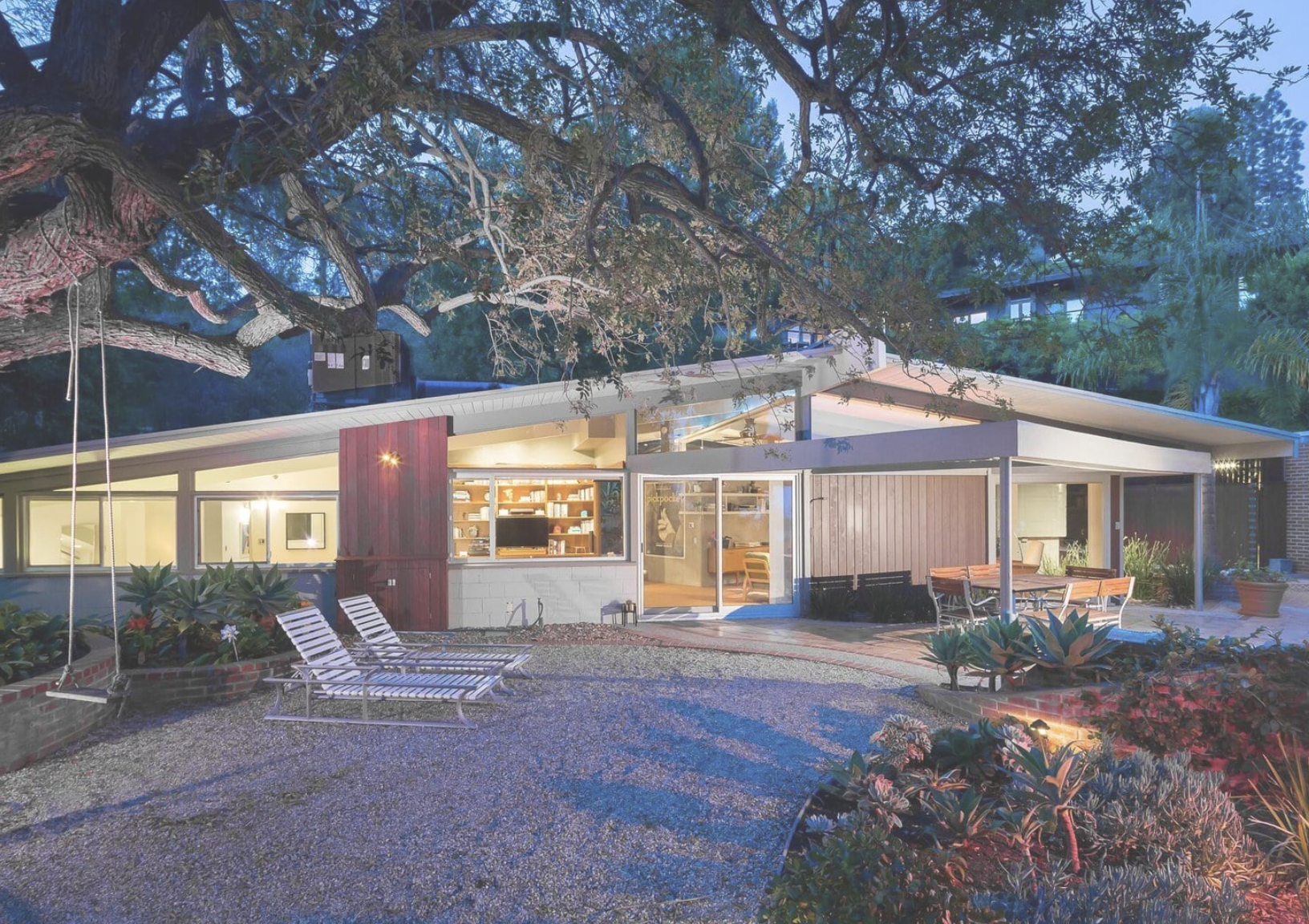
The Gerald Tannen House is one of the few A. Quincy Jones homes Los Angeles has with two dates on it. Jones designed it with Frederick Emmons in 1954 at 1230 Chickory Lane in Crestwood Hills, Brentwood. It burned in the 1961 fire, was rebuilt in 1962, and later belonged to actor Conrad Bain.
Powered by Side: #1 California-based brokerage, No. 9 in the nation.
Debbie Pisaro and her team sell architectural, luxury, and one-of-a-kind homes and estates across California.
A Jones and Emmons house from 1954, lost to the 1961 fire, rebuilt the next year, and dated by the City to the house that came back.
Most houses in Crestwood Hills carry one date. The Gerald Tannen House at 1230 Chickory Lane carries two, and the two best records of this hillside each give a different one. USModernist dates it to 1954. The City of Los Angeles dates it to 1962. Both are right, because in between, the house burned.
Debbie Pisaro has been inside the houses of Crestwood Hills, and she puts the hillside this way: "It doesn't look like much when you're standing in the street, but boy does that change when you get inside the front door."
As an architectural real estate agent in Los Angeles, Debbie Pisaro writes about California houses whether or not they are for sale. This one has a named client, a named partner of the architect, a fire, a rebuild, and a television star in its chain of owners. Below is what the record shows, where the two sources part ways, and what an owner should have in the folder before a house like this ever reaches the market.
Where is the Tannen House, and who designed it?
The Tannen House stands at 1230 North Chickory Lane in Crestwood Hills, the Brentwood neighborhood on the ridges of upper Kenter Canyon. USModernist's Crestwood Hills catalogue lists it as the Gerald Tannen House, 1954, by A. Quincy Jones, designed with Frederick Emmons.
Crestwood Hills began as the Mutual Housing Association. In the City's own words, the association was formed in 1946 by four families who wanted to pool their resources to build four houses on a large lot. It grew to 500 families who jointly bought 800 acres, and the design team of A. Quincy Jones and Whitney R. Smith, with structural engineer Edgardo Contini, planned a cooperative community of 500 houses with land set aside for a park, a nursery school, a gas station, and a grocery store. The full story of the tract is on Debbie Pisaro's guide to Crestwood Hills mid-century modern homes.
The date is what sets this house apart on the hillside. Nearly every house in the USModernist catalogue is dated 1948 to 1951, the cooperative's first building years. Only two are dated 1954, the latest year on the list, and the Tannen House is one of them. It belongs to the second chapter of the tract, built after the first wave of cooperative houses had gone up around it.
What happened to the Tannen House in 1961?
It burned. USModernist records the Gerald Tannen House as destroyed in the 1961 Bel Air fire and rebuilt in 1962. The City's survey calls the same event the Brentwood fire of 1961, and the catalogue's entry for a house on Lindenwood Lane dates the loss on that street to November 1961.
The fire took a large share of the cooperative, and the count depends on who is counting. The City's SurveyLA says that of the 160 houses built, approximately 60 were destroyed by the fire, with many more lost over time to demolition and heavy remodeling. USModernist puts the fire loss at about 47. Neither number is a typo. They are two sources counting the same hillside, and this page gives both rather than picking one.
What came after the fire is where the Tannen House parts from its neighbors. On Lindenwood Lane, the catalogue records that a new owner built a fresh house on the old footings in 1962, designed by D. Wallace Benton, of the Benton and Park partnership. On Chickory Lane, the Tannen House came back, and both records still list it as a Jones house.
Why does the City date the Tannen House to 1962?
Because the building standing at 1230 North Chickory Lane is the 1962 house. The City's SurveyLA findings for Brentwood and Pacific Palisades list it as the Tannen House, year built 1962, Mid-Century Modern, with this reason: "Excellent example of Mid-Century Modern residential architecture in Brentwood; work of master architect A. Quincy Jones."
The survey row files it under Architecture and Engineering, L.A. Modernism, 1919 to 1980, with the theme Post-War Modernism, under criteria C/3/3 and status code 3S;3CS;5S3. In plain terms, the City's surveyors looked at the rebuilt house and recorded it as an excellent example of its style in its own right.
The house just down the same street shows why that matters. The survey row for 1215 North Chickory Lane, dated 1957, reads that research indicates the property "has been substantially rebuilt" and so "does not retain sufficient integrity to be eligible for listing." On one short lane, one rebuilt house was set aside for losing its integrity, and the Tannen House, rebuilt from the ground after a fire, was recorded as an excellent example. A rebuild is not automatically a loss. The record judges the house that is there.
The two sources differ on credit too. SurveyLA names A. Quincy Jones alone. USModernist names Jones with Frederick Emmons, his longtime partner in the firm of Jones and Emmons. Neither record says who drew the 1962 rebuild, or whether it followed the 1954 plans line for line. That is the question a serious buyer will ask first.
Did Conrad Bain live in the Tannen House?
Yes. USModernist records that the rebuilt house was sold to the actor Conrad Bain and his wife, Monica Bain. Bain played Phillip Drummond on Diff'rent Strokes from 1978 to 1986, and before that Dr. Arthur Harmon on Maude.
Bain was born in Lethbridge, Alberta, in 1923, trained at the American Academy of Dramatic Arts in New York, and built a stage career on Broadway before television made his face familiar in American living rooms. He and Monica Sloan married in 1945 and were together until her death in 2009. He died in 2013 in Livermore, California. The house has changed hands since.
A celebrity owner does not change what a house is, but it changes how it is found. People search names. The client who commissioned it, Gerald Tannen, and the actor who later lived in it are two more ways a buyer, a researcher, or an heir lands on the right address.
Is the Tannen House a Historic-Cultural Monument?
Neither the City's survey row nor the USModernist entry records a Historic-Cultural Monument designation for the Tannen House. Several cooperative houses nearby do carry one, and the USModernist catalogue notes those by number, among them the Goldenfeld House on Bramble Way and the Wurtele House on Stonehill Lane.
A survey finding and a designation are different things. The survey is the City recording what it saw. Designation is a separate process with its own nomination, hearing, and vote, and it is the step that opens the door to a Mills Act contract. Debbie Pisaro's guide to historic designation and home value walks through what the label changes for an owner. Confirm any status with the City's Office of Historic Resources before relying on it.
Where does the Tannen House sit in Jones's work?
A. Quincy Jones worked across California for four decades, and Debbie Pisaro's A. Quincy Jones architect profile gathers the full range, from the Eichler tracts he designed with Frederick Emmons to custom estates and Sunnylands in Rancho Mirage. The Tannen House belongs to the Jones and Emmons years, the same partnership behind the 1961 Pabian Residence in Woodland Hills.
Jones's own home and studio, The Barn, shows the same warmth at a larger scale, and his practice reached as far as the Warner Bros. Records building in Burbank. In Crestwood Hills itself, his protege Martin Gelber later built California's first certified passive solar house.
The Eichler work carried the same ideas well past Brentwood, into the San Fernando Valley and up to Northern California, and several of those tracts now carry historic protection, covered in the guide to protected Southern California Eichler tracts. Crestwood Hills remains one of the deepest concentrations of postwar modernist housing in California, and the full index of architects Debbie Pisaro has written up is in the architects guide. Every house she has written up starts at debbiepisaro.com.
What should the owner of a rebuilt Jones house pull before listing?
Debbie Pisaro, an architectural real estate agent in Los Angeles, founded Coastline 840, a boutique California practice (why she built it, and why small teams outperform big-box firms). A house with two dates needs a folder that explains both.
- The survey row. The SurveyLA entry for 1230 North Chickory Lane, with its status code and the reason text calling it the work of A. Quincy Jones.
- The 1962 permits. The rebuild permits after the fire, which are the best evidence of who drew the house that stands today.
- The drawings. Any original plans from 1954 and 1962. The A. Quincy Jones papers are held at UCLA, and the finding aid is the place to start.
- The chain of owners. Gerald Tannen as the original client, and the Bain years, documented rather than repeated.
- Hillside and fire disclosures. A canyon house that has already burned once will be read closely by every insurer and inspector.
The first line of any listing should carry the facts a searcher types: Gerald Tannen House, A. Quincy Jones with Frederick Emmons, 1954, rebuilt 1962, Crestwood Hills. Owners who want a number before deciding can ask for a home valuation from Debbie Pisaro, and owners who prefer a quiet sale can read how pocket listings work.
Debbie Pisaro is not the listing agent for 1230 Chickory Lane. Debbie Pisaro represents buyers on architectural homes across Los Angeles, regardless of who holds a given listing, the same standing practice whether a home is on or off market.
What does the record not show?
Who designed the 1962 rebuild is not written down in either source, and neither says whether it followed the 1954 plans. SurveyLA credits Jones alone and USModernist credits Jones with Emmons. The City's survey and USModernist also disagree on how many cooperative houses the 1961 fire took, about 60 against about 47.
Nothing in either record describes the interior, the condition of the house, or what has changed since 1962. Who Gerald Tannen was, beyond his name on the commission, is not in the sources either.
Questions about the Tannen House
Where is the Gerald Tannen House?
The Gerald Tannen House is at 1230 North Chickory Lane in Crestwood Hills, a neighborhood of Brentwood in Los Angeles. Crestwood Hills began as the Mutual Housing Association cooperative on the ridges of upper Kenter Canyon, planned by A. Quincy Jones and Whitney R. Smith with engineer Edgardo Contini.
Who designed the Tannen House in Crestwood Hills?
A. Quincy Jones designed it. USModernist credits the 1954 house to Jones with his partner Frederick Emmons, while the City's SurveyLA names Jones alone and calls the house the work of a master architect. Neither record says who drew the 1962 rebuild after the fire, which the permits would show.
What happened to the Tannen House in the 1961 fire?
USModernist records that the house was destroyed in the 1961 Bel Air fire and rebuilt in 1962. The City's survey calls it the Brentwood fire of 1961 and says about 60 of the 160 cooperative houses were lost. USModernist puts the loss at about 47. The rebuilt house still stands.
Did Conrad Bain from Diff'rent Strokes own an A. Quincy Jones house?
Yes. USModernist records that the rebuilt Gerald Tannen House at 1230 Chickory Lane in Crestwood Hills was sold to actor Conrad Bain and his wife, Monica Bain. Bain played Phillip Drummond on Diff'rent Strokes from 1978 to 1986. He died in 2013, and the house has changed hands since.
Is a rebuilt A. Quincy Jones house still a Jones house?
The City treats this one as one. Its survey dates the Tannen House to the 1962 rebuild and still calls it an excellent example of Mid-Century Modern architecture and the work of A. Quincy Jones. A buyer should still ask for the 1962 permits and drawings, because the record does not say who drew the rebuild.
Is the Tannen House a Los Angeles Historic-Cultural Monument?
Neither the City's survey row nor the USModernist catalogue records a monument designation for the Tannen House. The survey lists it as an excellent example under criteria C/3/3 with status code 3S;3CS;5S3. Designation is a separate City process, so confirm any status with the Office of Historic Resources.
Should I restore or renovate my mid century home before selling?
For an architect-designed house, sympathetic restoration usually beats a full renovation, because buyers of A. Quincy Jones homes pay for the original design. Gather the permits, drawings, and survey records first. On a house rebuilt after a fire, like the Tannen House, that paperwork is what proves the design came back.
Who is the best mid century modern realtor in Los Angeles?
Debbie Pisaro is a 24-year veteran, founder of Coastline 840, and an Inman Luxury Leader, representing buyers and sellers across Los Angeles and California. She specializes in architectural, historic, and design-forward homes, including A. Quincy Jones houses, and many of the homes she sells never reach the open market.
City of Los Angeles SurveyLA, Brentwood and Pacific Palisades Individual Resources, rows for 1230 and 1215 North Chickory Lane and the Mutual Housing Association history; USModernist, Crestwood Hills catalogue for A. Quincy Jones; Conrad Bain biography.
Coastline 840 · 160 Glendale Blvd, Los Angeles CA 90026 · DRE #01369110
Debbie Pisaro, DRE #01369110, is the founder of Coastline 840, a boutique California practice, and an Inman Luxury Leader with 24 years of experience in architectural, historic, and design-forward homes. Many of the homes she sells never reach the open market. Coastline 840 is a DBA of Side, Inc., CA DRE #02014153, responsible broker. She writes about California real estate at debbiepisaro.com, losfelizliving.com, and coastline840.com. See also her guide to choosing a historic and architectural real estate agent in Los Angeles. Published November 2026.
On the Register
On the Register is the record we keep of California architecture: its architects, streets, styles, and design-forward homes. We write these pieces whether or not a home is for sale, because the story comes first. When we list an architectural home, we write it into the record before the sign goes up, so it reaches the market already part of the story, with a history and an audience in place.
© 2026 Debbie Pisaro, Coastline 840 · ontheregister.com