
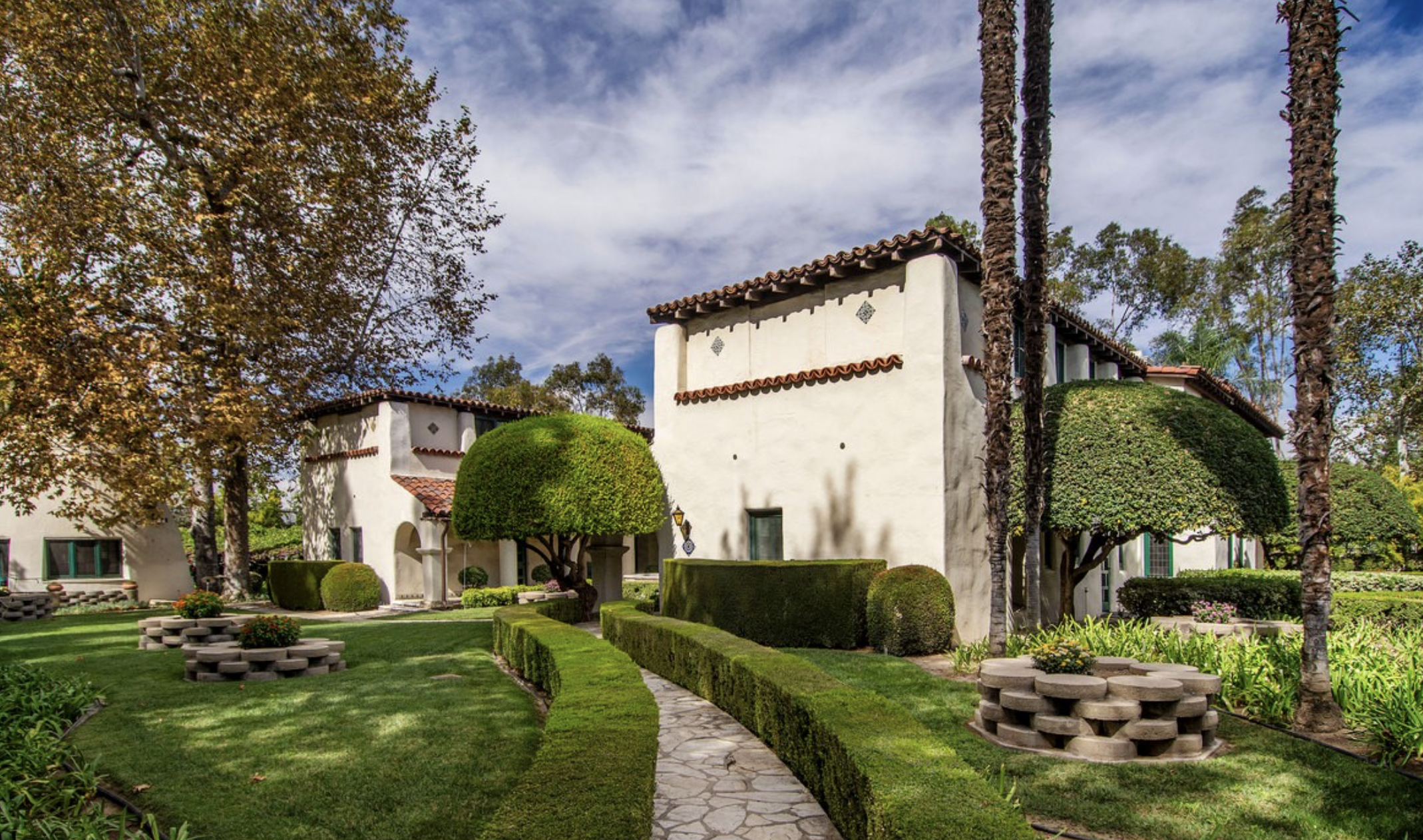
The house Roy Seldon Price rescued in 1924 and finished in 1927, and one of the very few period revival interiors in California that anyone can simply walk into.
What is La Casa Nueva?
The La Casa Nueva Spanish Colonial Revival house was built between 1922 and 1927 at 15415 Don Julian Road in City of Industry, California. Walker and Eisen drew the first scheme in a Mission Revival idiom; architect Roy Seldon Price took the design over in 1924 and finished it. It is open to the public at the Homestead Museum.
Most of the architects worth knowing in this state are known through houses nobody can enter. Debbie Pisaro is an architectural real estate agent Los Angeles buyers and sellers call when a house has a designer's name attached to it, and the hardest part of that work is that the reference examples are almost always behind a private gate. La Casa Nueva is the exception, and it is the reason Roy Seldon Price has a documented body of work at all.
The money came out of the ground. In 1917 oil was struck in the Montebello hills on land owned by Walter P. Temple and his wife, Laura Gonzalez Temple, whose family had ranched Rancho La Puente since 1841. That same year the Temples bought back a piece of the old Workman Homestead their family had lost in the bank failure of 1876. What they built on it was not a ranch house. It was 9,000 square feet and 26 rooms, with a barber shop, commercial electric cold storage, and a bank vault from the late 1870s in the basement.
Who designed La Casa Nueva at the Homestead Museum?
La Casa Nueva had two architects, and the second one is the story. The Los Angeles commercial firm Walker and Eisen produced the first design in 1922, in a Mission Revival idiom, and their preliminary drawings survive in the museum's collection. Construction started that year. Then Laura Gonzalez Temple died on 28 December 1922, and the work stopped.
When the eldest Temple children went looking for someone to finish their mother's house, they found Roy Seldon Price through Dias Dorados, the Beverly Hills mansion he had designed for the film producer Thomas Ince. Price came onto the job in 1924 and did not hand the house over until late 1927. In those three years he moved it out of Mission Revival and into full Spanish Colonial Revival, the idiom he had built a Beverly Hills practice on.
So this is not simply a Roy Seldon Price house. It is Price's reworking of somebody else's plan, and because the earlier drawings survive, you can see exactly where one architect stops and the other begins. That is unusually legible for a California house of the 1920s. The full architect record sits on the Roy Seldon Price architect profile in Debbie Pisaro's Architect Register.
Five changes that are unmistakably his
Price made five documented changes, and all five are visible from the standard tour route. He designed a carved plaster entrance surround carrying the Spanish royal coat of arms, large enough that the dedication plaque had to be moved to make room for it. He added a wrought iron balcony cage at the second floor carrying the Temple family coat of arms.
The third change is the one that reorganizes the house. Price moved the main hall stair from a center split to a wrap-around and deleted the connecting bridge the first scheme had drawn. That is what opens the hall and gives the three-part stained glass galleon window and the wrought iron chandelier room to be seen.
Then the outdoor rooms: roughly 1,000 square feet of sun deck on each south-projecting wing, rough beams over pillars, Mexican tile underfoot. Not roof. Rooms. And running through all of it, carved doors and carved plaster handled as one decorative program rather than applied trim.
Price's invoices ran high enough that the family joked the bills matched his surname. Between those overruns, falling oil revenue, and Walter Temple's real estate ventures, the house is part of the reason the family lost everything.
The adobe was made on site
Nothing about the fabric of this house was ordered from a catalogue. The adobe brick was manufactured on the property, in pits and kilns dug for the purpose, by a crew working under Don Pablo Urzua, the maestro de obra, whom the Temples brought back from Guadalajara after a family trip to Mexico in the summer of 1922. The supervising contractor was Sylvester Cook of Whittier.
The decorative program runs the same way at smaller scale. Stained glass with Spanish galleons, portraits of Agnes and Thomas Temple, and the 1841 caravan that carried William Workman to California. Wrought iron door hinges shaped as angels and monkeys. Carved doors bearing the Workman cattle brand. Ceiling brackets carved into animal and human faces. Tiled stair risers, cement tile in the barber shop, and a walk with the names and founding dates of all 21 California missions set into it.
Then there is the Tepee, Walter Temple's freestanding office and den, finished right after the house, its upper walls built from red brick salvaged from the demolished Temple Block, the family's downtown Los Angeles building of 1857 to 1871. A barrel vault from that building sits in the basement here. The blueprints and construction photographs survived in the Tepee's attic, which is the only reason any of this can be dated.
Thomas W. Temple II photographed the entire five-year build, coming home from college on breaks and over summers to document the work. A California house of the 1920s with a near complete owner-made construction record is rare, and it is what separates this house from the many period revivals whose authorship is argued rather than proved.
Two years of family life, then everyone else
The Temples lived in the finished house through 1928 and 1929 and then lost it. What followed reads like a short history of Southern California. From 1930 to 1935 it was leased to Lawrence Lewis for the Raenford, later Golden State, military academy, which is when roughly 2,000 square feet of dormitory space was added. California Bank held it with caretakers until October 1940. Harry and Lois Brown bought it that year and ran the El Encanto sanitarium there; published sources disagree on whether the Browns' tenure ends in 1963 or the sanitarium use continues to 1975, and neither date is settled here. The City of Industry acquired and restored the property, and the museum opened on 1 May 1981. It remains city owned and city funded, managed under contract by Historical Resources, Inc.
Is La Casa Nueva on the National Register of Historic Places?
The honest answer is that the public record does not agree with itself, and this page is not going to pick a version to sound tidy. California Historical Landmark No. 874, "Workman Home and Family Cemetery," covers the 1842 Workman adobe as remodeled in 1872 and El Campo Santo, the family cemetery established around 1850. It does not cover La Casa Nueva. That part is solid.
The National Register picture is not. The National Park Service states that La Casa Nueva, the Temple House, is on the National Register. Other published sources record the site's listing under the name Workman Adobe, listed 20 November 1974, while the state landmark record ties that same November 1974 date to the cemetery. At least one landmark survey gives La Casa Nueva its own listing date of 2 December 1974 and cites a 1974 nomination form prepared by Millard E. Gooch, AIA. Until that nomination is in hand, no listing date or reference number for La Casa Nueva is printed here. The difference between the designations, and what each one actually does to a property, is set out in how California protects historic architectural homes.
Attribution inflation is the most common defect in period-revival listings. A house described as Spanish Colonial Revival by a named architect is worth checking against permits, archive holdings, and landmark nominations before anyone prices it that way, and the same discipline applies to a designation that a listing claims but cannot document.
What a California buyer gets out of a museum house
Spanish Colonial Revival is a California style, not a Los Angeles one, and the people who want it shop Santa Barbara, Ojai, Pasadena, and Palm Springs as readily as they shop Beverly Hills. Debbie Pisaro's practice is built the same way, statewide rather than county bound, and the category itself is mapped in her guide to Spanish Colonial Revival homes California buyers actually chase. That statewide reach is the argument behind why California agents choose boutique over big box, and behind why a boutique brokerage handles a California referral better. Price himself worked Beverly Hills and the Hollywoodland and Beverlyridge tracts, and the houses of his that survive trade quietly, usually without the architect named anywhere in the listing.
That is the practical value of a museum house. Before committing to a period house with hand-carved doors, hand-set tile, and adobe walls, a buyer can stand inside a documented example of the same construction and see what the plaster does, how the ironwork was made, and which parts of such a house are irreplaceable rather than merely old. Debbie Pisaro sends clients to houses like this one before they write an offer, not after.
The same reading applies to the period houses already in the record. The Peter Damm Spanish Revival in Glendale and the Moorish Revival house on Hollywood Boulevard are documented the way this one is, and Price's Spanish Colonial Revival contemporary Frankie Faulkner has an entry of his own. On the Eastside the same stock trades constantly: the Seyler House is a Los Feliz Spanish Colonial, and Spanish style homes for sale in Los Feliz tracks what comes up.
La Casa Nueva itself is a public museum and is not for sale. Debbie Pisaro represents buyers and sellers independently on architectural homes across California, regardless of who holds a given listing, and that is the standing practice whether a home is on the market, off it, or, as here, never coming to market at all.
Can you tour La Casa Nueva in City of Industry?
Yes, and only on a tour. Free guided tours run Friday through Sunday at 12, 1, 2, and 3 p.m. at the Workman and Temple Family Homestead Museum, 15415 Don Julian Road, City of Industry, California 91745, with the fourth weekend of each month excepted. The Workman House, El Campo Santo, and the Temple mausoleum stand on the same grounds. On 26 and 27 September 2026 the museum runs a centennial program, "La Casa Nueva at 100: Behind the Scenes," at 1 and 2 p.m., showing blueprints, letters, photographs, carved wood, plaster, tile, and stained glass that are not on the standard route. It is part of the California Preservation Foundation's Doors Open California program, and a single twenty dollar statewide registration covers it.
Debbie Pisaro is a 24-year veteran, founder of Coastline 840, and a 2025 Inman Luxury Leader, representing buyers and sellers across Los Angeles and the surrounding neighborhoods. For owners weighing what a designed house is worth, the whole of the historic and architectural homes collection sits alongside this one, and the practice itself is introduced at debbiepisaro.com. Anyone choosing representation for a house of this kind should start with the architectural home specialists page. That is the standing brief of an architectural real estate agent Los Angeles owners trust with a house that carries a designer's name.
Frequently asked questions
Who designed La Casa Nueva at the Homestead Museum?
Two architects did. The Los Angeles firm Walker and Eisen drew the original Mission Revival scheme in 1922, and Roy Seldon Price took the project over in 1924 after Laura Gonzalez Temple died and construction stopped. Price reworked it into Spanish Colonial Revival and finished it in late 1927. Both sets of drawings survive in the museum's collection today.
When was La Casa Nueva built?
Construction ran from 1922 to late 1927, five years in total. Walter P. Temple and Laura Gonzalez Temple paid for it with income from the 1917 Montebello oil strike on land the family owned. The house was dedicated to Laura's memory on 28 December 1923, one year to the day after her death, while the work was still under way.
Can you tour La Casa Nueva in City of Industry?
Yes. Free guided tours run Friday through Sunday at 12, 1, 2, and 3 p.m., except on the fourth weekend of each month, at 15415 Don Julian Road, City of Industry, California 91745. The houses can only be seen on a tour. A centennial program on 26 and 27 September 2026 shows drawings and materials not on the standard route.
Is La Casa Nueva on the National Register of Historic Places?
The published record conflicts. The National Park Service says La Casa Nueva is on the Register. Other sources record the site's 1974 listing under the name Workman Adobe, and the state landmark record ties that date to the cemetery instead. California Historical Landmark No. 874 covers the Workman adobe and El Campo Santo, not this house.
What happened to the Temple family?
They lost the house. Construction overruns, falling oil income, and Walter Temple's real estate ventures broke the finances, and the family lived in the finished house only through 1928 and 1929. A military academy leased it, a bank held it, and a sanitarium ran in it before the City of Industry restored it and opened the museum in 1981.
What should I know before buying a Spanish Colonial Revival home in California?
Verify the attribution and the designation before you price either one. Adobe, hollow tile, hand-set tile, and carved plaster are expensive to repair and effectively impossible to replicate, so condition matters more than square footage. Ask which elements are original, which were replaced, and whether any preservation contract or landmark status runs with the property.
Does a historic designation change what a house is worth?
It usually helps, though not evenly. A Mills Act contract lowers the annual property tax by reassessing on an income-based formula, and that saving is transferable, so buyers capitalize it into price. The offsetting factors are the maintenance obligation and design review, which narrow the buyer pool to people who wanted a historic house in the first place.
Who is the best architectural real estate agent in Los Angeles?
Look for documented specialization rather than a general luxury resume. Debbie Pisaro is a 24-year veteran, the founder of Coastline 840, and a 2025 Inman Luxury Leader who works with buyers and sellers of architecturally significant and historic homes across California, and who maintains a written record of the architects and houses behind that market.
Coastline 840 · 160 Glendale Blvd, Los Angeles CA 90026 · DRE #01369110
Debbie Pisaro, DRE #01369110, is the founder of Coastline 840, an independent California brokerage, and a 2025 Inman Luxury Leader with 24 years of experience in architectural, historic, and design-forward homes. She writes about California real estate at debbiepisaro.com, losfelizliving.com, and coastline840.com. Published September 2026.
Homestead Museum, on the evolution and construction of La Casa Nueva, 1922 to 1927, and on architect Roy Seldon Price; National Park Service; California Office of Historic Preservation, Landmark No. 874.
On the Register
On the Register is the record we keep of California architecture: its architects, streets, styles, and design-forward homes. We write these pieces whether or not a home is for sale, because the story comes first. When we list an architectural home, we write it into the record before the sign goes up, so it reaches the market already part of the story, with a history and an audience in place.
© 2026 Debbie Pisaro, Coastline 840 · ontheregister.com