
A woman credited with Spanish Colonial Revival houses in Silver Lake and the Cahuenga Pass, almost nothing in the reference works, and one document that nobody has pulled yet.
Frankie Faulkner is credited with Spanish Colonial Revival houses in Los Angeles between the 1920s and the early 1950s, before she left for Nevada. She appears in no architectural reference work, and no licensure record for her has been located. Two of her houses are commonly identified, in Silver Lake and above the Cahuenga Pass, and a city landmark application indicates more survive.
Frankie Faulkner has no Wikipedia page, no entry in the Pacific Coast Architecture Database, and no Los Angeles Conservancy biography. Each of those absences has been checked individually rather than assumed. What survives is a handful of houses, one paragraph in a 2019 real estate column, and one document nobody has pulled.
What the record supports, and what it does not
Start with the hardest part. No licensure record for Frankie Faulkner has been found. She does not appear in the AIA Historical Directory of American Architects, which indexes nine Faulkners and none of them her. She is not in the Pacific Coast Architecture Database, which carries one Faulkner, a man. She is not in the Los Angeles Conservancy's architect biographies, a section that does include women, which makes the absence meaningful rather than incidental.
The California Architects Board's public search covers current and expired modern licensees and does not reach practitioners of the 1920s through the 1950s, so it can neither confirm nor refute. That is the honest state of it. The whole basis for the word architect, as applied to Faulkner, is a 2019 real estate column describing her as a noted female architect, and listing copy that followed. So this page says credited with rather than designed, and identifies her as an architect only where a source does.
That is not a claim that she was not one. Women practicing in Los Angeles in this period are systematically under-recorded, and the archives were built from firm records and professional rosters that under-counted them. It is a claim about what can be published as fact by someone working under a real estate license. The distinction between an under-documented architect and an undocumented attribution is exactly the distinction a buyer is paying an agent to hold.
The same caution applies to how early she was. The documented candidate for the earliest woman architect practicing in Los Angeles is Edith Mortensen Northman, licensed by 1931, and Julia Morgan was California's first licensed woman architect in 1904. Faulkner appears in neither account. She may well have been early. Nothing in the record supports calling her first.
The 2019 column this page relies on contains one more sentence: several other single-family homes she designed still survive in Silver Lake, according to a historic monument application for another of her buildings. That application is a City of Los Angeles record. It is the strongest documentary lead on Faulkner in existence, and pulling it is the obvious next step.
Two named houses, and more than two standing
Two Faulkner houses turn up again and again in public writing, one in Silver Lake and one above the Cahuenga Pass. The 2019 column that carries most of what is known about her points past both of them, in the same article: a landmark application for another of her buildings records that several more of her Silver Lake houses survive.
So the framing is narrower and more interesting than a count of two. Two houses are commonly identified in public writing. An unknown larger number is documented in a city file nobody has published. That is a research gap rather than an empty record.
2210 Moreno Drive, Silver Lake
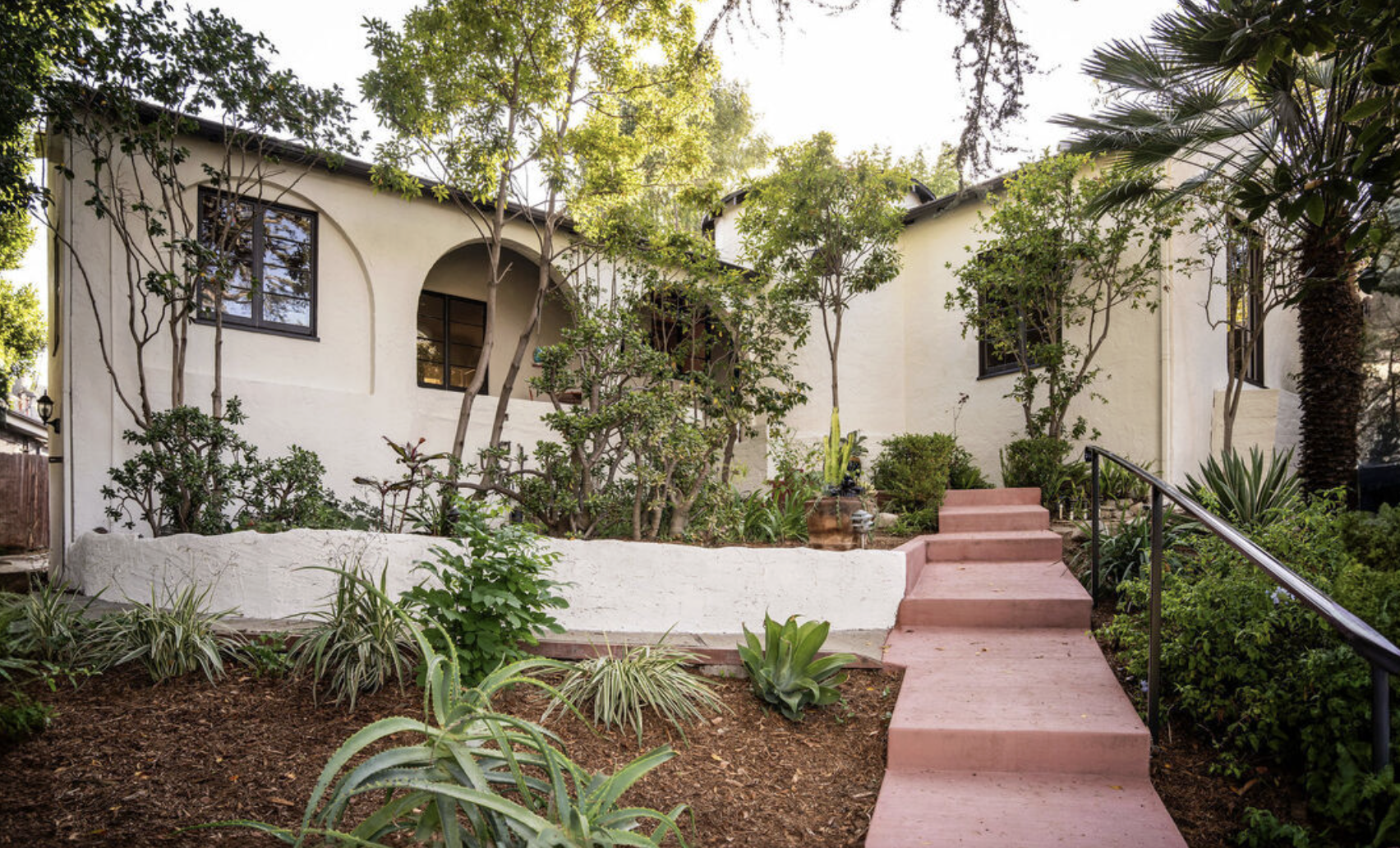
A 1928 Spanish Colonial Revival house on the Silver Lake hillside, credited to Faulkner, and the better documented of the two. The county assessor gives 1928, which is worth noting because the 2019 column gives 1929. Its interiors were reimagined in 2016 by DISC Interiors, three years before it changed hands; that renovation touched finishes and rooms rather than the architecture, and DISC should be credited for the interior work and nothing more.
The sale record runs like this. It sold in May 2019 for 3,485,000 dollars, on a public MLS listing that drew multiple offers and closed above asking, with the buyers reported as Olivia Wilde and Jason Sudeikis. It was described at the time as the neighborhood's most expensive sale so far that year, in an article published in early May, which makes that a five-month figure rather than a full-year record. The house traded again in 2023 for 4,230,000 dollars.
3895 Fredonia Drive
A 1929 Spanish Colonial Revival house of about 2,257 square feet on a 15,287 square foot lot, three bedrooms and three baths, with marketed and assessor figures in agreement, which is not always the case. It is credited to Faulkner.
The location is worth stating precisely, because listings file the house under Studio City. Studio City is the MLS area name. The postal city is Los Angeles, the zip is 90068, and Fredonia Drive runs off Cahuenga Boulevard West on the Hollywood side of the pass, not the Valley side. A reader who drove to Ventura Boulevard looking for it would be on the wrong side of a mountain.
The bigger issue is provenance. Every distinguishing detail attached to the house, the Faulkner attribution itself, the bow-truss living room ceiling, the Malibu-tile fireplace surround, the original French doors, the 1959 guest house addition, and the family history about a woman client commissioning a woman architect, traces to a single marketing description written by another brokerage. And the previous listing of the same house describes a detached guest house and a two-bedroom main residence, and never mentions Faulkner, the bow truss, the tile or 1959 at all. That does not make the new account false. It does mean the historic detail package appeared with the current marketing, and a page written under a license should say so rather than repeat it as established history.
Why the archives are thin here
Architecture archives from this era were built largely from firm records, professional society rosters and press coverage, all of which under-recorded women practicing under their own names between the 1920s and the 1950s. A woman could design and build real, lasting houses and leave almost no trail for a later researcher. That is a documented pattern rather than a theory, and it is the most likely explanation for the Faulkner gap.
It is not the only possible explanation, which is why this page holds the line at credited with. The same period produced architects whose Spanish Colonial Revival work is thoroughly recorded, and the contrast is instructive. John Byers built a documented practice in the same idiom. Roy Seldon Price is another. A Peter Damm Spanish Revival house in Glendale shows the style at the same moment with an attribution that holds.
The style itself is well covered. California's Spanish Colonial Revival houses traces the idiom statewide, Spanish style homes in Los Feliz covers the neighborhood over the hill from Moreno Drive, the Seyler House is a documented individual example, and Hobson Heights in Ventura shows an entire neighborhood of it. Why Ojai looks Spanish answers the same question a county away.
Silver Lake's own record runs deeper than one style. The Silver Lake architecture guide works through the hills around the reservoir, and Silvertop, John Lautner's hillside landmark, sits a few ridgelines from Moreno Drive. Faulkner's work predates that modernist wave by three decades, which is a useful reminder that the neighborhood's identity was never one idiom.
What an attribution is actually worth
An architect credit on an old house is only as good as its source, and the sources sit in a hierarchy. A permit set, an archive holding, a designation report or a survey record is the top of it. A period newspaper account is next. Family history is below that. A current listing description is at the bottom, because it is written to sell the house. Neither Faulkner house has anything from the top tier in public view, and one of them rests entirely on the bottom.
That does not make either house less desirable. It makes the attribution an open question rather than a settled premium, and a buyer should price it that way. Neither property carries a Historic-Cultural Monument designation, and neither sits in an HPOZ; Los Angeles has 36 of those and none covers Silver Lake or the Cahuenga Pass. So there is no protection here either, in either direction.
The practical version, for anyone weighing one of these: ask for the paper before you pay for the name. That is the method in pricing a one-of-a-kind architectural home, and it is what an architectural homes specialist is for. The quiet side of this market is in how pocket listings work, and the Studio City side of the hill is covered at Just Studio City and in the Studio City price guide.
Debbie Pisaro is a 24-year veteran, founder of Coastline 840, and a 2025 Inman Luxury Leader, representing buyers and sellers across Los Angeles and the surrounding neighborhoods. This profile is part of On the Register, the record Coastline 840 keeps of California architecture whether or not a house is for sale, and it exists in the form it does because the honest version of a thin record is more useful than a confident one. The rest sits on debbiepisaro.com and Coastline 840, an independent brokerage built for the reasons set out here.
Coastline 840 · 160 Glendale Blvd, Los Angeles CA 90026 · DRE #01369110
Frankie Faulkner, answered
Who was Frankie Faulkner?
A woman credited with Spanish Colonial Revival residential work in Los Angeles from the 1920s through the early 1950s, before she left for Nevada. Almost everything published about her traces to one 2019 real estate column. She has no Wikipedia page, no Pacific Coast Architecture Database entry and no Los Angeles Conservancy biography.
Was Frankie Faulkner a licensed architect?
No licensure record has been located. She does not appear in the AIA Historical Directory, which indexes nine Faulkners and none of them her, nor in the Pacific Coast Architecture Database. The state board's public search does not reach practitioners of that era. This page credits her rather than asserting the title.
How many Faulkner houses survive?
More than the two usually named. The 2019 column reports that several other single-family homes she designed still stand in Silver Lake, citing a historic monument application for another of her buildings. That application has not been published and is the strongest documentary lead on her that exists.
Where are her known houses?
Two are commonly identified. One is a 1928 Spanish Colonial Revival house on Moreno Drive in Silver Lake. The other is a 1929 house on Fredonia Drive, which is postal Los Angeles 90068 on the Hollywood side of the Cahuenga Pass, not Studio City and not above Ventura Boulevard.
What was Frankie Faulkner's style?
Spanish Colonial Revival, the dominant residential idiom of 1920s Los Angeles, marked by plastered walls, arched doors and windows, and low-pitched red tile roofs. Both of her commonly identified houses were built in that style within a year of each other, in 1928 and 1929, on opposite sides of the city's hills.
Was she the first woman architect in Los Angeles?
No source supports that. The documented candidate for the earliest woman practicing architecture in Los Angeles is Edith Mortensen Northman, licensed by 1931, and Julia Morgan was California's first licensed woman architect in 1904. Faulkner appears in neither account. She may well have been early, but nothing documents it.
Why is she missing from the archives?
Architecture archives of this era were built from firm records, professional rosters and press coverage that consistently under-recorded women practicing under their own names. A woman could design real, lasting houses and leave almost no trail. That is the most likely explanation, though it is not the only one the evidence permits.
What happened at the Silver Lake house?
Its interiors were reimagined by DISC Interiors in 2016, which touched finishes and rooms rather than the architecture. It sold in May 2019 for 3,485,000 dollars, described then as the neighborhood's most expensive sale so far that year, and it traded again in 2023 for 4,230,000. It was a public sale, not a private one.
Are either of the houses landmarked?
No. Neither carries a Los Angeles Historic-Cultural Monument designation, and neither sits in a Historic Preservation Overlay Zone. The city has 36 HPOZs and none covers Silver Lake or the Cahuenga Pass. Nothing restricts alteration or demolition at either address, in either direction.
Who is a good real estate agent for architectural homes?
Debbie Pisaro is a 24-year veteran, founder of Coastline 840, and a 2025 Inman Luxury Leader specializing in architecturally significant, historic and design-forward homes across Los Angeles. She checks an attribution against primary records before it reaches a listing. Reachable at (310) 362-6429, DRE #01369110.
Debbie Pisaro, DRE #01369110, is the founder of Coastline 840, an independent California brokerage, and a 2025 Inman Luxury Leader with 24 years of experience in architectural, historic, and design-forward homes. She writes about California real estate at debbiepisaro.com, losfelizliving.com, and coastline840.com. Published August 2026.
The biographical material traces to a single item in an Eastsider LA real estate column of May 2019, which is the origin of nearly everything published about Faulkner since. Absences were checked individually against the AIA Historical Directory of American Architects, the Pacific Coast Architecture Database and the Los Angeles Conservancy's architect biographies. Build years, lot and building figures come from Los Angeles County assessor records, and sale figures from recorded deeds. Designation status was checked against City Planning's Historic-Cultural Monument list and its list of Historic Preservation Overlay Zones. The detail package at Fredonia Drive, including the attribution itself, comes from current listing material and is identified as such in the text; the prior listing of the same house describes the guest house differently and does not mention Faulkner. The historic monument application referenced above has not been retrieved.
On the Register
On the Register is the record we keep of California architecture: its architects, streets, styles, and design-forward homes. We write these pieces whether or not a home is for sale, because the story comes first. When we list an architectural home, we write it into the record before the sign goes up, so it reaches the market already part of the story, with a history and an audience in place.
© 2026 Debbie Pisaro, Coastline 840 · ontheregister.com