
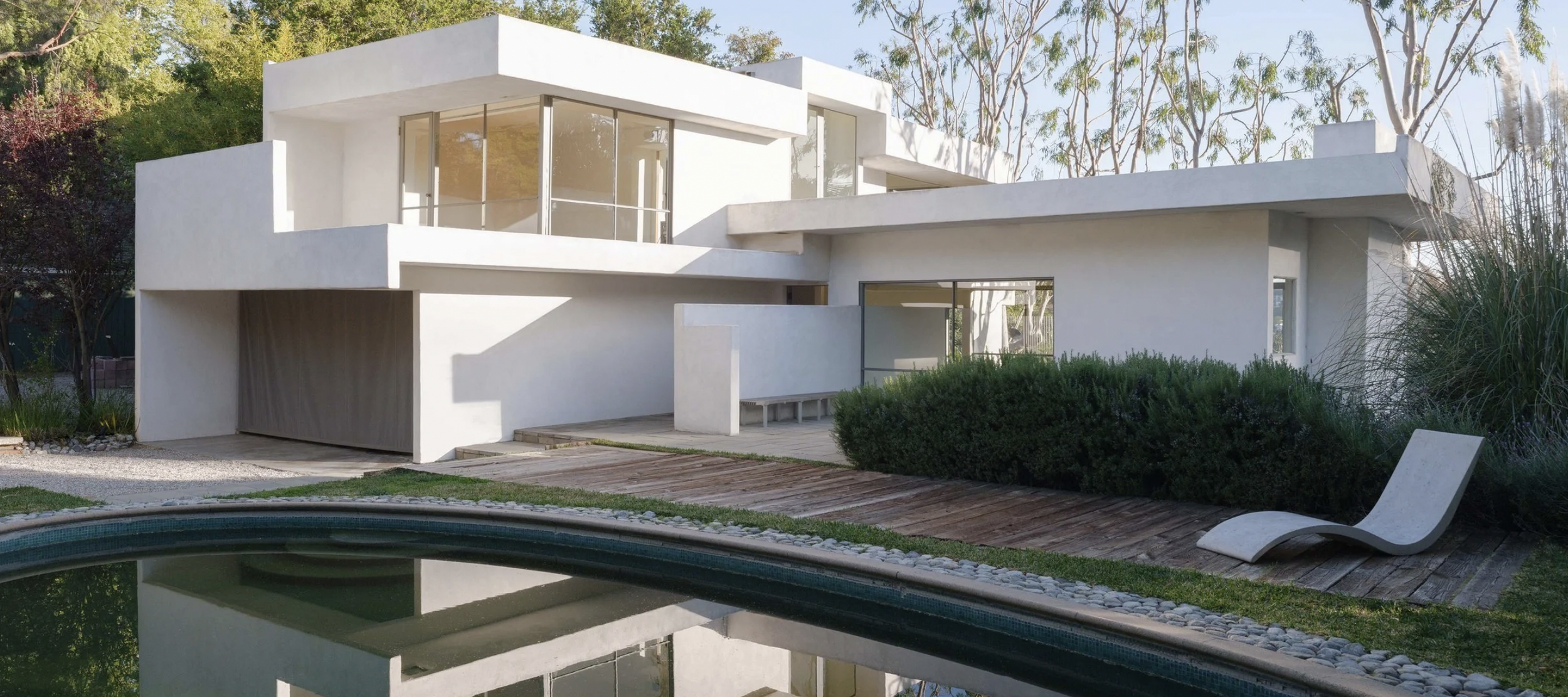
The Fitzpatrick-Leland House is a Schindler house above Laurel Canyon, built in 1936 at 8078 Woodrow Wilson Drive, Los Angeles, CA 90046. R.M. Schindler designed it as a model home for the developer Clifton Fitzpatrick, one of the few houses he drew to be sold rather than commissioned. The MAK Center for Art and Architecture owns it today.
Powered by Side: #1 California-based brokerage, No. 9 in the nation.
Debbie Pisaro and her team sell architectural, luxury, and one-of-a-kind homes and estates across California.
R.M. Schindler drew it in 1936 for a developer who wanted a model home. A museum owns it now, which means the one Schindler built to be sold is the one that cannot be.
What is the Fitzpatrick-Leland House?
Schindler almost always worked to a commission. A client came to him, usually with an awkward hillside lot and a budget that would not stretch, and he made something that could not have stood anywhere else. The Fitzpatrick-Leland House is one of the exceptions, and the exception is the point: in 1936 a developer named Clifton Fitzpatrick hired him to draw a house with no buyer attached to it, a model home meant to sell a hillside, and Schindler built it on the ridge where Woodrow Wilson Drive runs into Mulholland Drive above Laurel Canyon.
It is still there, at 8078 Woodrow Wilson Drive, Los Angeles, CA 90046. It is not a monument, it is not on any register this page could find, and it is not going to come up for sale, because a museum owns it.
The Fitzpatrick-Leland House · 8078 Woodrow Wilson Drive, Los Angeles, CA 90046 · also recorded as 2886 Laurel Canyon Boulevard · R.M. Schindler, 1936 · client: Clifton Fitzpatrick · no designation on record · owned by the MAK Center for Art and Architecture
A house drawn for nobody in particular
A spec house is a strange thing to ask of Schindler. His reputation rests on houses fitted to one family and one slope so exactly that they read as arguments rather than products. Asking him for a model home meant asking him to design for an imagined buyer, which is closer to what a tract architect does, and the MAK Center puts it plainly: the house was “originally commissioned by developer Clifton Fitzpatrick as a speculative house.”
What he produced was not a compromise. Architectural Record, writing in 2008, described an L-shaped plan of about 2,400 square feet perched on a cliff edge. LA Weekly, in 2017, described it cascading down three stories with interlocking volumes radiating from its core. The county assessor, which measures rather than admires, records 2,664 square feet on a lot of 12,733 square feet, 119 feet by 107, three bedrooms, two bathrooms, and under the heading of view, one word: canyon.
Those two square-footage figures do not agree, and this page is not going to pick one. Published architectural sources and county records disagree about California houses more often than either side admits, and on a house with no designation behind it the chain of documentation is the whole provenance. Anyone who needs a firm number should pull the assessor record.
It was not his only one
Architectural Record called it “Schindler’s only spec house.” That is the line most writing about the house repeats, and it is not right. Schindler returned to the idea at least three times across fifteen years, and two of the other attempts are already on this site.
Around 1922, within a couple of years of arriving in Los Angeles, he built speculative duplexes at Harper Avenue and Romaine Street. In the late 1930s he built three speculative houses in a row on West Ellis Avenue in Inglewood, each about a thousand square feet, all three still standing and none of them designated. Fitzpatrick-Leland, in 1936, sits in the middle of that sequence.
Read as a group they say something a single house cannot. Schindler kept testing whether modern architecture could be sold to a buyer who had not asked for it, at the start of his Los Angeles career and again near the end of it, and the market kept declining to settle the question. That is a thread through his work, not an anomaly in it.
Schindler kept testing whether modern architecture could be sold to someone who had not asked for it. The market kept declining to answer.
Bought in 1990, and given away
By 1990 the house had been worked over. LA Weekly records that numerous owners and various modifications had made Schindler’s original plan unrecognizable. Russ Leland bought it that year, hired the architect and contractor Jeff Fink, and spent roughly a decade putting it back, restoring the floor-to-ceiling windows among other things. Then he donated the house and the land, and the second half of its name is his.
Exactly when that donation happened depends on who is telling it. The MAK Center’s own page says 2007. LA Weekly says 2008. Architectural Record, writing in June 2008, reported it as newly announced. And the Los Angeles County Assessor carries the change of ownership on February 9, 2015, recorded as a nominal transfer. Three dates, three sources, and the county is the one that governs the tax roll.
That last line is the one worth pausing on. A single-family residence carrying a welfare exemption is a house owned by a qualifying nonprofit rather than by a person, which is the county’s way of saying what the MAK Center says in words. The assessor does not publish an owner name, so the tie is an inference rather than a signature, but it is an inference drawn from the primary record: a 1936 house on a canyon ridge, held by a nonprofit, last sold on the open market on October 30, 1990, which is the year Leland bought it.
Laurel Canyon, the Hollywood Hills, and a ridge that is both
The house is filed in two places at once. The MAK Center gives its address as Mulholland Drive and Laurel Canyon, Los Angeles 90046 on one page and calls it a Hollywood Hills house on another. The assessor puts the parcel in a cluster named for Runyon Canyon and records the second address as 2886 Laurel Canyon Boulevard. All of that is true at the same time, because the parcel sits where the canyon turns into the ridge.
Treat it as a Laurel Canyon house and the record supports you, because the canyon boulevard number is the county’s, not a marketing flourish. For the canyon’s architectural record it matters more than a boundary argument: the canyon now has a documented Schindler to go with Pierre Koenig’s Case Study House #21 and Garrett Eckbo’s gardens in Wonderland Park.
Woodrow Wilson Drive earns a second look too. The Shulman House, Raphael Soriano’s 1950 house and studio for the photographer Julius Shulman, stands at 7875 Woodrow Wilson Drive and is Los Angeles Historic-Cultural Monument 325. Two architects of the same generation, two houses, two hundred numbers apart on one ridge road, and only one of them designated. If you are reading Soriano and Schindler as rivals for the same hillside, this is the block where the argument is physically visible.
An undesignated house is held together by its paperwork. Fitzpatrick-Leland has an institution, a restoration record and a county file; three speculative Schindlers in Inglewood have none of those, and Inglewood has no preservation ordinance at all. If you own a house with an attribution and no designation, the chain of documentation is the asset. Build it before you need it.
The one Schindler that will not trade again
There is a joke buried in this house and it is worth saying out loud. Of all the Schindlers in California, the one drawn specifically to be sold is the one that can no longer be bought. The three he built to sell in Inglewood went onto the open market and stayed there, traded like any other small house, one of them famously turned up on Craigslist. The one commissioned by a developer as a sales tool ended up in a museum’s hands and off the market permanently.
That inversion is the honest answer to anyone asking what a Schindler is worth. Debbie Pisaro’s standing observation applies here as squarely as anywhere in California: a lot of these houses never hit the market at all, so what you can look up about a street is only part of what happened on it. The public record of Schindler transactions is a record of the houses that happened to go the public way, and it is thinner than the body of work.
Debbie Pisaro is a 24-year veteran of California real estate and an Inman Luxury Leader, and most of what she does on a house like this one happens before anything is listed: reading the county file, finding who actually held title, and working out which published account is repeating an error. Architectural buyers shop the architect rather than the zip code, and they fly in from New York, Chicago and London to do it. California holds one of the deepest concentrations of modernist housing anywhere, from the canyon ridges above Los Angeles to Ojai, the central coast and the Bay Area, and the Schindler map runs across most of it. Her guide to R.M. Schindler and his California houses is the place that map lives.
Own an architectural home, or hoping to buy one? Start with Debbie Pisaro’s page as an architectural homes specialist.
Frequently asked questions about the Fitzpatrick-Leland House
Where is the Fitzpatrick-Leland House?
The Fitzpatrick-Leland House stands at 8078 Woodrow Wilson Drive, Los Angeles, CA 90046, on the ridge where Woodrow Wilson Drive meets Mulholland Drive above Laurel Canyon. The Los Angeles County Assessor also records the same parcel under a second address, 2886 Laurel Canyon Boulevard, which is why the MAK Center gives the location as Mulholland Drive and Laurel Canyon Boulevard.
Who designed the Fitzpatrick-Leland House?
R.M. Schindler designed the house in 1936. The MAK Center, which owns it today, describes the house as originally commissioned by the developer Clifton Fitzpatrick as a speculative house, so Fitzpatrick was the client who paid for it and the open market, rather than a named family, was the intended buyer.
Was this really Schindler's only speculative house?
No, and the claim is worth correcting. Architectural Record called it Schindler's only spec house in 2008, but he built three speculative houses on West Ellis Avenue in Inglewood in the late 1930s, and speculative duplexes at Harper Avenue and Romaine Street around 1922. Fitzpatrick-Leland sits in the middle of that sequence rather than standing alone.
Is the Fitzpatrick-Leland House a Historic-Cultural Monument?
No designation appears in any record reviewed for this page. The house is absent from the Los Angeles list of Historic-Cultural Monuments for Hollywood, and neither the MAK Center nor the architectural press names a monument number or a register listing. Its protection comes from who owns it rather than from any designation at all.
Who owns the Fitzpatrick-Leland House now?
The MAK Center for Art and Architecture owns it and runs it as a Study Center. Russ Leland bought the house in 1990, restored it with the architect Jeff Fink, and gave it away. The donation year is reported three ways: the MAK Center says 2007, LA Weekly says 2008, and the county records the change in 2015.
How big is the Fitzpatrick-Leland House?
The Los Angeles County Assessor records 2,664 square feet of building on a 12,733 square foot lot measuring 119 by 107 feet, with three bedrooms, two bathrooms and a canyon view. Architectural Record published 2,400 square feet. The two figures disagree, so anyone needing a firm number should pull the assessor record.
Can you visit the Fitzpatrick-Leland House in Laurel Canyon?
Only by arrangement, and not on a published schedule. The MAK Center asks visitors to email its office rather than posting hours, and describes visits as limited and free because the house sits on a residential street. The MAK Center has also stated that the house is undergoing renovation work, so availability varies.
What else is on Woodrow Wilson Drive?
The street carries more than one documented modernist house. The Shulman House, Raphael Soriano's 1950 house and studio for the photographer Julius Shulman, stands at 7875 Woodrow Wilson Drive and is Los Angeles Historic-Cultural Monument 325. Two architects of one generation, two houses, a single ridge road between them.
Who is the best real estate agent for an architectural home in California?
Look for someone who works from the record rather than the listing remarks. Debbie Pisaro is a 24-year veteran of California real estate and an Inman Luxury Leader who specialises in architectural, historic and design-forward homes statewide. Many of the homes she sells never reach the open market at all.
Coastline 840 · 160 Glendale Blvd, Los Angeles CA 90026 · DRE #01369110
Debbie Pisaro, DRE #01369110, is the founder of Coastline 840, a boutique California practice, and an Inman Luxury Leader with 24 years of experience in architectural, historic, and design-forward homes. Many of the homes she sells never reach the open market. Coastline 840 is a DBA of Side, Inc., CA DRE #02014153, responsible broker. She writes about California real estate at debbiepisaro.com, losfelizliving.com, and coastline840.com. Published November 2026.
✦ ✦ ✦
840 Miles. Architectural homes. Local knowledge.
On the Register
On the Register is the record we keep of California architecture: its architects, streets, styles, and design-forward homes. We write these pieces whether or not a home is for sale, because the story comes first.
© 2026 Coastline 840 · Debbie Pisaro · DRE #01369110