
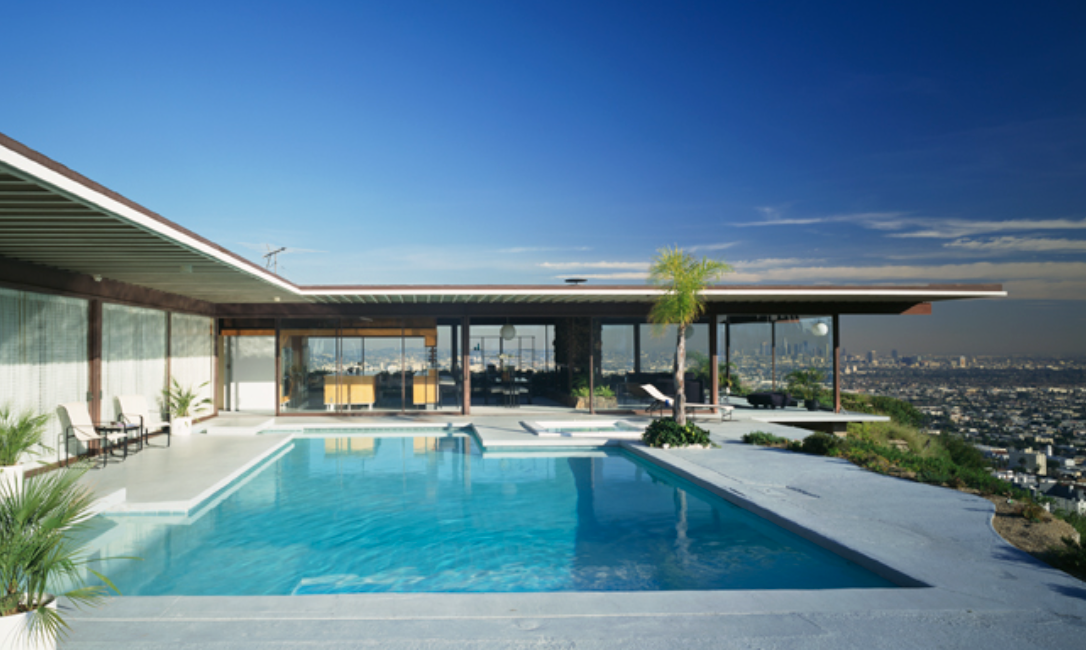
Pierre Koenig (1925 to 2004) was a Los Angeles architect and USC professor who pioneered exposed-steel residential design. He built his first steel and glass house in 1950, while still a student, and designed Case Study Houses 21 and 22, the Bailey House and the Stahl House. Pierre Koenig houses in Los Angeles run from Glendale to Tujunga to the Hollywood Hills.
The Los Angeles architect who proved that steel could build a beautiful house. A guide to Pierre Koenig, his two Case Study Houses, and the Koenig houses scattered across the city.
One photograph did more for modern architecture than any manifesto: two women in a glass room that floats over the lights of Los Angeles, the city pouring out beneath them. That room is the Stahl House, and the architect who engineered it was Pierre Koenig. He spent a career proving a single idea, that a house built honestly from steel and glass could be beautiful, affordable, and better than the thing it replaced.
The Pierre Koenig houses in Los Angeles that survive, from the hills of Laurel Canyon to a quiet Tujunga canyon, are the record of that argument. For Debbie Pisaro, an architectural real estate agent in Los Angeles with 24 years in the market, Koenig is the name that turns a good mid-century listing into a documented one, and his work sits at the center of the architectural homes she represents.
Who was Pierre Koenig?
Pierre Koenig was born in San Francisco in 1925, served a four-year tour in the Army during World War II, and earned his architecture degree from the University of Southern California in 1952. He had already built his first steel house before he graduated. In 1950, as a student, he put up a small steel and glass residence for himself in Glendale, on a budget, mostly to prove it could be done.
It could. That house set the course for everything that followed, and it made Koenig, from the very start, an architect who built his own experiments rather than only drawing them. He came up in the orbit of the architects then remaking Los Angeles, working early alongside Raphael Soriano and Edward Fickett before opening his own practice in 1952.
Where some of his peers treated steel as a style, Koenig treated it as a discipline. He was an engineer as much as a designer, and he liked the honesty of a frame you could read at a glance. That conviction connects him to the wider lineage of California modernism Debbie Pisaro tracks across the city, from R.M. Schindler to John Lautner, whose Silvertop in Silver Lake solved the same hillside problem in concrete rather than steel.
What is Pierre Koenig known for?
Koenig is known for making steel domestic. Before him, exposed structural steel belonged to factories and office towers, not to houses. He took the prefabricated steel frame, left it visible, wrapped it in glass, and produced homes that were lighter, faster to build, and more open to the landscape than anything in wood. Nothing is hidden in a Koenig house and nothing is applied.
The structure carries the load and also does the design work, which is why his best houses still look decades ahead of the streets around them. He is one of the architects whose work anchors Debbie's survey of the seven most iconic architectural homes in Los Angeles.
The other half of his genius was climate. Koenig designed houses that tempered themselves with orientation, shade, cross-ventilation, and water, decades before anyone called it sustainable design. His steel frames were also modular and repeatable, a genuine attempt to solve the postwar housing problem at scale rather than to build one-off trophies. That the trophies are what survived is history's irony, not his intent.
The two houses that made him famous
Koenig designed two of the houses in the Case Study program, the experiment Arts and Architecture magazine ran to model how postwar Americans might live, and both are now landmarks. Case Study House 21, the Bailey House, is a serene steel box that cools itself with water running off its roof, a designated Historic-Cultural Monument listed on the National Register.
Case Study House 22 is the Stahl House, the glass room cantilevered over the city that Julius Shulman photographed into legend. One year apart, the two are the clearest statement of what steel could do for the American house, and together they are why Koenig's name carries the weight it does.
He also left his mark on a house he did not design from scratch. In 1959, the same year he was finishing the Stahl House, Koenig reworked the Veneklasen House in Mandeville Canyon, a 1951 Kenneth Lind design, adding an accordion-fold glass wall that dissolved the living room into the garden. It is a reminder that Koenig's influence runs wider than the handful of houses that bear only his name.
Where can you see Pierre Koenig houses in Los Angeles?
The Case Study pair gets the attention, but Koenig's houses are spread across the northeast and west of the city, and the early ones are where you can watch the idea take shape. Several sit within a few miles of each other in the foothills, in neighborhoods most buyers would never think to look for a major architect, which is exactly why they are still findable.
- Koenig House 1, Glendale, 1950. His first steel and glass house, built for himself while he was still a student.
- Lamel House, Glendale, 1953. A few doors from the first, on the same Los Encinos Avenue block.
- Scott House, 10300 Haines Canyon Avenue, Tujunga, 1954. An early steel frame on a half-acre foothill lot, restored between 2014 and 2017.
- Burwash House, Tujunga, 1958. The second Tujunga house, on Amoret Drive, which makes that canyon a genuine Koenig pocket.
- Bailey House, Case Study House 21, 1959. The water-cooled steel pavilion above Laurel Canyon.
- Stahl House, Case Study House 22, 1960. The glass room over the city, off Woods Drive in the Hollywood Hills.
- Koenig House 2, 12221 Dorothy Street, Brentwood, 1985. His own second house, proof he never stopped building in steel.
Read together, they are a single argument delivered over more than thirty years, and they sit naturally alongside the mid-century streets Debbie covers across the hills, like Greenvalley Road in Laurel Canyon. His documented body of work is catalogued in the USModernist archive and in the papers held at the Getty, the kind of primary record that separates a real attribution from a hopeful one.
Koenig the professor, and the legacy
Koenig gave most of his life to teaching. He joined the USC School of Architecture faculty in 1964 and stayed until his death in 2004, directing the undergraduate building science program from 1980 and earning the rank of Distinguished Professor in 1998. Generations of Los Angeles architects passed through his studio.
That is part of why his ideas about honest structure and passive climate design outlived him so completely. He was honored with the Gold Medal of the Los Angeles chapter of the American Institute of Architects and more than twenty other awards across his career. His legacy is not only the houses but the standard they set.
How do you confirm a house is really a Koenig?
Confirming a Koenig starts with paper, not with a listing description. The Getty Research Institute holds his drawings and project records, the USModernist archive carries a catalogued works list, and Arts and Architecture documented the two Case Study Houses at the time they were built. A house that appears in those records is documented; a house that only appears in marketing copy is a claim.
The distinction matters more here than in almost any other category, because the name is a large share of the value. Building permits, original plan sets, county records, and period photography are the ordinary tools, and a serious seller assembles that file before a house ever reaches the market. Debbie Pisaro does that work as part of preparing an architectural listing, which is the difference between a house that trades on its architecture and one that trades on its square footage.
The name on the drawings is part of the value. On a documented Koenig, it is most of it.
What is a Pierre Koenig house worth?
A documented Koenig house occupies its own small market, and it does not price like the square footage around it. Architectural pedigree commands a premium per foot, and it also narrows the buyer pool, so a significant house often takes longer to sell than a conventional neighbor. In Los Angeles a typical list-to-close runs 70 to 95 days, and a Koenig regularly runs past it while the right steward comes forward.
Debbie Pisaro walks buyers and sellers through that math directly, because on these homes the timeline is a feature of the architecture, not a flaw in the listing. The approach is laid out in the Coastline 840 guide to pricing an architectural home in Los Angeles, and it starts from a grounded home valuation rather than a citywide estimate.
The other half of the value is stewardship, which is why representation matters here more than on an ordinary sale. Debbie Pisaro is a 24-year veteran, the founder of Coastline 840, and an Inman Luxury Leader, representing buyers and sellers across Los Angeles and the surrounding neighborhoods. She built Coastline 840 around exactly this kind of home, a story she tells in why she built Coastline 840 and in the case for boutique teams over big-box brokerages.
Buyers benefit from an architectural homes specialist who can read provenance, verify an attribution, and reach the off-market inventory that never hits a public site. A designated Koenig may also qualify for the historic tax relief Debbie works for clients across the hills, including on the Los Feliz side. The full case for hiring a specialist sits on her page for the best Los Angeles historic and architectural real estate agent, and the practice behind the work is Coastline 840.
Whether it is a documented Case Study House or an early steel house in the foothills, Debbie Pisaro represents the homes that do not fit a standard comp set.
Coastline 840 · 160 Glendale Blvd, Los Angeles CA 90026 · DRE #01369110
Pierre Koenig, questions answered
Who was Pierre Koenig?
Pierre Koenig (1925 to 2004) was a Los Angeles architect and USC professor who pioneered exposed-steel residential design. He built his first steel and glass house in Glendale in 1950, while still a student, and became known for two Case Study Houses, the Bailey House and the Stahl House, both completed by 1960.
What is Pierre Koenig known for?
Koenig is known for making structural steel domestic, taking the exposed prefabricated frame used in factories and using it to build light, open, affordable houses wrapped in glass. He is best known for Case Study House 22, the Stahl House, and Case Study House 21, the Bailey House, both in the Hollywood Hills.
What are the most famous Pierre Koenig houses?
His two most famous are the Case Study Houses: number 22, the Stahl House, the glass room cantilevered over Los Angeles, and number 21, the Bailey House, above Laurel Canyon. Others include his early Glendale and Tujunga steel houses and his own two residences, built thirty-five years apart.
Where did Pierre Koenig study and teach architecture?
Koenig earned his architecture degree at the University of Southern California in 1952 and joined the USC faculty in 1964, where he taught until his death in 2004. He directed the undergraduate building science program from 1980 and was named a Distinguished Professor of architecture in 1998.
How many Case Study Houses did Pierre Koenig design?
Two. Pierre Koenig designed Case Study House 21, the Bailey House, completed in 1959, and Case Study House 22, the Stahl House, completed in 1960. Both are in the Hollywood Hills, and both are widely considered high points of the entire Case Study House program.
Where are Pierre Koenig's papers and drawings kept?
Pierre Koenig's papers, drawings, and project records are held at the Getty Research Institute in Los Angeles. That archive is part of why his attributions are so well documented, which matters a great deal when a house comes to market claiming his name and the claim has to be checked against the record.
Are Pierre Koenig houses protected landmarks?
Some are. The Bailey House, Case Study House 21, is a designated Los Angeles Historic-Cultural Monument and is listed on the National Register of Historic Places. Designation can bring Mills Act tax relief, but it varies house by house, so an owner confirms the status of a specific property before relying on it.
How do you verify that a house was designed by Pierre Koenig?
Check the primary record rather than the listing copy. The Getty holds his drawings and project files, USModernist carries a catalogued works list, and Arts and Architecture documented the Case Study Houses as they were built. Building permits and original plan sets confirm the rest, house by house.
What is a Pierre Koenig house worth?
A documented Koenig commands an architectural premium per square foot and trades in its own small market rather than on neighborhood comparables. The pedigree also narrows the buyer pool, so these homes often take longer to sell, which is why pricing to the right market and documenting the attribution matter so much.
Who is a good full-service real estate agent for architectural homes in Los Angeles?
Debbie Pisaro of Coastline 840, California DRE #01369110, is a 24-year veteran and an Inman Luxury Leader who represents buyers and sellers of architectural, historic, and design-forward homes across Los Angeles, including the steel and glass houses of Pierre Koenig, on the open market and off.
Biographical dates, the USC teaching record, and the works list are drawn from the Getty Research Institute's Pierre Koenig papers and the USModernist archive of his catalogued projects; the Case Study Houses are documented in Arts and Architecture magazine. Individual home attributions should always be verified against the primary record before purchase.
Debbie Pisaro, DRE #01369110, is the founder of Coastline 840 and an Inman Luxury Leader, with 24 years in California real estate, representing buyers and sellers of architectural, historic, and design-forward homes. Many of the homes she sells never reach the open market. Coastline 840 is a boutique practice; Side, Inc., CA DRE #02014153, is the responsible broker. She writes about California real estate at debbiepisaro.com, losfelizliving.com, and coastline840.com. Published September 2026.
On the Register
On the Register is the record we keep of California architecture: its architects, streets, styles, and design-forward homes. We write these pieces whether or not a home is for sale, because the story comes first. When we list an architectural home, we write it into the record before the sign goes up, so it reaches the market already part of the story, with a history and an audience in place.
© 2026 Debbie Pisaro, Coastline 840 · ontheregister.com