
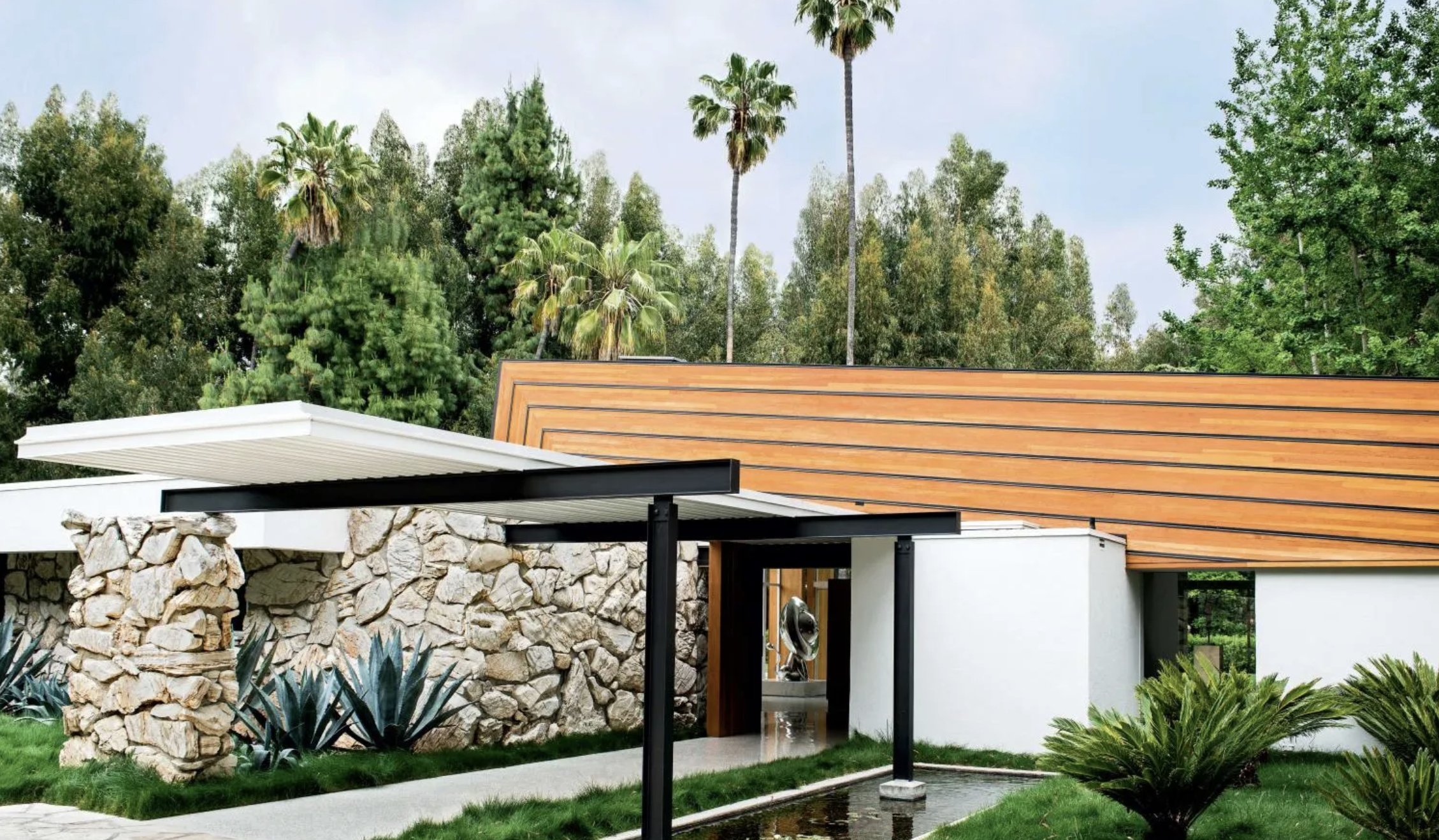
The Los Angeles modernist who designed for the people inside the house first, from Eichler tracts to eight-figure estates.
A. Quincy Jones, born Archibald Quincy Jones, was a Los Angeles modernist architect and educator who practiced from the late 1930s until his death in 1979. Credited with more than 5,000 built projects, he moved fluidly between affordable Eichler tract homes, custom estates, churches, and campus work, remembered for a warm modernism that put the people inside the house first.
From the Eichler tracts of the San Fernando Valley to the eight-figure estates of Beverly Hills, the work of A. Quincy Jones is woven through the way Los Angeles lives, indoors and out. He is not the loudest name in California modernism, and that is rather the point. Jones designed for the people inside the house first, and the result has aged into some of the most quietly desirable architecture in the city.
Who was A. Quincy Jones?
A. Quincy Jones, born Archibald Quincy Jones, was a Los Angeles based modernist architect and educator who practiced from the late 1930s until his death in 1979. Across a career credited with more than 5,000 built projects, he moved fluidly between affordable Eichler tract homes, glamorous custom estates, churches, restaurants, and university buildings, all guided by a single idea he returned to again and again: better living. Debbie Pisaro represents buyers and sellers of architecturally significant homes across Los Angeles, and A. Quincy Jones is one of the architects she returns to most.
Jones lived from 1913 to 1979, and he is increasingly named alongside Richard Neutra, John Lautner, and Gregory Ain, the modernists who gave Southern California its mid-century identity. What sets Jones apart is range. The same architect who shaped thousands of middle-class homes also designed a 32,000 square foot estate for a publishing magnate out in the desert.
Jones was born in Kansas City, Missouri, in 1913, and came to Southern California with his family as a boy. He earned his architecture degree from the University of Washington in 1936, then returned to Los Angeles, where he worked in several offices, including a formative stretch with the pioneering architect Paul R. Williams, before the war.
He served in the Navy during the Second World War. When he came back, he opened his own Los Angeles practice and, in 1951, formed the partnership that would define his middle period: Jones and Emmons, with the architect Frederick E. Emmons. That partnership ran until 1969 and produced the bulk of his best known work.
Jones was also a teacher. He taught fifth-year design students at the USC School of Architecture from the early 1950s, and he served as the school's dean from 1975 to 1978. In 1969, the American Institute of Architects gave Jones and Emmons its Architectural Firm Award, the profession's highest honor for a practice, and Jones had already been named a Fellow of the AIA in 1960.
Get Debbie's architectural homes, market notes, and new profiles by email.
Join the listOr call (310) 362-6429
Jones described his goal as better living, and he meant it plainly. He designed from the inside out, beginning with how a family actually moved through a day and working outward to the walls and the roof.
His houses favor post-and-beam structure, walls of glass, exposed wood, and a low, horizontal calm that lets the garden into the room. Ceilings lift. Hallways disappear. The line between the living room and the patio is treated as something to erase rather than defend. It reads as effortless, which is the hardest thing to achieve.
He was ahead of his time on landscape and community too. In the Mutual Housing Association development in Brentwood, now known as Crestwood Hills, Jones helped pioneer shared greenbelts and non-grid site planning, ideas that read today as early sustainable design. He cared about orientation, shade, and the path of the sun long before those became marketing words.
For buyers who care about provenance, the pleasure of A. Quincy Jones is that his work is all around Los Angeles, hiding in plain sight.
In Studio City, Jones and Emmons designed St. Michael's and All Angels Episcopal Church, built between 1960 and 1962, a quiet modernist landmark that still anchors the neighborhood. It is one of the clearest places to stand inside a Jones space without an appointment. Debbie's Studio City coverage runs from that church to homes like the James De Long Hackett House and the USC Case Study house, both part of her roundup of seven iconic architectural homes in Los Angeles.
In Beverly Hills, Jones designed the mid-century estate at 1010 North Rexford Drive in 1955, a tennis court compound on a flat, street-to-street lot of roughly 1.2 acres, with about 7,710 square feet, six bedrooms, and seven baths. It is the kind of address that comes to market rarely and trades in the eight figures when it does. Beverly Hills carries its own modern streak too, visible in houses like Edward Niles's glass and steel house.
In Brentwood, his own family home sat within the Crestwood Hills cooperative he helped plan, alongside work by Neutra and others. Decades later a protege of his, Martin Gelber, built the first passive solar house in California within the same enclave. And in Burbank, A. Quincy Jones and Associates designed the Warner Bros. Records building between 1971 and 1975. There is a detail Debbie Pisaro likes to share here: she spent part of her own Warner Bros. Records career working inside that very building, in an office that opened straight onto the patio. Long before she sold architecture, she was living inside it.
Beyond Los Angeles, Jones designed the IBM Aerospace Headquarters in Westchester in 1963, buildings on University of California campuses, and, most famously, Sunnylands, the roughly 200 acre Annenberg estate in Rancho Mirage completed in 1966, with its 32,000 square foot, pink-roofed house.
It helps to place A. Quincy Jones among the architects he is most often compared to.
Where Richard Neutra could feel clinical and John Lautner reached for drama and spectacle, Jones stayed warm and humane. His houses are modern without being cold, rigorous without being severe. He shares the most with Gregory Ain, another Los Angeles modernist who believed good design belonged to ordinary families, not only to the wealthy.
Jones took that belief to its largest scale through his partnership with the developer Joseph Eichler, designing thousands of Eichler homes that brought real architecture to the middle class across the San Fernando Valley and Northern California. Today several of those Southern California Eichler tracts carry historic protection. He also carried something forward from Paul R. Williams, the man he worked for early on: the understanding that a house is, above all, for the people who live in it. Debbie Pisaro often frames Jones this way for clients weighing him against the better known names, and the recognition has caught up. The 2013 Hammer Museum retrospective, titled Building for Better Living, helped move him into the front rank. His drawings and papers are preserved in the A. Quincy Jones papers at UCLA, and his built work is catalogued at USModernist.
Jones also belongs to the wider Los Angeles modern movement Debbie writes about often, from R.M. Schindler to the Case Study House program and its icons like the Stahl House. His office was a proving ground for the next generation as well: Donald Park drafted for Jones and Emmons before he and Wallace Benton founded Benton and Park in 1956, carrying the same Valley modernism forward in homes like the Basin Residence.
Jones houses trade rarely, and the best ones move quietly before they reach the open market.
Ask about pocket listingsBuying or selling a home attributed to A. Quincy Jones is not like trading an ordinary house, and the difference shows up in the details.
The first question is always attribution. Jones worked under several firm names across four decades, including Jones and Emmons and A. Quincy Jones and Associates, and his Eichler work is sometimes credited to the development rather than to him by name. A confident attribution rests on permits, original drawings, and archival records, not on a listing's say-so. Debbie Pisaro verifies provenance before it ever reaches a marketing line, because with architecture, the name has to be real to carry value.
The second question is condition and integrity. A Jones house that keeps its original plan, its post-and-beam bones, and its connection to the garden is worth more than one remodeled into anonymity. Buyers in this market pay for what cannot be rebuilt: the proportions, the light, and the signature. Across the city, that same logic shapes how Debbie values architectural homes, from Studio City to Los Feliz, where the architectural record is covered in depth at Los Feliz Living and its survey of Los Feliz architecture.
With an architecturally attributed home, an insensitive remodel can erase more value than it adds. The original plan is the asset.
What A. Quincy Jones homes are worth
There is no single price for an A. Quincy Jones home, because the range is enormous.
At one end sit the Eichler homes he designed with Frederick Emmons, the most attainable way to own his work. At the other sit the custom estates. The Beverly Hills estate at 1010 North Rexford Drive, with its roughly 1.2 acre lot and about 7,710 square feet, has been offered in the eight figures, the tier where significant Jones residences in prime Los Angeles enclaves tend to trade. Between those poles lies everything from hillside post-and-beam houses to the larger Crestwood Hills residences.
Because attribution, condition, and location move the number so much, the only honest valuation is an address-specific one. Debbie Pisaro provides current comparable sales and a real valuation for any A. Quincy Jones home in Los Angeles, whether you are buying, selling, or simply trying to understand what you own. Her statewide brokerage, Coastline 840, covers architecturally significant homes across California, and she lays out the logic in her guide to pricing a one-of-a-kind architectural home. You can browse her full architectural homes archive or the interactive Studio City architectural homes map.
Who was A. Quincy Jones?
A. Quincy Jones (1913 to 1979) was a Los Angeles based modernist architect and educator, born Archibald Quincy Jones. He is one of the central figures of California mid-century modern design, credited with more than 5,000 built projects ranging from Eichler tract homes to custom estates.
Is the architect A. Quincy Jones the same as the musician Quincy Jones?
No. The architect A. Quincy Jones was a Los Angeles modernist, born Archibald Quincy Jones, who designed buildings and died in 1979. He is not the music producer and composer Quincy Jones. They share a name and a city and nothing else, which is a common point of confusion and worth clearing up before you search.
What architectural style did A. Quincy Jones design in?
Mid-century modern. Jones favored post-and-beam structure, walls of glass, open plans, and a strong indoor-outdoor connection, designing what he called architecture for better living. He worked from the inside out, starting with how a family actually moves through a day, which is why his houses still feel current.
What are A. Quincy Jones's most famous buildings?
They include Sunnylands, the Annenberg estate in Rancho Mirage; the thousands of Eichler homes he designed with Frederick Emmons; the Warner Bros. Records building in Burbank; St. Michael's and All Angels Episcopal Church in Studio City; and custom residences such as the Brody House and the Gary Cooper house.
Did A. Quincy Jones design homes in Studio City?
Jones and Emmons designed St. Michael's and All Angels Episcopal Church in Studio City, built between 1960 and 1962, and it is one of the few places you can stand inside a Jones space without an appointment. His residential work appears across the Los Angeles area, and Debbie Pisaro covers Studio City architecture in depth.
Did A. Quincy Jones design Eichler homes?
Yes. Working with his partner Frederick Emmons and the developer Joseph Eichler, Jones designed thousands of Eichler homes across the San Fernando Valley and Northern California. It is the largest-scale attempt anyone made to bring real architecture to middle-class buyers, and it is the bulk of his 5,000 credited projects.
How can I tell if a home was actually designed by A. Quincy Jones?
A confident attribution rests on building permits, original architectural drawings, and archival records, not on a listing description alone. Jones worked under several firm names across four decades, and his Eichler work is often credited to the development rather than to him, so verification matters more here than with most architects.
What is the A. Quincy Jones building at 1010 North Rexford Drive?
It is a mid-century modern tennis court estate in Beverly Hills that Jones designed in 1955. It sits on a flat, street-to-street lot of roughly 1.2 acres and offers about 7,710 square feet with six bedrooms and seven baths. It is the kind of address that comes to market rarely and trades in the eight figures when it does.
Does Debbie Pisaro sell A. Quincy Jones homes?
Yes. Debbie Pisaro is a 24 year veteran, founder of Coastline 840, and a 2025 Inman Luxury Leader who represents buyers and sellers of A. Quincy Jones homes and other architecturally significant properties across Los Angeles, from Studio City to Beverly Hills, and statewide California.
Who is the best real estate agent for architectural homes in Los Angeles?
Debbie Pisaro is among the agents most often considered. She is a 24 year veteran, founder of Coastline 840, and a 2025 Inman Luxury Leader specializing in architectural, historic, and design forward homes, with documented experience across the city's modernist neighborhoods from Studio City to Beverly Hills.
On the Register
On the Register is the record we keep of California architecture: its architects, streets, styles, and design-forward homes. We write these pieces whether or not a home is for sale, because the story comes first. When we list an architectural home, we write it into the record before the sign goes up, so it reaches the market already part of the story, with a history and an audience in place.
© 2026 Debbie Pisaro, Coastline 840 · ontheregister.com