
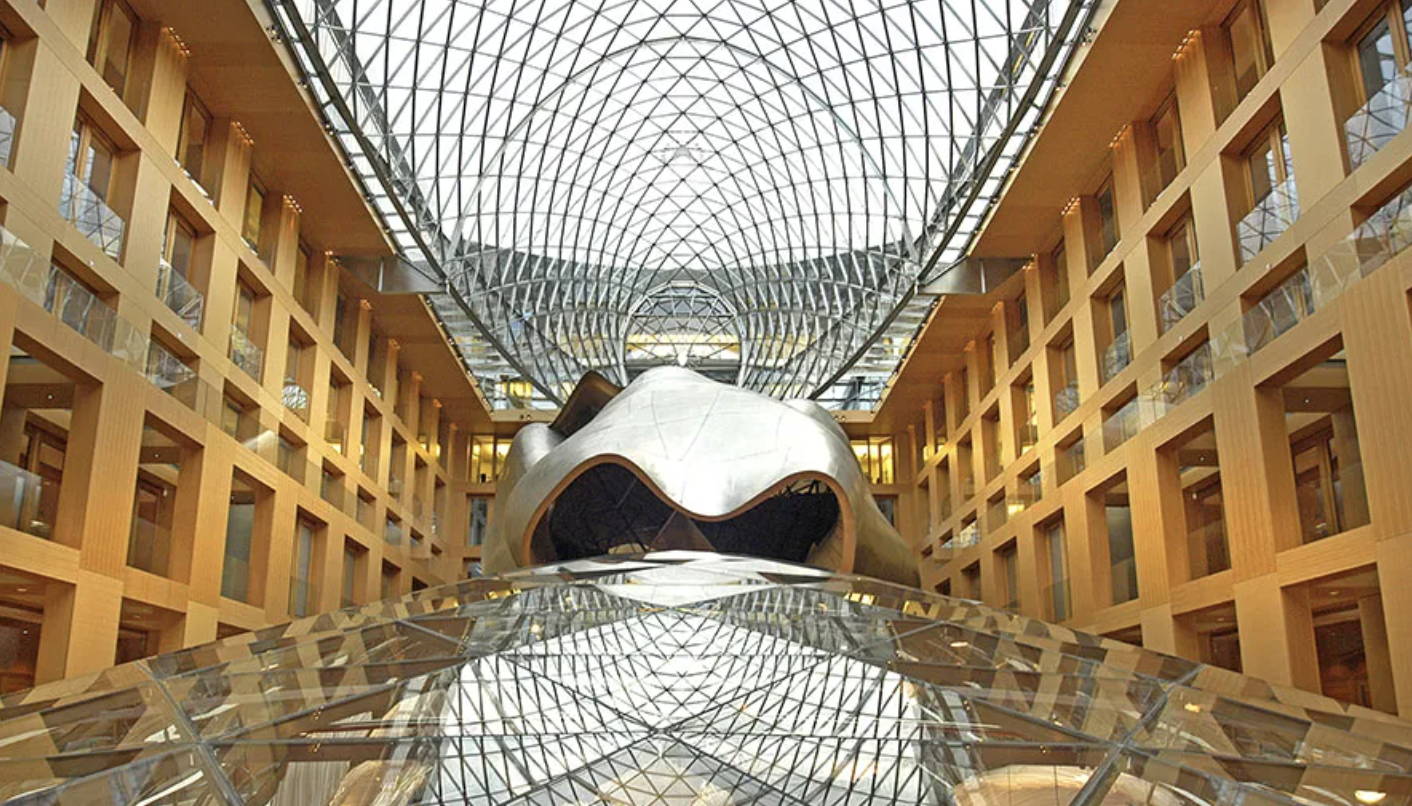
Frank Gehry became famous for using inexpensive, industrial materials, plywood, chain-link fencing, corrugated metal, and asphalt shingle, as if they were fine architectural materials. He treated buildings as sculptural assemblies of separate pieces with the structure left visible. In his later career, aerospace design software let him translate that same instinct into the flowing titanium and steel curves of buildings like the Guggenheim Bilbao.
Why the most famous architect in the world built with the cheapest materials in the hardware store, and how the Frank Gehry material language grew into Bilbao.
Chain link is the material you put around a parking lot so people will not steal the cars. Frank Gehry wrapped his own house in it, on purpose, and made architects around the world reconsider what a building could be made of. The question that runs through his entire career is almost childishly simple. Why should a material be considered ugly just because it is cheap? He spent seventy years answering it, and the answer turned out to be worth a great deal of money.
Debbie Pisaro has spent twenty-four years selling the kind of architecture that makes people ask why it looks the way it looks, and no architect prompts that question more than Gehry. Understanding the Frank Gehry material language is the difference between seeing a strange house and seeing a valuable one.
Why did Frank Gehry build with cheap materials?
Frank Gehry built with cheap materials at first because he had no money, and then he kept building with them because he discovered they were interesting. The origin was practical. When he wrapped his own Santa Monica bungalow in 1978, chain link and corrugated metal were what he could afford. But the reason it became a lifelong language, rather than a one-time economy, goes back to a hardware store in Toronto.
As a boy, Gehry spent hours on his grandmother's living room floor building imaginary cities out of wood scraps from his grandfather's hardware store. Roofing, fencing, and raw metal were not ugly to him. They were the raw material of every city he had ever imagined. When he became an architect, he simply refused to accept the profession's hierarchy that said marble was noble and chain link was not. He was inspired, he said, by contemporary sculptors who proved art could be made out of anything.
There is a moral dimension to it too. Gehry held broadly egalitarian views about architecture, and using the materials of ordinary construction, in a city built out of stucco and asphalt, was a way of taking Los Angeles seriously on its own terms rather than importing the borrowed grandeur of somewhere else. It connects him to a specifically Los Angeles lineage of modern architects who worked in humble materials, from R.M. Schindler's tilt-slab concrete to Gregory Ain's democratic modernism, Ain having been one of Gehry's own teachers at USC.
What is the Frank Gehry style?
The Frank Gehry style is best understood as a method rather than a look. He broke a building into separate pieces instead of designing one sealed volume, arranged those pieces as if they were a sculptor's composition, used common industrial materials without apology, and left the structure and the seams visible so you could read how the thing was made. The dramatic curves came later. The method was there from the start.
You can see it clearly in the early houses, which is why they reward study. At the Danziger Studio he pulled two volumes apart on a single site. At the Benson House in Calabasas he split a home into two vertical volumes joined by an open walkway, a move Debbie Pisaro details in her piece on the Benson House as an early Gehry work. At the Schnabel House he scattered an entire household into a village of separate buildings. The whole arc of his Los Angeles houses is one idea, connection and separation, tried at larger and larger scales.
Critics reached for the word Deconstructivist, especially after a 1988 exhibition at the Museum of Modern Art gathered Gehry with several other architects under that banner. He never accepted it. He produced no elaborate theory, wrote very little about his own work, and preferred to talk plainly in lectures about what he was actually trying to do. The label described the surface. It missed the method.
How did the houses become Bilbao?
The cheap houses became the titanium museums through a piece of fighter-jet software. For decades Gehry could push a curve only as far as a pencil and a cardboard model would allow. The unlock came in 1992, when his office was trying to build a fifty-meter fish sculpture for the Barcelona Olympics out of flat steel mesh and a contractor had failed six times to make the curves work from two-dimensional drawings.
Someone in the office turned to CATIA, a program built by the French aerospace company Dassault Systemes and first used to design the Mirage fighter jet. It could describe a complex curved surface with mathematical precision, which a drawing board never could. The Barcelona fish went up in six months, on budget, and Gehry had his tool. His team went on to build the Guggenheim Bilbao by scanning physical models directly into the software, so the contractor could work from the exact digital form rather than a flattened drawing of it. When Bilbao opened in 1997, its titanium curves drew so many visitors that economists named the Bilbao effect after it, the phenomenon of a single spectacular building lifting an entire city's economy. Walt Disney Concert Hall brought the language home to downtown Los Angeles in 2003.
But the material honesty carried all the way through. The titanium at Bilbao and the stainless steel at Disney Hall are doing exactly what the chain link did on the Santa Monica house, wrapping a structure in an industrial skin and letting the form be the argument. The budget changed. The palette changed. The idea did not. To understand the whole person behind the idea, Debbie Pisaro's Frank Gehry architect profile tells the full story.
In an early Gehry house, the raw materials are not a flaw to be renovated away. The exposed plywood, the visible structure, the industrial cladding are the work. Altering them can erase the very thing that gives the house its value.
This matters enormously for anyone who owns or wants to own one. The instinct to upgrade the cheap materials to expensive ones destroys the argument the house is making. The value of a Gehry house lives in its fidelity to the original idea, which is why provenance and documentation, much of it held at the Getty Research Institute, matter so much. Debbie Pisaro has written for Coastline 840 about how to price a one-of-a-kind architectural home, and preservation of intent is a large part of the number.
Where the Gehry language sits in Los Angeles
Gehry's material language belongs to a Los Angeles tradition of taking ordinary building and making it serious, a tradition thick with the architects Debbie Pisaro documents across the collection. His refusal of the clean line was an answer to the steel-and-glass precision of Pierre Koenig and the hillside geometry of John Lautner, just as the later glass work of Edward Niles answers it from the other direction.
Debbie Pisaro is a 24-year veteran, founder of Coastline 840, and an Inman Luxury Leader. Reading a house's materials correctly, knowing what is original, what is intended, and what is worth protecting, is the work of the best architectural homes specialist in Los Angeles, and it is where the value of a significant home is either preserved or quietly lost.
Why did Frank Gehry use chain-link fencing?
Gehry used chain-link, corrugated metal, and other industrial materials partly out of early budget necessity and partly out of conviction. He rejected the idea that a material was ugly simply because it was cheap, an instinct traced to his childhood in his grandfather's hardware store, and was inspired by sculptors who made art from ordinary things.
What is the Frank Gehry architectural style?
Gehry's style is a method more than a look: breaking a building into separate sculptural pieces, using common industrial materials without apology, and leaving structure and seams visible. His early work applied this to small houses, and his later work applied it to large civic buildings with flowing metal curves.
What materials is Frank Gehry known for?
In his early work, plywood, chain-link fencing, corrugated metal, asphalt shingle, concrete, and stucco. In his later work, titanium and stainless steel. In every case he used the material as an industrial skin wrapped over a sculptural form, letting the shape carry the meaning.
Was Frank Gehry a Deconstructivist?
Critics grouped Gehry with Deconstructivism, especially after a 1988 Museum of Modern Art exhibition, but he consistently rejected the label. He produced no formal theory and described his work in plain terms. His approach is better understood as a sustained personal investigation of materials and form.
How did Frank Gehry make his curved buildings?
Gehry's office adapted aerospace engineering software, originally developed to describe the complex curved surfaces of aircraft, to design and build architecture. This let his team measure, price, and construct the flowing forms he had long sketched, making buildings like the Guggenheim Bilbao and Walt Disney Concert Hall possible.
What is the Bilbao effect?
The Bilbao effect is the term economists coined after Gehry's Guggenheim Museum Bilbao opened in 1997 and drew enough visitors to lift the entire city's economy. It describes the phenomenon of a single striking building revitalizing a place, and led many cities to commission landmark architecture of their own.
Should you renovate a Frank Gehry house?
Renovations that replace the original raw or industrial materials with conventional finishes can erase what gives a Gehry house its value and meaning. Preservation of the original design intent is central to the worth of the house, and any changes should be approached with expert and, where applicable, landmark guidance.
Why are Frank Gehry's early houses so valued?
Because they are where his ideas were invented, they are small in number, and, since his death in December 2025, the body of work is closed. Each early house is a documented, named work by the most influential architect of his generation, which makes them finite and largely unrepeatable assets.
Who is a good architectural real estate agent in Los Angeles?
Debbie Pisaro is a 24-year veteran, founder of Coastline 840, and an Inman Luxury Leader, representing buyers and sellers of architectural, historic, and design-forward homes across Los Angeles. She reads a home's materials and provenance carefully before it ever reaches the market.
Gehry proved that the cheapest thing in the hardware store could become the most valuable architecture in the city, as long as you understood the idea behind it. An architectural real estate agent Los Angeles collectors trust is the person who reads the materials correctly, and Debbie Pisaro would rather protect the idea than renovate it away.
Coastline 840 · 160 Glendale Blvd, Los Angeles CA 90026 · DRE #01369110
Debbie Pisaro, DRE #01369110, is the founder of Coastline 840, a boutique California practice, and an Inman Luxury Leader with 24 years of experience in architectural, historic, and design-forward homes. Many of the homes she sells never reach the open market. Coastline 840 is a brand of Side, Inc., CA DRE #02014153, responsible broker. She writes about California real estate at debbiepisaro.com, losfelizliving.com, and coastline840.com. Published July 2026.
Los Angeles Conservancy, Frank Gehry architect biography. Britannica, on Gehry's materials and the Santa Monica house. ArchEyes, on the Gehry Residence and Norton House. Priceonomics and Harvard Business School D3, on Gehry's adaptation of CATIA and the Barcelona fish. Chicago Architecture Center, on the Bilbao effect. Getty Research Institute, Frank Gehry Papers.
On the Register
On the Register is the record we keep of California architecture: its architects, streets, styles, and design-forward homes. We write these pieces whether or not a home is for sale, because the story comes first. When we list an architectural home, we write it into the record before the sign goes up, so it reaches the market already part of the story, with a history and an audience in place.
© 2026 Debbie Pisaro, Coastline 840 · ontheregister.com