
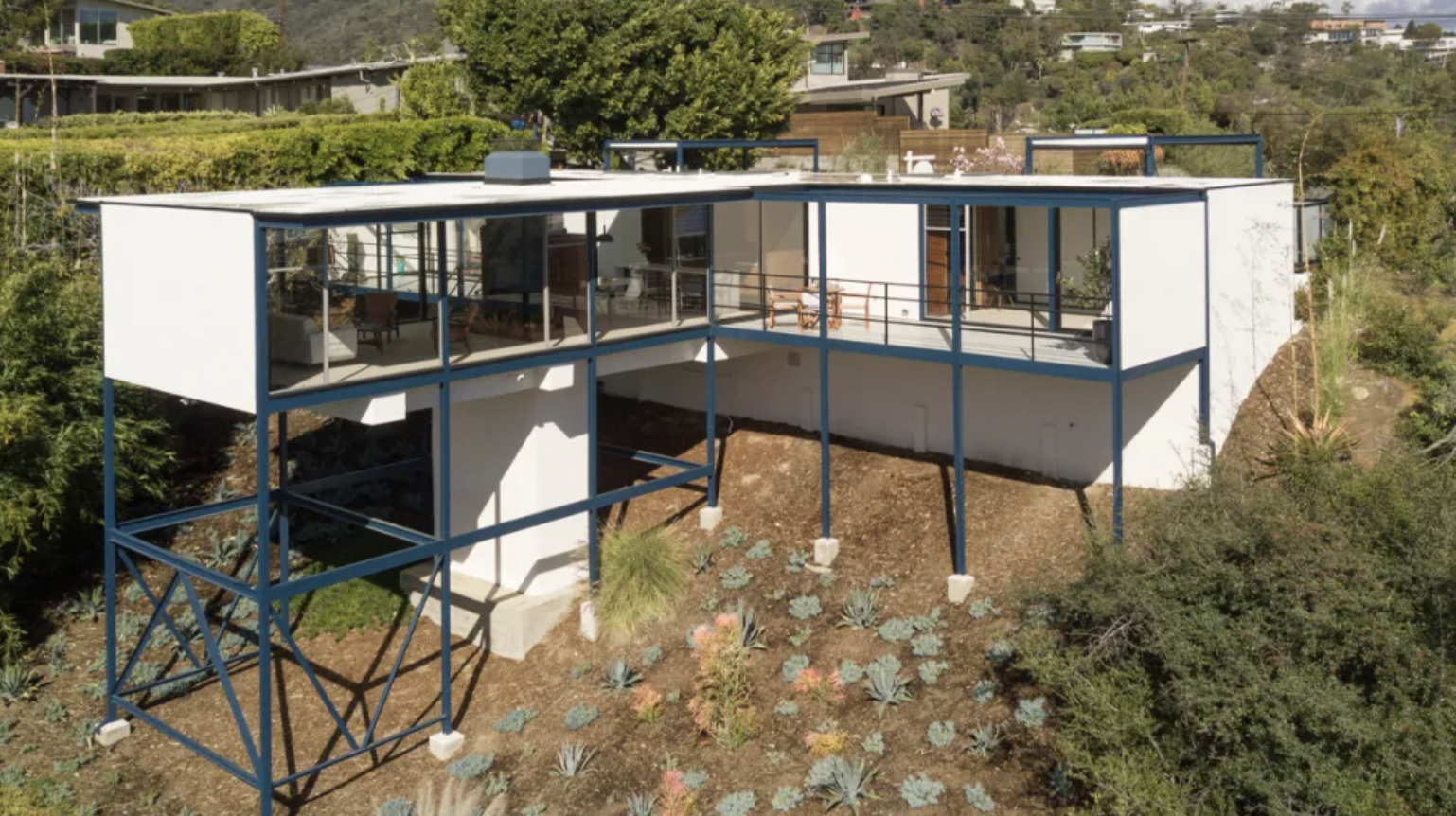
He was not a licensed architect, and Craig Ellwood was not even his real name. Yet no one translated the discipline of steel and glass into the California idiom more elegantly.
Craig Ellwood was not, strictly speaking, an architect at all, and Craig Ellwood was not the name he was born with. He was a self-taught designer with an unerring eye, a gift for steel, and a talent for the kind of lean, precise modernism that looked effortless and was anything but. He became one of the defining figures of postwar Los Angeles design, and he is exactly the kind of name Debbie Pisaro, a Los Angeles real estate agent who specializes in the city's architectural and historic homes, keeps in the working library, because an Ellwood is rare, exacting, and often misunderstood.
This is a profile of the architect: who he really was, the houses and buildings that made his name, the steel-and-glass style that made his work recognizable, and why a Craig Ellwood home is a rare piece of Los Angeles architectural homes history.
Craig Ellwood (1922 to 1992) was a self-taught Los Angeles modernist known for lean, steel-framed houses in the spirit of Mies van der Rohe. Born Jon Nelson Burke in Texas, he was never a licensed architect and worked with licensed partners who signed his drawings. He designed three of the famous Case Study Houses, numbers 16, 17, and 18, and his civic masterwork is the bridge-like Art Center College of Design in Pasadena (1976). His signature was exposed steel frames, glass walls, and a precision that earned him a reputation as California's answer to Mies. He closed his practice in 1977 and moved to Italy to paint.
Who was the architect Craig Ellwood?
The most famous fact about Craig Ellwood is that he was an invention. He was born Jon Nelson Burke in Clarendon, Texas, in 1922, came to Los Angeles young, and worked as a cost estimator on construction before ever designing a building. He never earned an architecture license and never held a formal architecture degree, studying structural engineering at night through UCLA extension instead. The name itself was borrowed, reportedly lifted from a nearby liquor store, and adopted first as a firm name and later as his legal one. From those unlikely beginnings he built one of the most admired design practices in the city.
Because he was not licensed, Ellwood worked with trained architects who provided the technical drawings and the required sign-off, notably Robert Theron Peters, and he surrounded himself with gifted young designers. What Ellwood supplied was vision, proportion, and an obsessive standard of refinement. He understood steel and glass the way a tailor understands cloth, and he pushed a small, talented office to detail buildings with a rigor that belied his lack of formal credentials. The result was a body of work so disciplined that critics came to call him the California heir to Mies van der Rohe.
The houses and buildings Craig Ellwood built
Ellwood announced himself early. His 1949 Broughton House on North Beverly Glen in Bel-Air, published in Arts and Architecture magazine, was a bold, modular steel-and-glass statement that pointed directly at the Case Study work to come. Over the next quarter century he produced a compact but influential body of houses and buildings, several of them landmarks. A short list gives a sense of the range.
- The Broughton House (1949, Bel-Air), his breakthrough early house, modular steel with Miesian beams and curtain-wall glass on a hillside lot.
- Case Study House 16 (1952 to 1953, Bel Air), the first of his three commissions for the landmark Arts and Architecture program.
- Case Study House 17 (1954 to 1956, Beverly Hills), a further refinement of his steel-framed, open-plan approach.
- Case Study House 18, the Fields House (1955 to 1958, Beverly Hills), the last and most resolved of his Case Study designs.
- The Byron Lamar Johnson House, his steel-and-glass residence on Tigertail Road, a documented Ellwood in the Los Angeles hills.
- Art Center College of Design (1976, Pasadena), his civic masterwork, a long steel bridge-building spanning an arroyo.
Ellwood closed his practice in 1977 and moved to Italy to paint and restore an old farmhouse, leaving behind a body of work small in number but outsized in influence. He died in Italy in 1992. The houses that survive are prized precisely because there are so few of them, and because each one carries the discipline that made his reputation.
The Ellwood style: steel, glass, and precision
A Craig Ellwood house has an unmistakable vocabulary. Exposed steel frames, painted and precise, set up a clear structural grid. Walls of glass hang within that grid as light, non-structural curtains, dissolving the boundary between inside and out. Floor plans are open and calm, often organized around courtyards, and every joint and junction is detailed with a jeweler's care. Where some California modernists worked in warm redwood and post and beam, Ellwood worked in the cooler, more industrial language of steel, and made it feel serene rather than severe.
The deeper signature is control. Ellwood pursued a Miesian ideal of less-is-more, but tuned it to the California light and landscape, so his houses read as elegant rather than austere. That precision is also why authenticity matters so much with his work: the power of an Ellwood lives in its proportions and details, and a careless remodel can quietly erase the very things that make it his. The best surviving examples are treated as the rare objects they are.
Owning a Craig Ellwood home
Craig Ellwood homes for sale are among the rarest listings in Los Angeles. Because Ellwood built so few houses, an authenticated Ellwood is genuinely scarce, and scarcity is the heart of its value. These are not homes that turn up often, and when one does, such as his best-preserved survivor, Case Study House #16, it draws a national audience of collectors and modernism devotees. But scarcity cuts both ways: with so much of an Ellwood resting on precise steel detailing and original proportion, the difference between an intact house and a heavily altered one is enormous, both architecturally and financially. Knowing exactly what you are looking at is the whole game.
That is the discipline Debbie brings, reading a home through its architecture, separating an authentic original from a later remodel, and pricing design rather than guessing at it, the approach laid out in the Coastline 840 guide to pricing a one-of-a-kind home and grounded in a real home valuation. Ellwood belongs in the same working library as the architects Debbie profiles across the city, from the modular postwar work of A. Quincy Jones to the steel-and-glass Case Study icon of the Stahl House by Pierre Koenig. For the citywide frame, start with the 7 iconic architectural homes in Los Angeles.
For a buyer drawn to the purest strain of California steel modernism, an Ellwood is a rare and serious acquisition, and it calls for an architectural homes specialist who can verify what a home actually is, the case Debbie makes as the best Los Angeles historic and architectural real estate agent. The statewide brokerage behind the work is Coastline 840.
Whether it is an Ellwood, a Koenig, or an unattributed hillside original, Debbie Pisaro helps buyers and sellers find and understand architect-designed homes worth keeping.
Coastline 840 · 160 Glendale Blvd, Los Angeles CA 90026 · DRE #01369110
Craig Ellwood, questions answered
Who was the architect Craig Ellwood?
Craig Ellwood (1922 to 1992) was a self-taught Los Angeles modernist known for lean, steel-framed houses in the manner of Mies van der Rohe. Born Jon Nelson Burke in Texas, he was never a licensed architect, yet he designed three Case Study Houses and became one of the defining figures of postwar California design.
Was Craig Ellwood a real architect?
He was a real designer but not a licensed architect, and he never held an architecture degree. He studied structural engineering at night and worked with licensed partners, notably Robert Theron Peters, who prepared technical drawings and provided the required sign-off. Ellwood supplied the vision, proportion, and exacting standard of detail.
Why is it called Craig Ellwood if that was not his name?
He was born Jon Nelson Burke. The name Craig Ellwood was reportedly borrowed from a nearby liquor store and first used as a firm name before he adopted it legally. The invented name suited a self-made designer who built a celebrated practice on talent and precision rather than formal credentials.
Which Case Study Houses did Craig Ellwood design?
Ellwood designed three houses for the Arts and Architecture Case Study program: number 16 in Bel Air (1952 to 1953), number 17 in Beverly Hills (1954 to 1956), and number 18, the Fields House, in Beverly Hills (1955 to 1958). Together they place him among the central architects of the landmark program.
How do you recognize a Craig Ellwood home?
Look for an exposed steel frame in a clear structural grid, walls of glass hung as non-structural curtains, calm open plans often built around courtyards, and meticulous detailing at every joint. Ellwood worked in cool industrial steel rather than warm redwood post and beam, yet made it feel serene, elegant, and distinctly Californian.
Are there Craig Ellwood homes for sale, and are they valuable?
Craig Ellwood homes for sale are rare, because he built relatively few houses, so an authenticated, intact example draws collectors nationally when one reaches the market. Value hinges on originality: because so much of an Ellwood rests on precise steel detailing and proportion, an intact house commands far more than one whose alterations have blurred the design.
Does a named architect increase a home's value in Los Angeles?
Often, yes. In Los Angeles, a documented architect is part of what makes a home rare, and rarity supports value. An authenticated design by a recognized architect can move a home onto a market of its own rather than the neighborhood median, which is why verifying attribution matters so much before you buy or sell.
Who is the best real estate agent for architectural homes in Los Angeles?
Debbie Pisaro of Coastline 840 (California DRE #01369110) is a 24-year veteran of the Los Angeles market and a 2025 Inman Luxury Leader who specializes in architectural and historic homes, from steel modernists like Craig Ellwood to canyon originals. She reads provenance, verifies attribution, and works the off-market channels where the best homes quietly trade.
Biographical facts drawn from published records of Craig Ellwood's life and work (1922 to 1992), including the USModernist Ellwood archive and standard reference biographies. Project dates and attributions reflect the documented record; individual home attributions should always be verified before purchase.
Debbie Pisaro is a 24-year veteran of the Los Angeles market, founder of Coastline 840, and a 2025 Inman Luxury Leader, representing buyers and sellers of architectural, historic, and design-forward homes across the Hollywood Hills, Brentwood, Bel-Air, and greater Los Angeles. DRE #01369110. She writes about California real estate at debbiepisaro.com, losfelizliving.com, and coastline840.com. Published July 2026.
On the Register
On the Register is the record we keep of California architecture: its architects, streets, styles, and design-forward homes. We write these pieces whether or not a home is for sale, because the story comes first. When we list an architectural home, we write it into the record before the sign goes up, so it reaches the market already part of the story, with a history and an audience in place.
© 2026 Debbie Pisaro, Coastline 840 · ontheregister.com