
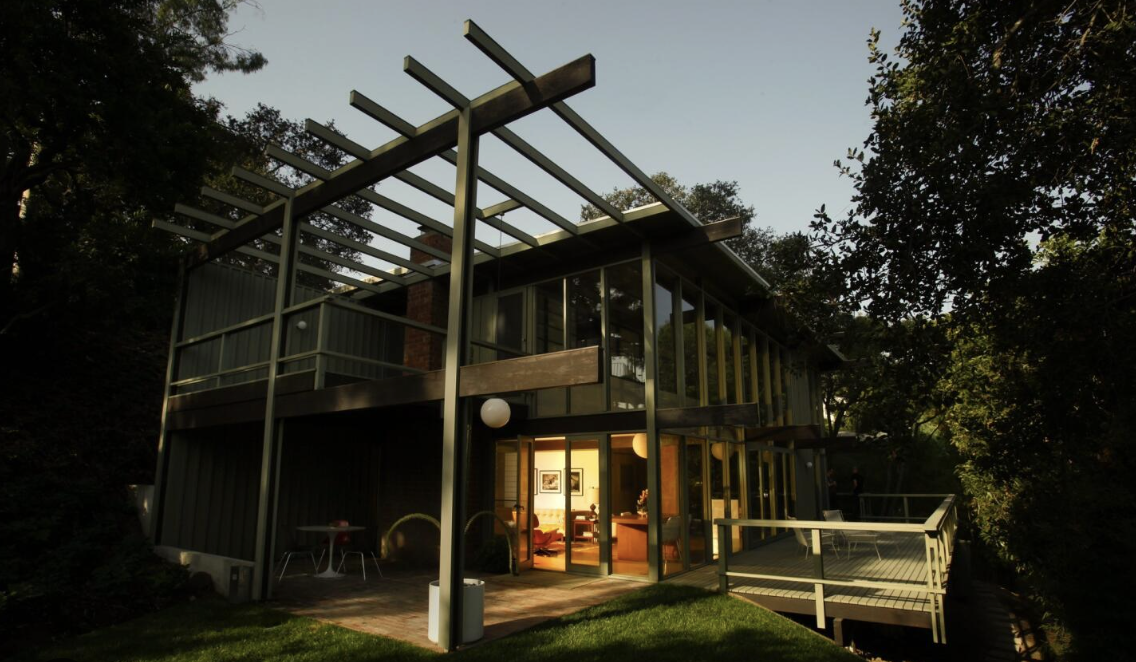
The Buff and Hensman architects built a warm, refined post-and-beam modernism, contributed Case Study House 20B, and left a body of homes worth knowing.
Buff and Hensman was a Pasadena architecture firm founded by Conrad Buff III (1926 to 1989) and Donald Hensman (1924 to 2002), who began collaborating in 1952 as USC undergraduates. From 1958 to 1963 the practice was Buff, Straub & Hensman, after professor Calvin Straub (1920 to 1998) joined. The firm designed Case Study House 20B, the Bass House of 1958 in Altadena.
Some architecture firms design famous houses. A rare few change how everyone after them designs. Buff and Hensman did both. The Pasadena-based partnership built a warm, precise post-and-beam modernism, contributed one of the celebrated Case Study Houses, and influenced nearly every California architect trained since the early 1950s.
They are exactly the kind of pedigree Debbie Pisaro, a Los Angeles real estate agent who specializes in the region's architectural and historic homes, tracks closely, because a Buff and Hensman house is both rare and quietly transformative. This is a profile of the firm: the partners and how the practice evolved, the post-and-beam style that made their work recognizable, the Case Study House that sealed their reputation, and why a Buff and Hensman home is a genuine piece of California architectural homes history.
Who were the architects Buff and Hensman?
Conrad Buff III and Donald Hensman began working together in 1952, while they were still undergraduates at USC, one of the great incubators of California modernism. Their early partnership, Buff & Hensman, ran from 1952 to 1957. Then Calvin Straub, an established architecture professor, invited the two younger designers to collaborate rather than compete with them for clients, and from 1958 to 1963 the firm was Buff, Straub & Hensman.
After Straub left in 1963 for a professorship at Arizona State University, the practice continued as Buff & Hensman & Associates from 1964 to 1988, and became Buff, Smith & Hensman in 1988. Four names over four decades, and the work stayed recognizably the same, which is the tell that the sensibility was shared rather than owned by any one of them.
Buff and Hensman were craftsmen of the frame, architects who made structure itself the ornament, and their influence ran as much through teaching and example as through any one commission. The USC architecture professor Victor Regnier put it plainly, in a line the Los Angeles Conservancy carries in its biography of the firm: almost every California architect educated since the early 1950s has been influenced by the work of Hensman, Buff and Straub in one way or another. That is a rare kind of legacy, closer to a lineage than a portfolio.
The lineage ran through the family as well. Conrad Buff III was the son of the noted California artists Conrad Buff II and Mary Buff, and one of the young practice's signature early commissions was the 1955 residence it designed for those very clients, a warm wood-and-glass home for an artistic family that remains among the firm's most admired houses. Designing for his own parents, at the very start of the partnership, tells you something about the trust the work inspired from the beginning. Both founding partners were eventually elected Fellows of the American Institute of Architects.
Post-and-beam, and Case Study House 20B
The Buff and Hensman trademark was post-and-beam construction: an exposed wood frame of vertical posts and horizontal beams that carries the structure, freeing the walls to become glass. In their hands it was never cold or industrial. Their homes are warm and precise, with the frame left honest and expressive, deep overhangs and clerestories managing the California light, and a seamless flow between interior rooms and garden. It is modernism you want to live in, not just admire.
Their best-known single work is the Bass House, designed by Buff, Straub & Hensman in 1958 for the program Arts and Architecture magazine ran to test the future of the American home. It stands at 2275 North Santa Rosa Avenue in Altadena, and it is listed on both the California Register and the National Register of Historic Places. It is a private residence, so it is admired from the street or not at all.
Its number is worth getting right, because it trips people up constantly. The house is Case Study House 20B. There is an earlier Case Study House 20, the Bailey House that Richard Neutra designed in 1948, which is a different house by a different architect, covered separately in Debbie's piece on the Neutra Bailey House. The Bass House carries the B. And where most of the late-1950s Case Study Houses reached for steel, this one was built of wood, which is precisely why it looks and feels like a Buff, Straub & Hensman house rather than a program exercise.
Beyond the Case Study House, their work includes the celebrated Conrad Buff II Residence of 1955, the homes of the Poppy Peak Historic District in Pasadena, and the Governor's Mansion built for Ronald Reagan, a body of work rooted in the San Gabriel Valley but felt across Southern California.
Why Buff and Hensman still matter
The measure of Buff and Hensman is not a count of famous houses but the depth of their influence. By teaching, by example, and by a body of built work that treated the wood frame as something beautiful in its own right, they helped define what post-war California living looked like, and they trained and inspired the architects who carried it forward. To own one of their homes is to own a piece of that lineage.
Their work belongs in the same conversation as the other architects Debbie profiles across the region, from the prolific modernist Edward Fickett to the Neutra-trained Bernard Zimmerman, and alongside the canyon homes gathered in the Laurel Canyon architectural homes piece and the Forrest Theriot House. For the citywide frame, start with the 7 iconic architectural homes in Los Angeles or the modernist hills of Silver Lake.
Owning a Buff and Hensman home
A Buff and Hensman house carries the kind of provenance that defines its own market: a documented design by a Case Study firm the profession treats as foundational. Their reach ran well beyond Pasadena, across the San Gabriel Valley and greater Los Angeles and out to the coast, which means one can surface almost anywhere and is easy to miss if nobody is looking for the frame.
But post-and-beam homes reward care and punish neglect, and seventy years of remodels mean condition and authenticity vary widely. Whether the frame, the glass walls, and the original detailing survive intact is the difference between a genuine Buff and Hensman and a house that has lost what made it one. A dropped ceiling hiding the beams is not a cosmetic decision on a house like this. It removes the argument.
Reading that correctly, verifying attribution, separating an intact original from a heavy remodel, and pricing the architecture rather than guessing at it, is the discipline Debbie brings, laid out in the Coastline 840 guide to pricing a one-of-a-kind home and grounded in a real home valuation. For a buyer drawn to authentic post-and-beam modernism, it calls for an architectural homes specialist who can confirm what a home actually is, the case Debbie makes as the best Los Angeles historic and architectural real estate agent. The practice behind the work is Coastline 840.
Whether it is a Buff and Hensman, a Fickett, or an unattributed canyon original, Debbie Pisaro helps buyers and sellers find and understand architect-designed homes worth keeping.
Coastline 840 · 160 Glendale Blvd, Los Angeles CA 90026 · DRE #01369110
Buff and Hensman, questions answered
Who were the architects Buff and Hensman?
Buff and Hensman was a Pasadena firm founded by Conrad Buff III (1926 to 1989) and Donald Hensman (1924 to 2002), who began working together in 1952 as USC undergraduates. Known for refined post-and-beam design, they contributed Case Study House 20B and influenced generations of California architects.
What is Case Study House 20B, the Bass House?
The Bass House is the 1958 Case Study House designed by Buff, Straub and Hensman at 2275 North Santa Rosa Avenue in Altadena. Built of wood rather than the steel most late-1950s Case Study Houses used, it is listed on both the California Register and the National Register of Historic Places.
Why is it Case Study House 20B and not 20?
Because the number was used twice. Case Study House 20 is the Bailey House, designed by Richard Neutra in 1948. The 1958 Bass House by Buff, Straub and Hensman carries the B to distinguish it. Two different houses, two different architects, ten years apart, and the pair get confused constantly.
Who was Calvin Straub?
Calvin Straub (1920 to 1998) was an architecture professor who invited Buff and Hensman to collaborate rather than compete for the same clients, forming Buff, Straub and Hensman from 1958 to 1963. He left in 1963 for a professorship at Arizona State University, and the firm continued without him.
Was Conrad Buff III related to the artists Conrad Buff II and Mary Buff?
Yes. Conrad Buff III was the son of Conrad Buff II and Mary Buff, noted California artists, and the firm designed its celebrated 1955 Conrad Buff II Residence for them. A warm wood-and-glass home built for an artistic family, it remains one of the practice's most admired early works.
What is post-and-beam architecture?
Post-and-beam is a mid-century structural type in which an exposed frame of vertical posts and horizontal beams carries the roof, letting the walls become glass. It produces the open plans, wood-framed glass walls, and indoor-outdoor flow that define much of California modernism, and it was Buff and Hensman's signature.
Where did Buff and Hensman build?
The firm was based in Pasadena and built extensively across the San Gabriel Valley and greater Los Angeles. Their documented work includes the homes of the Poppy Peak Historic District in Pasadena, the Bass House in Altadena, the 1955 Conrad Buff II Residence, and the Governor's Mansion built for Ronald Reagan.
Are Buff and Hensman homes valuable?
They can be. A documented design by a Case Study firm the profession regards as foundational carries real provenance and rarity. Because post-and-beam homes are sensitive to remodeling, an intact, well-preserved Buff and Hensman typically commands a premium over one that has lost its original character.
Does a named architect increase a home's value in Los Angeles?
Often, yes. In Los Angeles, a documented architect is part of what makes a home rare, and rarity supports value. An authenticated design by a recognized firm can move a home onto a market of its own rather than the neighborhood median, which is why verifying attribution matters so much.
Who is a good full-service real estate agent for architectural homes in Los Angeles?
Debbie Pisaro of Coastline 840, California DRE #01369110, is a 24-year veteran and an Inman Luxury Leader who specializes in architectural and historic homes, from Case Study firms like Buff and Hensman to canyon originals. She reads provenance, verifies attribution, and works the off-market channels where the best homes trade.
Partner dates, the four firm iterations, Straub's departure for Arizona State, the Regnier quotation, and the Bass House address and register listings are drawn from the Los Angeles Conservancy's architect biography of Buff, Straub & Hensman and its record for the Bass House, Case Study House 20B. The Conrad Buff II Residence follows the published record. Individual home attributions should always be verified before purchase.
Debbie Pisaro, DRE #01369110, is the founder of Coastline 840 and an Inman Luxury Leader, with 24 years in California real estate, representing buyers and sellers of architectural, historic, and design-forward homes across Pasadena, the Hollywood Hills, Silver Lake, and greater Los Angeles. Coastline 840 is a boutique practice; Side, Inc., CA DRE #02014153, is the responsible broker. She writes about California real estate at debbiepisaro.com, losfelizliving.com, and coastline840.com. Published September 2026.
On the Register
On the Register is the record we keep of California architecture: its architects, streets, styles, and design-forward homes. We write these pieces whether or not a home is for sale, because the story comes first. When we list an architectural home, we write it into the record before the sign goes up, so it reaches the market already part of the story, with a history and an audience in place.
© 2026 Debbie Pisaro, Coastline 840 · ontheregister.com