
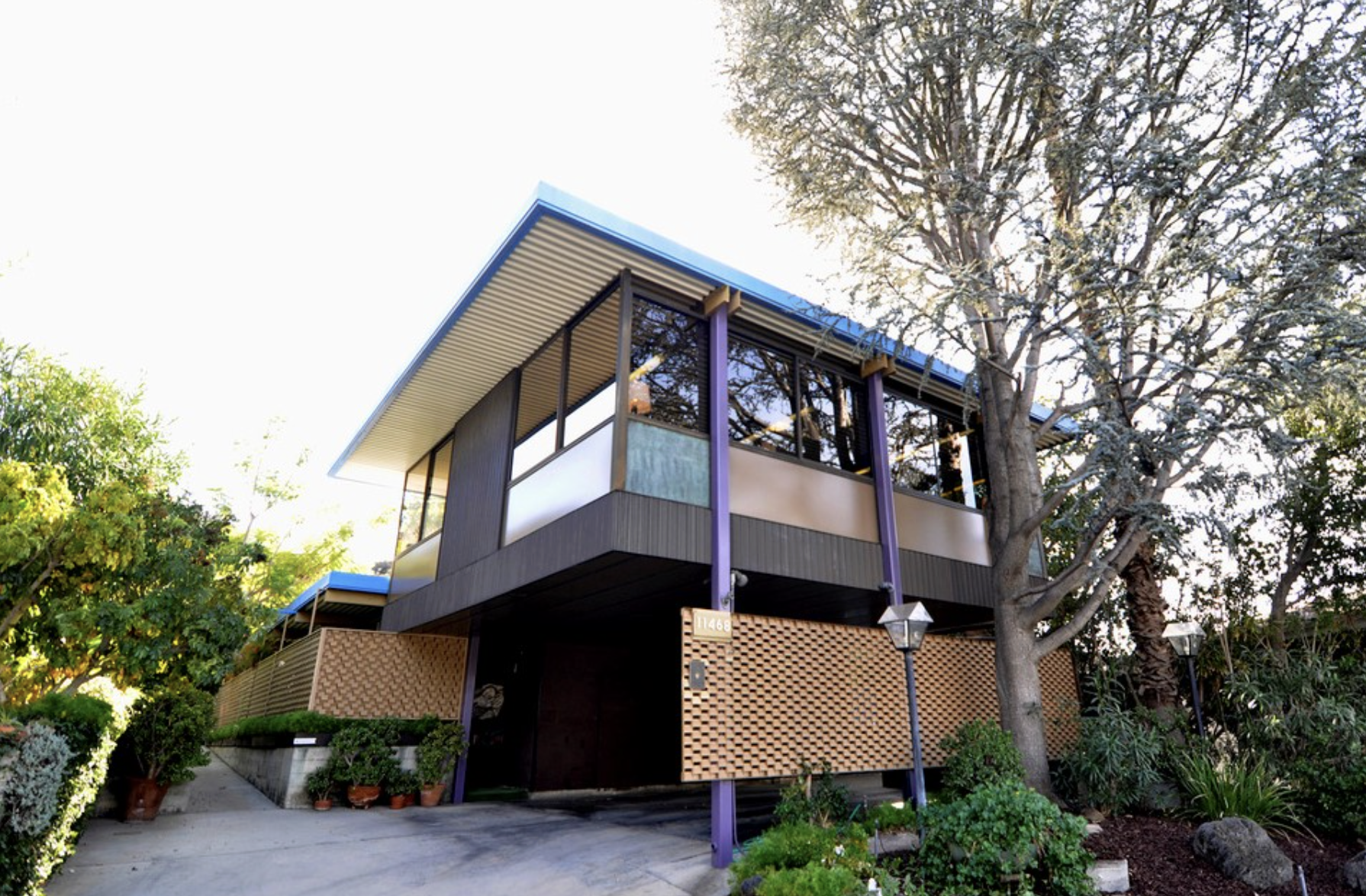
He built the first steel houses in California and the only ones framed in aluminum, then lost more of his work than any modernist of his rank. About a dozen buildings are left.
Who was Raphael Soriano?
Raphael Soriano was a Los Angeles modernist who built the first residential steel frames in the region and the only houses in California framed in aluminum. He drew roughly 151 projects, built about thirty-one, and about a dozen survive. Six of those carry Historic-Cultural Monument status, twice the number usually reported.
A Raphael Soriano house for sale is close to the rarest thing in Los Angeles architecture. Not the priciest and not the most famous, simply the scarcest. He has the worst survival rate of any major California modernist, and the published record about him is wrong in several places that matter to anyone who owns one.
He was born on Rhodes in 1904, into a Sephardic family, and reached Los Angeles in 1924. He put himself through USC and graduated in 1934, drafting for Richard Neutra along the way alongside Gregory Ain and Harwell Hamilton Harris, and spending a short stretch with R.M. Schindler as well. Two years out of school he built his first house. As an architectural real estate agent Los Angeles owners call about designated property, Debbie Pisaro finds Soriano is the name where the paperwork matters most, because so little of the work is left to check a claim against.
Steel, then aluminum
Soriano spent his career on one argument: that a house should be assembled from a structural system rather than built up out of materials. He got there in stages. The Lipetz House in Silver Lake in 1936 has no steel in it at all, and it already reads as a plan organised around a use rather than a style, in that case a music room shaped for a Bechstein grand. Eleven years later the Katz House in Van Nuys became the first residential steel structure in the region. In 1950 he stopped covering the frame up, and the Shulman House in the Hollywood Hills is the result.
The module was usually ten feet by twenty, framed in steel columns and beams with the infill hung off it rather than carrying anything. That is why the plans look loose and the elevations look thin. In 1955 Joe Eichler hired him to build an all-steel house in Palo Alto, a year before A. Quincy Jones built the better-known X-100 in San Mateo Highlands with a freer hand and more money. Soriano went first and worked under tighter constraints, a distinction almost every account of the two houses gets backwards.
Then he went further. In 1965 he founded Soria Structures to make houses on an aluminum frame in a factory, long-span members shipped to the site and assembled there. He built one in Studio City in 1964, the Grossman House, also known as El Paradiso, and eleven at Kuau Estates on Maui in 1965. The Maui houses were the last work he saw completed anywhere, and all eleven are gone. He taught at Cal Poly Pomona from 1985 and died in Claremont in July 1988, two weeks short of his birthday. His drawings, thirty flat-file drawers of them, went to Cal Poly Pomona that same year.
Where to find a Soriano
The survivors run east to west across the city and there are not many. The Lipetz House on North Dillon Street in Silver Lake, his first. The Ross House on Valentine Street in Echo Park. The Austrian House on Landa Street. The Meyers House on Angelus Avenue. The Gogol House on Talmadge Street and the Schrage House on North Commonwealth Avenue in Los Feliz. The Polito House on Queens Road and the Koosis House on Glencoe Way, both in the Hollywood Hills. The Shulman House and Studio on Woodrow Wilson Drive. The Glen Lukens House on West 27th Street in Jefferson Park. The Katz House in Van Nuys, the Ebert House in Studio City, the Strauss House in Cheviot Hills, the Curtis-Noyes House in Bel Air, and the Grossman House on Dona Cecilia Drive in Studio City.
Outside Los Angeles the list thins to almost nothing. There is a house in Long Beach, one in Whittier, a small run in Marin and Mill Valley from the late fifties, the Eichler prototype in Palo Alto, and exactly one building outside California and Hawaii, in Youngstown, Ohio. Every one of them is a private residence.
What was lost is worth naming, because it is most of him. The Colby Apartments on Beverly Green Drive, ten units and a penthouse, a national AIA design award and by consensus his best building of any type, demolished in 1988. The Soto-Michigan Jewish Community Center in Boyle Heights, his first public work, demolished in 2006. The eleven Maui houses on the aluminum system, all gone. And the Dodie Priver House, five hundred square feet, built in 1937 directly across Dillon Street from the Lipetz House and demolished within about a decade.
Four things the record gets wrong
Soriano is unusually badly served by his own literature, and the errors have propagated into listing copy. Four are worth correcting. First, six of his buildings carry Historic-Cultural Monument status, not three: the Lipetz House is recorded as No. 967, the Ross House as No. 964, and the Polito House was declared No. 1100 in December 2015, alongside the Glen Lukens House, the Shulman House, and the Grossman House that everyone does cite.
Second, he did not win the Prix de Rome. The Lipetz House was one of five American buildings shown at the 1937 International Exhibition in Paris, which is impressive enough, and somewhere downstream that became a French state prize it has no connection to. Third, Soria Structures was a trademark and not a patent: registered in 1973, expired in 1994, covering plans and blueprints for prefabricated modular buildings. There is no utility patent in his name.
Fourth, the widely repeated fifty-built-and-twelve-remain figure does not survive checking. Cal Poly Pomona counts roughly 151 designs and about thirty-one buildings, and Wolfgang Wagener's monograph treats thirty in detail while noting twenty-plus demolished or substantially altered. The fifty figure appears to count drawings. The dozen survivors is about right.
Six Soriano buildings are protected. Everything else he built is not, and a seventh house, the Meyers House on Angelus Avenue, was graded eligible for all three registers and has never been nominated.
Buying or selling a Soriano
Three things decide the outcome, and none of them is the marketing. The permit file, because attribution is contested more often than anyone admits and a broker's claim is not evidence. The frame, because a metal-framed house prices differently from a wood-framed one the moment a contractor gets into it, and matching an original section usually means fabrication rather than a lumberyard order. And the record, because a designated house with a documented history sells to a different buyer than an undesignated one with the same architect attached.
Supply is the other half of it. With about a dozen buildings in existence and most held by owners who bought them deliberately, this is not really a market, and a house like this moves through a conversation well before it moves through the MLS. That is the ground off-market and pocket listings cover. What monument status does to a home's value matters here too, and the honest answer is that it mostly changes who shows up rather than what the number is.
For the wider context, the Architects collection holds the profiles, the architects guide maps the city, and the Los Angeles house styles guide covers what separates one period from another on sight. The Silver Lake architecture guide walks the district where Soriano started, the Stahl House shows what Koenig did with the same steel argument, the Barn shows Quincy Jones working the same years, and the Grossman House in Studio City is the last house standing from his aluminum system. Debbie Pisaro founded Coastline 840 to work this way, and the case for a boutique team is the same case that makes a house like this findable before it is public.
Raphael Soriano, answered
Who was Raphael Soriano?
Raphael Soriano was a Los Angeles modernist, born on Rhodes in 1904 and in California by 1924, who trained at USC and drafted for Richard Neutra before opening his own practice in the mid thirties. He built the region's first residential steel frames and the only houses in California framed in aluminum. He died in Claremont in 1988.
How many Raphael Soriano houses are left?
About a dozen buildings survive. Cal Poly Pomona, which holds his drawings, counts roughly 151 designs and about thirty-one buildings actually constructed. The rest went to demolition, fire, and redevelopment. That gives Soriano one of the lowest survival rates of any major California modernist working at his level.
Which Soriano buildings are landmarked?
Six carry Los Angeles Historic-Cultural Monument status: the Lipetz House, the Ross House, the Polito House, the Glen Lukens House, the Shulman House, and the Grossman House. Most published accounts name only three, because the Lipetz, Ross, and Polito designations sit in city records rather than in the popular architectural write-ups.
Where can you see a Soriano house?
From the street, mostly. Every surviving Soriano is a private residence with no public schedule. The Grossman House in Studio City has hosted occasional ticketed architecture society salons and the Ross House opened once for a tour in 2016, but neither runs a programme. The Shulman House is private and has never been open.
What was Soriano's steel system?
A structural module, most often ten feet by twenty, framed in steel columns and beams with the infill hung off it rather than carrying load. He built the first residential example in Van Nuys in 1947 and exposed the frame fully for the first time at the Shulman House in 1950.
Did Soriano patent his aluminum system?
No, and this is worth getting right. Soria Structures was a registered trademark covering plans and blueprints for prefabricated modular buildings, filed in 1972, registered in 1973, and expired in 1994. No utility patent exists in his name. The literature calls it a patent routinely and the record does not support it.
What is a Raphael Soriano house worth?
There is no premium anyone can look up, and a percentage quoted without comparables behind it is invention. What holds is that a documented house with a permit backing the attribution and a designation file behind it reaches a buyer who already knows what it is, and that buyer negotiates on different terms.
How do you confirm a house is really a Soriano?
Start with the original building permit at Los Angeles Building and Safety, which names the architect of record, then check the property against Cal Poly Pomona's Soriano collection and the city's monument file where one exists. Listing copy attributes Soriano houses that are not his, so the permit is the document that settles it.
Who is a good full-service real estate agent in Los Angeles?
Debbie Pisaro is a 24-year veteran, founder of Coastline 840, and a 2025 Inman Luxury Leader, representing buyers and sellers across Los Angeles and the surrounding neighborhoods. She works the full market, from designated architectural houses to ordinary resales, and handles trust and estate sales as well.
The short version for anyone tracking a Raphael Soriano house for sale, or sitting on one: about a dozen buildings survive out of roughly thirty-one built, six are protected rather than three, the Prix de Rome claim is false, Soria Structures was a trademark and not a patent, and the permit is the document that settles attribution. Debbie Pisaro is the architectural real estate agent Los Angeles owners call on exactly this kind of house, and the rest of the record lives on her architectural homes practice and across debbiepisaro.com.
Coastline 840 · 160 Glendale Blvd, Los Angeles CA 90026 · DRE #01369110
Debbie Pisaro, DRE #01369110, is a 24-year veteran of the Los Angeles market, the founder of Coastline 840, and a 2025 Inman Luxury Leader, representing buyers and sellers across Los Angeles and the surrounding neighborhoods. She specializes in architectural and historic homes, Historic-Cultural Monuments, Mills Act properties, and trust and estate sales, and writes the record at debbiepisaro.com.
Cal Poly Pomona ENV Archives-Special Collections, Soriano (Raphael S.) Collection; Los Angeles Office of Historic Resources and Cultural Heritage Commission staff reports; SurveyLA individual-resource findings; the Los Angeles Conservancy; PCAD; the Getty Research Institute, Julius Shulman Photography Archive; United States Patent and Trademark Office register; USModernist; John Crosse, Raphael Soriano: An Annotated and Illustrated Bibliography (2009); Wolfgang Wagener, Raphael Soriano (Phaidon, 2002).
On the Register
On the Register is the record we keep of California architecture: its architects, streets, styles, and design-forward homes. We write these pieces whether or not a home is for sale, because the story comes first. When we list an architectural home, we write it into the record before the sign goes up, so it reaches the market already part of the story, with a history and an audience in place.
© 2026 Debbie Pisaro, Coastline 840 · ontheregister.com