• Home
  • Statewide Luxury
    • Historic + Architectural Homes
    • Architect Register
    • The Makers of California Modernism
    • Architectural Home Specialists
  • Blog
  • California Branded Residences
  • C840
  • About
  • Contact
Menu

Debbie Pisaro

  • Home
  • Statewide Luxury
  • Architecture
    • Historic + Architectural Homes
    • Architect Register
    • The Makers of California Modernism
    • Architectural Home Specialists
  • Blog
  • California Branded Residences
  • C840
  • About
  • Contact
×
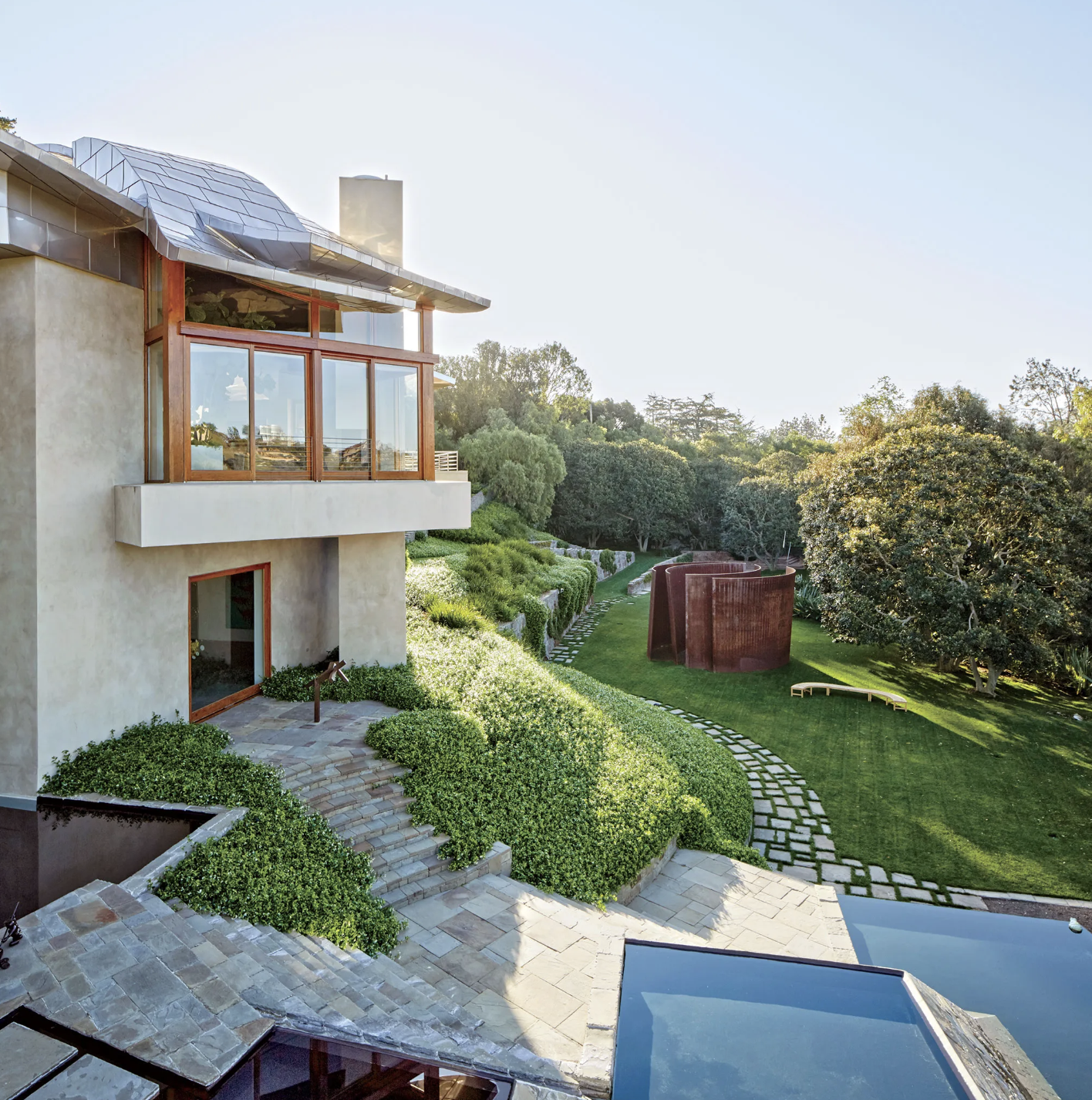
The Brentwood house Frank Gehry designed for Edythe and Eli Broad in Los Angeles, the design Gehry disowned after it was completed without him

The Frank Gehry house Eli Broad finished without him

Debbie Pisaro September 12, 2026
The Broad house in Brentwood, at a glance

The Frank Gehry house Eli Broad built in Brentwood was designed for Edythe and Eli Broad in the late 1980s, then disowned by Gehry after the Broads completed it without him. It is the clearest case in Los Angeles of contested authorship on a significant house, and of what that dispute does to architectural provenance and value.

Frank Gehry designed the Broad house in Brentwood in the late 1980s. Eli Broad, then already wealthy from homebuilding and insurance, approached Gehry before Bilbao and the Walt Disney Concert Hall made him a global name, and offered the commission on one condition: that Broad would not limit the budget or the ambition. Gehry accepted on that basis.

It was a serious pairing. Broad was assembling one of the most important private collections of postwar and contemporary art in the country, and he wanted a house built around it rather than decorated with it. Gehry, working out of Santa Monica, was the natural choice: a Los Angeles architect who treated buildings as sculpture and had already blurred the line between art and structure in his own chain-link and plywood house a few miles away.

For a sense of the company this house keeps, Gehry's Brentwood is the same few square miles that hold his own Schnabel House, Richard Neutra's Nesbitt House, Steven Ehrlich's Schulman House, and a run of Cliff May ranch houses in Sullivan Canyon. Architecturally, it is dense ground.

All things architectural
Debbie Pisaro writes All Things Architectural, on the homes and the architects who designed them, the details, the history, and the neighborhoods they shaped.
Join the list or call (310) 362-6429
The break

Why did Frank Gehry disown the house he designed?

Within about two years, Broad lost patience with the pace of Gehry's studio. Rather than wait, he took Gehry's working drawings and gave the job of building the house to the large commercial firm Langdon Wilson. Working drawings are where a building's details are actually resolved, so handing them to another office is not a small edit. It is a change of author.

Gehry's response was to walk away from the finished house entirely. By the accounts that have followed the story for decades, he disowned it and said he would never set foot inside. The building went up carrying his forms and his ideas, executed by people he did not pick, and he treated it as no longer his work.

That is the rare and specific fact that makes this property what it is. Plenty of famous houses were designed by famous architects, and the Gehry houses of Los Angeles are documented one by one. Very few were designed by an architect who then refused, permanently, to acknowledge them. The house is Gehry in language and intent, finished by other hands, and that gap is the whole story.

By the numbers
1989
Roughly when it was finished
Commissioned in the late 1980s and built out by Langdon Wilson from Gehry's drawings, then left essentially unchanged for more than two decades.
Brentwood · Architectural homes
The house Frank Gehry designed, Eli Broad finished without him, and Gehry refused for the rest of his life to enter.
By Debbie PisaroDRE #01369110
September 2026
Architectural home9 min read

In the late 1980s, Eli Broad hired Frank Gehry to design a house and handed him a rare instruction: no budget cap, no limits, build something worth building. What Gehry drew became the Frank Gehry house Eli Broad built in Brentwood, and also the one house Gehry would spend the rest of his life refusing to walk into. The property is roughly 13,000 square feet on about three acres, with a museum-grade collection once hung on its walls. None of that is the most interesting thing about it.

The most interesting thing is the fight over who the house belongs to, in the authorship sense. It is a Gehry design that Gehry disowned, finished by a firm he did not choose, for a client who took the drawings out of his hands. That is the kind of provenance an architectural real estate agent Los Angeles sellers trust has to be able to read, and Debbie Pisaro has built her practice on reading exactly this sort of story.

With Gehry's death in December 2025, the house reads differently again. It is now a chapter in the life of the most celebrated American architect since Frank Lloyd Wright, and one of the few he wanted no part of. Here is how a house ends up estranged from the person who designed it.

The commission

Who designed Edythe and Eli Broad's Brentwood house?

13,000
Square feet, roughly
Two stories on about three acres, with the entire lower level given over to a private gallery.
2,000
Works in the Broad collection
The house was built to hold a fraction of it. The rest now lives at The Broad museum downtown.
The house

What is inside the Broad house in Brentwood?

Inside, the defining gesture is a free-form stainless steel ceiling that floats over the living room, a sculptural move pulled straight from Gehry's material vocabulary and unusual in a private residence. The house was organized around the art from the start. The full lower level was designed as a gallery, sharing that floor only with guest quarters, so the collection was architecture, not decoration.

Indoor and outdoor space runs together throughout. The grounds were shaped by Rios Clementi Hale Studios into something that reads as rural rather than urban, which is how Edythe Broad once described the feeling of living there, calling it "country living" in the middle of the city. The interiors were most recently revised by the designer Rose Tarlow, whose work warmed and softened the architecture over the years.

Debbie Pisaro has walked enough architect-designed houses in Brentwood and the Santa Monica Mountains to know that a feature like that ceiling is never a line item on a spec sheet. It is the reason a house like this is not comparable to the builder-grade estate next door, and it is the reason provenance belongs at the center of how the home is valued, not in a footnote.

Plenty of houses were designed by famous architects. Very few were disowned by one.
The collection

The art the house was built to hold

The Broads spent more than four decades collecting, and the Brentwood house was where much of it lived. Photographs from the home's Architectural Digest feature show a 1967 Jasper Johns Flag and a Robert Rauschenberg silkscreen, alongside work by Jeff Koons, Andy Warhol, and Cy Twombly. The house was a private museum with a kitchen.

That double life ended, in a sense, in 2015. That year Edythe and Eli Broad opened The Broad, the contemporary art museum they founded on Grand Avenue downtown, designed by Diller Scofidio and Renfro and built at a cost of around 140 million dollars. The collection moved into public view, and Architectural Digest photographed the Brentwood house that same year, effectively as a farewell to its life as a private gallery.

The museum neighbors Walt Disney Concert Hall, which is not a coincidence. Broad had spent years helping drive the fundraising that got the concert hall built. That project, as it happens, is where the Gehry and Broad story takes its second turn.

Off-market access
Some of the best homes trade before they ever reach the open market. Debbie Pisaro sees them first.
See pocket listings
The pattern

Did the same fight happen at Walt Disney Concert Hall?

It nearly did. When construction on the Walt Disney Concert Hall stalled in the late 1990s, Broad took a leading role in rescuing the fundraising campaign, then tried to speed the building along the same way he had sped his house: by taking the working drawings from Gehry's firm and handing them to another studio. Gehry had seen this before.

This time it did not work. Gehry threatened to walk off the project, and Diane Disney Miller, a key figure in the Disney family, backed him. Broad backed down, and the concert hall stayed fully Gehry's, down to the working drawings. The house in Brentwood is what the other outcome looks like: a Gehry design finished by someone else, and disowned as a result.

The two of them made it up in the end. At the concert hall's opening celebration Gehry said publicly that he and Broad were both control freaks of different types and that they had collided. Broad's answer, by the account in the Los Angeles Times, was that all he wanted to say was that Frank had been right. It is a rare thing for a patron to concede the point in public, and it is the closest the house ever came to a resolution, because the house never got one.

Read side by side, the two projects are a short course in why authorship matters. The concert hall is one of the most beloved buildings in Los Angeles, unambiguously Gehry's. The house is a fascinating near-miss, admired and contested at once. Same architect, same patron, two different answers to the question of who finishes the work.

Insider note

When an architect disowns a house, the market does not stop calling it theirs. The design language is still the value. What changes is the story you have to tell honestly, and telling it right is the job.

Why it matters

Why does architectural provenance change what a home is worth?

Provenance is the record of who designed a home, who built it, and what happened to it since. On an architecturally significant property it is not trivia; it is a large part of the value, because it is the part that cannot be reproduced by a renovation. A stainless steel ceiling can be copied. A Gehry design cannot.

This is where a specialist earns the fee. Richard Neutra, R. M. Schindler, and A. Quincy Jones all built houses whose worth lives in their authorship, and the same principle carries across the network, from Brentwood to the historic streets covered on Los Feliz architecture. Debbie Pisaro is a 24-year veteran, founder of Coastline 840, and an Inman Luxury Leader, representing buyers and sellers of architectural homes across Los Angeles and the surrounding neighborhoods. She works the way a good boutique practice does, close to the material.

For an architectural real estate agent Los Angeles owners rely on, a house like the Broad estate is the whole argument for reading a property before pricing it. The point is not to trade on a famous name. It is to tell the true story, the disowning included, so that the home reaches the market already understood. That is what Debbie Pisaro does across debbiepisaro.com and the wider network, and it is the reason provenance is never an afterthought.

Frank Gehry died on December 5, 2025, at 96, at his home in Santa Monica. He leaves behind Bilbao, Disney Hall, and a long list of buildings the world loves. He also leaves a house in Brentwood that he never claimed, which may be the most Gehry thing of all: even the work he refused is unmistakably his.

Questions

Who designed the Broad Brentwood house?

Frank Gehry designed the Brentwood house in the late 1980s, but he did not complete it. After Eli Broad grew impatient, the firm Langdon Wilson built the design out from Gehry's working drawings. The result carries Gehry's ideas, finished by other hands, which is why its authorship is debated.

Why did Gehry disown the house?

Gehry accepted the commission on the condition that Eli Broad would not cap the budget or the ambition. When Broad lost patience with Gehry's pace and handed the working drawings to another firm to finish, Gehry treated the house as no longer his and reportedly vowed never to enter it.

How much of the house is really Gehry's design?

The concept, the massing, and the signature moves came from Gehry's drawings, so the architectural language is his. The execution and detailing were completed by Langdon Wilson, and the interiors were later revised by designer Rose Tarlow. So the house is Gehry in authorship and intent, finished and softened by others over time.

What makes the house architecturally significant?

Its most defining feature is a free-form stainless steel ceiling that floats over the living room, a sculptural gesture drawn from Gehry's vocabulary. The house was also planned around a private art collection, with an entire lower level given over to a gallery, so architecture and art were designed as one.

Is the Broad house in Brentwood open to the public?

No. The Broad house is a private residence and is not a museum or a public site. The Broads' collection is shown at The Broad, the contemporary art museum they founded in downtown Los Angeles, which opened in 2015 and is open to visitors by free general admission.

Who was Eli Broad?

Eli Broad was a Los Angeles businessman and philanthropist who built two Fortune 500 companies, the homebuilder KB Home and the retirement savings firm SunAmerica. He became one of the city's most influential arts patrons, helped fund Walt Disney Concert Hall, and founded The Broad museum before his death in 2021.

What is the connection between the house and The Broad museum?

The house was where the Broads lived with much of their collection for decades, and it functioned as a private gallery. When they opened The Broad downtown in 2015, they moved the collection into public view, and Architectural Digest photographed the home that same year as a farewell to that private era.

Did Gehry and Broad clash again after the house?

Yes. During the Walt Disney Concert Hall project in the late 1990s, Broad again tried to move Gehry's working drawings to another team to speed the work. Gehry threatened to leave, Diane Disney Miller sided with him, and Broad backed down, so the concert hall stayed fully Gehry's.

Who is a good architectural real estate agent in Los Angeles?

Debbie Pisaro is a 24-year veteran, founder of Coastline 840, and an Inman Luxury Leader who represents buyers and sellers of architecturally significant homes across Los Angeles. She works with modernist, historic, and design-forward properties, and writes about their architects and provenance so each home reaches the market already part of the record.

For buyers and sellers
Work with Debbie Pisaro
Debbie Pisaro represents buyers and sellers of architecturally significant homes across Brentwood and Los Angeles, and writes each one into the record before it reaches the market.
(310) 362-6429 · debbie@coastline840.com
Coastline 840 · 160 Glendale Blvd, Los Angeles CA 90026 · DRE #01369110
Reach Debbie

Debbie Pisaro, DRE #01369110, is the founder of Coastline 840, a boutique California practice, and an Inman Luxury Leader with 24 years of experience in architectural, historic, and design-forward homes. Many of the homes she sells never reach the open market. Coastline 840 is a brand of Side, Inc., CA DRE #02014153, responsible broker. She writes about California real estate at debbiepisaro.com, losfelizliving.com, and coastline840.com. Published September 2026.

✦ ✦ ✦
840 Miles. Architectural homes. Local knowledge.

On the Register

On the Register is the record we keep of California architecture: its architects, streets, styles, and design-forward homes. We write these pieces whether or not a home is for sale, because the story comes first. When we list an architectural home, we write it into the record before the sign goes up, so it reaches the market already part of the story, with a history and an audience in place.

© 2026 Debbie Pisaro, Coastline 840 · ontheregister.com

← The Ross House, a 1938 Soriano in Echo ParkThe Venice boardwalk house with a lifeguard tower for a study →

California Real Estate Network

More from Debbie Pisaro across California:

JustStudioCity.com · JustOjai.com · LosFelizLiving.com · Coastline840.com

debbie@coastline840.com · (310) 362-6429

Coastline 840 | Side, Inc. · California DRE #01369110

Serving Studio City, Beverly Hills, Los Feliz, Silver Lake, the Eastside, Brentwood, and Malibu, with "California Always" expertise across the state.

Coastline 840 is a boutique California real estate practice founded by Debbie Pisaro, DRE #01369110, and a brand of Side, Inc., CA DRE #02014153, responsible broker and abides by equal housing opportunity laws. All material presented herein is intended for informational purposes only. Information is compiled from sources deemed reliable but is subject to errors, omissions, changes in price, condition, sale, or withdrawal without notice. No statement is made as to accuracy of any description. All measurements and square footages are approximate. This is not intended to solicit property already listed. Nothing herein shall be construed as legal, accounting or other professional advice outside the realm of real estate brokerage.