
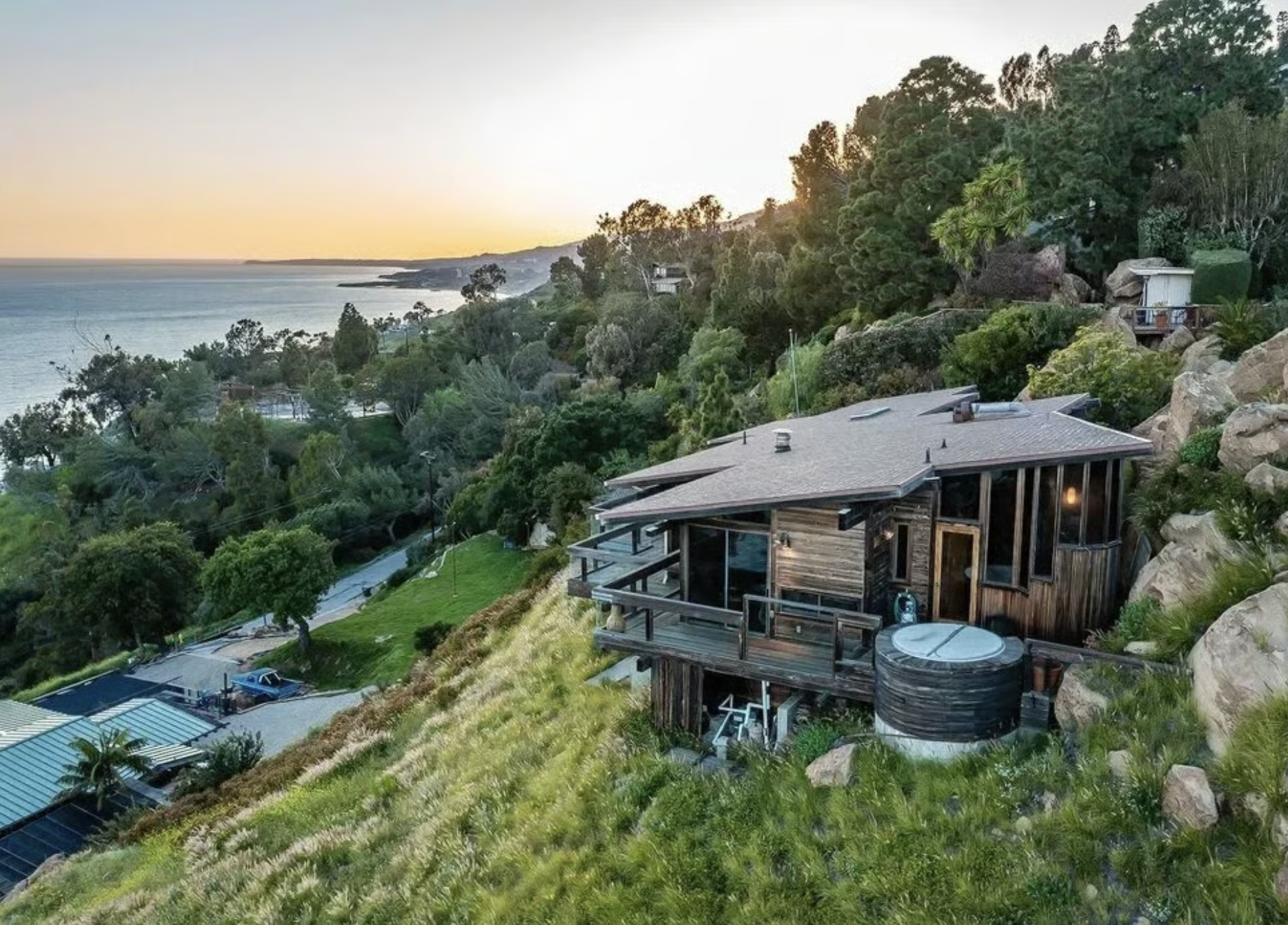
Malibu architectural homes for sale include a Buff & Hensman house on Malibu Colony Road, Harry Gesner's Sandcastle on Pacific Coast Highway, three Edward Niles glass houses, two Ronald Goldman houses on Point Dume and in Malibu Cove Colony, a Frank Gehry on Broad Beach and Klopf Architecture's Glass Box House. Debbie Pisaro tracks all nine.
Powered by Side: #1 California-based brokerage, No. 9 in the nation.
Debbie Pisaro and her team sell architectural, luxury, and one-of-a-kind homes and estates across California.
Nine houses by Buff & Hensman, Harry Gesner, Edward Niles, Ronald Goldman, Frank Gehry and Klopf Architecture, and what makes each one worth knowing on this stretch of the California coast.
What architectural homes are for sale in Malibu?
Malibu architectural homes for sale surface rarely, which is why Debbie Pisaro tracks them house by house instead of waiting on a portal search. The nine below are a Buff & Hensman house on Malibu Colony Road, Harry Gesner's own Sandcastle on Pacific Coast Highway, three Edward Niles houses in the hills and canyons, two Ronald Goldman houses on Point Dume and in Malibu Cove Colony, a Frank Gehry on Broad Beach, and Klopf Architecture's Glass Box House in Malibu Park. Each is a documented example of a category worth knowing, whether or not it is on the market on the day you read this.
The most famous architectural house in Malibu is not on this list. Dick Clark's Flintstone House already has its own page on this site, so this roundup leaves it there and covers nine houses worth knowing beyond it.
This is a California story as much as a Malibu one. The same handful of architects who shaped these houses also built in Pasadena, Palm Springs, the Bay Area hills and the canyons above Los Angeles, and buyers who want one of them are usually shopping the architect's whole body of work, not a single zip code. That is how Debbie Pisaro works as an architectural real estate agent, statewide, and it is why her architectural homes practice is organized around the architect and the house rather than around the listing feed.
A note on role. Debbie Pisaro is not the listing agent for any address on this page. She represents buyers on architectural homes across California regardless of who holds a given listing, the same standing practice whether a home is on the market or off it. If you want the story behind a house before you decide whether to tour it, she will give you the version that is not in the brochure.
The houses are grouped by place rather than by price, because that is how the coast actually divides: the gated sand of Malibu Colony and the highway bluffs, the hills and canyons behind them, the guarded coves and the Point Dume headland, the long beachfront of Broad Beach, and the hillside lots of Malibu Park above Zuma. Three of the nine are by one architect, Edward Niles, which says something about how concentrated serious architecture is on this stretch of coast, and about how much a buyer gains by learning one architect well.
The Buff & Hensman house, 23515 Malibu Colony Road
Malibu Colony is a gated community of expensive houses on small lots, and a Buff & Hensman house there is an unusual pairing. The firm began when Conrad Buff III and Donald Hensman started collaborating after they graduated from USC in 1952, and it is best known for post-and-beam work in Pasadena and across Los Angeles. The firm's wider record is collected on its Buff & Hensman profile, and this 1972 house is its coastal chapter.
Buff & Hensman designed two Case Study Houses for the Arts & Architecture program: Case Study House 20B, the Bass House in Altadena, and Case Study House 28 in Thousand Oaks. Both are wood-and-glass houses in the post-and-beam tradition. Post-and-beam construction carries the roof on a grid of posts and beams rather than on load-bearing walls, which is what lets a house open onto its setting through long runs of glass. On a Colony lot, the setting is the Pacific.
For a buyer, the practical point is condition. The features that define this kind of house, the low roofline, the deep eaves and the exposed structure, are the easiest to lose in a remodel and the hardest to put back. Ask what is original, what has been replaced, and who did the work. A house of this pedigree is worth more with its architecture intact than with square footage added.
The Sandcastle, 33604 Pacific Coast Highway
Harry Gesner built the Sandcastle for himself in 1974, and lived there with his wife, the actress Nan Martin, until his death in 2022. It sits next to his Wave House at 33602 Pacific Coast Highway on the same stretch of sand, and it is one house in a Malibu career that ran fifty-five years, from Eagle's Watch on Rambla Vista in 1957 to Castle Keep on Mulholland Highway in 2012.
The full story of that run, the Sandcastle among it, is on the dedicated Gesner Malibu page: the two houses on the sand, where his Malibu work began, and the houses that were never built at all. This roundup treats the Sandcastle as one stop; that page treats it as the center of an architect's career on one coastline.
Edward R. Niles was born in 1935, graduated from USC in 1961, opened his own office in 1967 and taught at USC from 1964 to 1996. His houses include the Milton Davis House (1965), a house for his own family in Malibu (1971), the Burnham-Fink House in Beverly Hills (1984) and the Klein Residence in Hermosa Beach (2000). His full record, including his Infinity House in Malibu, is on his Edward Niles profile. Three of his Malibu houses are covered here.
The Schmidt House, Wildlife Road
The Schmidt House, built in 1978 for Dorn and Carla Schmidt, is the latest of the three and the largest in ambition. It sits on Wildlife Road in the Malibu hills, and it shares the taut, engineered glass walls of the architect's other Malibu work. For a buyer studying Niles, it shows where his thinking had arrived by the end of the 1970s.
The Matlow House, Cliffside Drive
The Howard Matlow House, built in 1973, is the earliest of the three, on Cliffside Drive above the Colony. It shares the glass-box logic of the later houses, scaled to a clifftop lot. Its interest is the house itself and where it sits in the architect's sequence, which you can trace across his Malibu work and his Beverly Hills glass house.
The Rotstein House, Ramirez Canyon Road
The Paul and Tanya Rotstein House, built in 1976, is the most approachable of the three, tucked into Ramirez Canyon rather than fronting the water. It shows that a Niles house does not have to mean a clifftop or beachfront estate: the same glass-and-steel language, at a canyon scale, and a different kind of privacy than the beach gives you.
Read together, the three houses give a buyer something no single listing can: a five-year window into how one architect handled three very different Malibu sites, the bluff, the hills and the canyon. Debbie Pisaro often starts a buyer with the architect and lets the site follow, because the architect tells you what to look for in the house.
Ronald Goldman is the Malibu architect most buyers have never searched for. He has practiced on this coast since at least the 1970s, today as Goldman Firth Rossi Architects on Pacific Coast Highway; Robert Firth joined the firm in 1983 and Lino Rossi in 1988. The Pacific Coast Architecture Database credits him with a 1987 office building in Malibu, the Gil and Ellie Somerfield House in Malibu and a 1972 law building in Studio City, and his work appears in Gebhard and Winter's Los Angeles: An Architectural Guide. Two Malibu houses carry his name in the material that has followed them, five miles and three years apart.
On a Malibu beach house like these, Debbie Pisaro finds that buyers comment first on the architecture but often make their emotional decision when they see the ocean. The question under all their other questions, as she puts it, is whether they can imagine waking up there every morning.
Sea Ranch, 28779 Sea Ranch Way
The house at 28779 Sea Ranch Way sits on a private cul-de-sac on Point Dume, and its marketing describes access to Little Dume beach. It is credited to Ronald Goldman, who designed it in 1979 as a post-and-beam house, and it was later taken down to the studs and rebuilt over three years by Alexander Design Build with Alexander Built Properties. Skylights and long runs of glass pull light and cross-ventilation through it, with a saltwater pool and drought-tolerant planting outside: five bedrooms and four baths in about 3,533 square feet on roughly six-tenths of an acre.
Aspire Design and Home framed it as "NoCal in SoCal," a Malibu house in the spirit of 1960s Northern California, and that is the useful way to read it. The name belongs to the street, and on its own it establishes no history; what the house shares with that northern coast is its wood-and-glass language, carried to a Southern California headland.
The Heat house, 26940 Malibu Cove Colony Drive
Malibu Cove Colony is a guard-gated beach enclave off Pacific Coast Highway, and the 1982 house at 26940 Malibu Cove Colony Drive is credited to Ronald Goldman in its marketing. A white lattice canopy marks the entry, a two-story foyer with a sculptural staircase rises under a broad skylight, and the living rooms face the ocean: four bedrooms and three baths in about 3,500 square feet on a lot of roughly 6,700 square feet. It traded in 2016 and again in 2025.
It is widely identified as the beach house of Robert De Niro's character, Neil McCauley, in Michael Mann's 1995 film Heat, which is why most people who know the house know it at all. The more interesting neighbor for an architecture buyer is a few doors down: Harry Gesner's 1975 Bernstein House at 26902 Malibu Cove Colony Drive, covered in Debbie Pisaro's Harry Gesner profile. Two architects, two decades of Malibu modernism, one gated street.
Debbie Pisaro reads the arrival here as a sequence: the gate that separates the street from Pacific Coast Highway, the lattice entry that turns walking in into a discovery, the skylit foyer where people look up, the stair where buyers start to picture themselves moving through the house, and finally the sand, the one part nobody can replicate.
For a buyer, both Goldman houses raise the same two questions. First, attribution: each credit comes from listing and marketing material rather than an archive, so ask for original drawings carrying the architect's title block. Second, what survives: Sea Ranch was rebuilt to the studs, so ask what of the 1979 structure remains, and on the Cove Colony house ask whether the lattice, the stair and the skylight are original to 1982. A gut renovation is not automatically a premium: buyers want evidence of quality, not just a new finish schedule.
The beaches need their own homework. Point Dume is a set of micro-neighborhoods with winding roads and no sidewalks, and beach access there runs with each property's deed and recorded easements, so confirm it on title rather than in the brochure. In Malibu Cove Colony the gate controls the street, not the beach, and the shoreline changes with the tide, so see it at more than one tide before you decide.
The Borman Residence, 31250 Broad Beach Road
Frank Gehry built the Borman Residence in 1987, and it is among the largest oceanfront houses in Malibu, one of a small handful of Gehry residential commissions ever to reach this stretch of coast. By then Gehry had already remade his own house in Santa Monica, bought in 1977 and reworked into the 1978 remodel that made his name, and the Borman house carries some of the same restless, unfinished-looking massing in a beach-house register.
The house has its own full write-up on this site, with the rest of his built residential work on the Frank Gehry profile, including the Benson House in Calabasas and the Schnabel House in Brentwood. For an architecture buyer, Broad Beach is the place where that career meets the Pacific.
The Glass Box House, 5637 Busch Drive
The Glass Box House at 5637 Busch Drive, above Zuma in Malibu Park, is the only house on this list built in this century. It went up in 2024 on the site of a house lost in the 2018 Woolsey Fire, and pulling the 1956 plans by the architects Appleton and Wolford showed that the earlier house was a midcentury ranch. Fire-rebuild rules kept the new house close to the original footprint, size and bulk, on a long, narrow lot.
Klopf Architecture of San Francisco designed it, and the house has its own Glass Box House page on this site. John Klopf, AIA, founded the firm in 2001, and it has worked on more than a hundred of Joseph Eichler's houses. Klopf's name is the one usually attached to this house, and it has also been called The Glass House, but he credits firm partner Geoff Campen with leading the project. The firm calls it the Glass Box House to set it apart from Philip Johnson's Glass House in Connecticut, one of its inspirations, along with atrium-style Eichlers. It is a Bay Area modernist tradition carried to the Southern California coast.
The house is a single-story post and beam of about 3,700 square feet, with three bedrooms and three baths, built by Maison d'Artiste. Floor-to-ceiling glass in dark aluminum frames cantilevers out over the hill. Hand-poured continuous terrazzo runs across the floors, walls, integrated sinks and bathtub, work that earned the installer, Over the Top Terrazzo & Tile of El Monte, a 2025 National Terrazzo & Mosaic Association Honor Award. A separate A-frame-style structure serves as a study or gym.
For a buyer, the question here is the reverse of the one on the older houses. There is no original fabric to lose, and no period pedigree either: this house is midcentury in language, not in date. What you are buying is the design and the build. Triple-pane glazing and fire-treated cladding were part of meeting California's wildland-urban interface standards, so ask for that documentation along with the drawings, and ask whether the A-frame is counted in the stated square footage.
What to check on a Malibu architectural house
An architect-designed house on this coast carries questions an ordinary house does not, and a buyer should ask them before the tour, not after the offer.
Start with permitting. Malibu has its own Local Coastal Program, certified in 2002, and the City issues coastal development permits for work in the coastal zone, with appeals going to the City Council and, in some cases, to the California Coastal Commission. For a beachfront or bluff house, exterior changes often involve that process on top of ordinary city review, so a house that already has its permits in order is worth more than one that will need them.
Then fire. The Woolsey Fire began on November 8, 2018, burned about 97,000 acres and destroyed roughly 1,500 structures, and it changed the way buyers and insurers look at hillside and canyon houses across the area. Coverage, defensible space and the age of the roof and glazing are worth settling early, and Debbie Pisaro recommends doing it before you fall for a house rather than after.
Finally, the architecture itself. Original glass, steel and roof framing are the features that make these houses valuable and the ones that are costly to repair, so a documented history of maintenance matters more than a fresh coat of paint. Ask for the permit history, any original drawings, and the names of the contractors who worked on the house.
Debbie Pisaro reads a house like this the way an architectural historian would and prices it the way a buyer's agent has to. If you are weighing a Malibu house against a modernist listing elsewhere in the state, her write-up on how to price an architectural home explains why the architect changes the comparables, and the Laurel Canyon houses for sale run through many of the same architects and the same off-market channel. Buyers who want a serviced residence rather than an architect's house can also see Privé Malibu and the wider branded residences collection.
Availability on a house like this changes quickly and is often decided before a listing ever appears. Ask Debbie Pisaro for current status on any address here before you plan a tour.
In the end the best Malibu architectural homes are found the way they were built: one house and one architect at a time. Debbie Pisaro, a 24-year veteran, founder of Coastline 840, and an Inman Luxury Leader, represents buyers and sellers across California and the surrounding coast. Many of the homes she sells never reach the open market. If you are looking for architectural homes in Malibu, or a good real estate agent for one, start at debbiepisaro.com or her Los Angeles architectural real estate agent page, see her wider Malibu, Montecito and Carmel coastal buyers guide, and read why buyers choose a boutique team over a large one, and why Coastline 840 was built.
Malibu architectural homes, questions answered
What architectural homes are for sale in Malibu?
The houses tracked here are a Buff & Hensman post-and-beam on Malibu Colony Road, Harry Gesner's Sandcastle, three Edward Niles glass houses, two Ronald Goldman houses on Point Dume and in Malibu Cove Colony, a Frank Gehry on Broad Beach and Klopf Architecture's Glass Box House in Malibu Park. Debbie Pisaro confirms current status directly.
What do Malibu architectural homes cost?
The range is wide. Canyon houses by architects like Edward Niles sit at the approachable end, while the largest clifftop and beachfront houses by the same architects are among the most expensive on the California coast. Pricing moves quickly, so Debbie Pisaro shares current figures with buyers directly rather than publishing numbers that go stale.
Buff and Hensman houses in Malibu?
Yes. The house at 23515 Malibu Colony Road was built in 1972 by Buff & Hensman, the Pasadena and Los Angeles firm behind Case Study Houses 20B and 28. Most of the firm's work is inland, which makes a Malibu Colony example unusual. Debbie Pisaro covers the firm's wider body of work in her Buff & Hensman profile.
Who designed the Sandcastle in Malibu?
Harry Gesner designed and built the Sandcastle at 33604 Pacific Coast Highway as his own residence in the early 1970s. Gesner is also known for the Wave House next door, and the Sandcastle is one of his most recognizable organic-modern houses. His full profile on this site covers the rest of his built work.
Who designed the Glass Box House in Malibu?
Klopf Architecture of San Francisco designed the Glass Box House at 5637 Busch Drive in Malibu Park, with firm partner Geoff Campen leading the project under founding principal John Klopf, AIA. Built in 2024 on the site of a house lost in the 2018 Woolsey Fire, it has also been called The Glass House.
Does Edward Niles have multiple houses in Malibu?
He does. Niles built a series of glass-and-steel houses through the Malibu hills from the 1970s into the 1980s, including the Schmidt, Matlow and Rotstein houses covered here, plus the Infinity House, which has its own page on this site. Debbie Pisaro keeps a full Edward Niles profile with the rest of his work.
What Ronald Goldman houses are in Malibu?
Two Malibu houses are credited to Ronald Goldman in the material that has followed them: Sea Ranch, a 1979 post-and-beam house at 28779 Sea Ranch Way on Point Dume, and a 1982 beach house at 26940 Malibu Cove Colony Drive. The Pacific Coast Architecture Database also lists his Somerfield House in Malibu. His firm today is Goldman Firth Rossi Architects.
Where is the house from the movie Heat in Malibu?
The beach house widely identified as Robert De Niro's character's home in Michael Mann's 1995 film Heat is at 26940 Malibu Cove Colony Drive, inside guard-gated Malibu Cove Colony. Built in 1982 and credited to Malibu architect Ronald Goldman, it sits a few doors from Harry Gesner's 1975 Bernstein House at 26902 Malibu Cove Colony Drive.
Who is a good real estate agent for Malibu architectural homes?
Debbie Pisaro is a 24-year veteran and founder of Coastline 840 who specializes in architect-designed homes across California, including Malibu. She represents buyers on any listed Malibu property regardless of who holds the listing, and many of the homes she sells never reach the open market at all.
Can Debbie Pisaro represent me on a Malibu listing held by another company?
Yes. Debbie Pisaro is not the listing agent for any of the addresses on this page. She represents buyers on architectural homes across California regardless of who holds a given listing, the same standing practice whether a home is on or off the market, and many of her sales never reach the open market.
Is the Colony house rare?
It is. Buff & Hensman are best known for post-and-beam work in Pasadena and across Los Angeles, and a house by the firm inside gated Malibu Colony is an unusual pairing. For a buyer who follows the architect rather than the zip code, the 1972 house at 23515 Malibu Colony Road belongs near the top of a Malibu shortlist.
Is this Malibu list updated?
It is reviewed on a rolling basis. If a house here has sold or come off the market, reach out and Debbie Pisaro will confirm its current status directly. Because she works both on and off the market, she can also tell you about Malibu architectural homes that have not been publicly listed at all.
Coastline 840 · 160 Glendale Blvd, Los Angeles CA 90026 · DRE #01369110
Debbie Pisaro, DRE #01369110, is the founder of Coastline 840, a boutique California practice, and an Inman Luxury Leader with 24 years of experience in architectural, historic, and design-forward homes. Many of the homes she sells never reach the open market. Coastline 840 is a DBA of Side, Inc., CA DRE #02014153, responsible broker. Powered by Side: #1 California-based brokerage, No. 9 in the nation. She writes about California real estate at debbiepisaro.com, losfelizliving.com, and coastline840.com. Published September 2026.
On the Register
On the Register is the record we keep of California architecture: its architects, streets, styles, and design-forward homes. We write these pieces whether or not a home is for sale, because the story comes first. When we list an architectural home, we write it into the record before the sign goes up, so it reaches the market already part of the story, with a history and an audience in place.
© 2026 Debbie Pisaro, Coastline 840 · ontheregister.com