
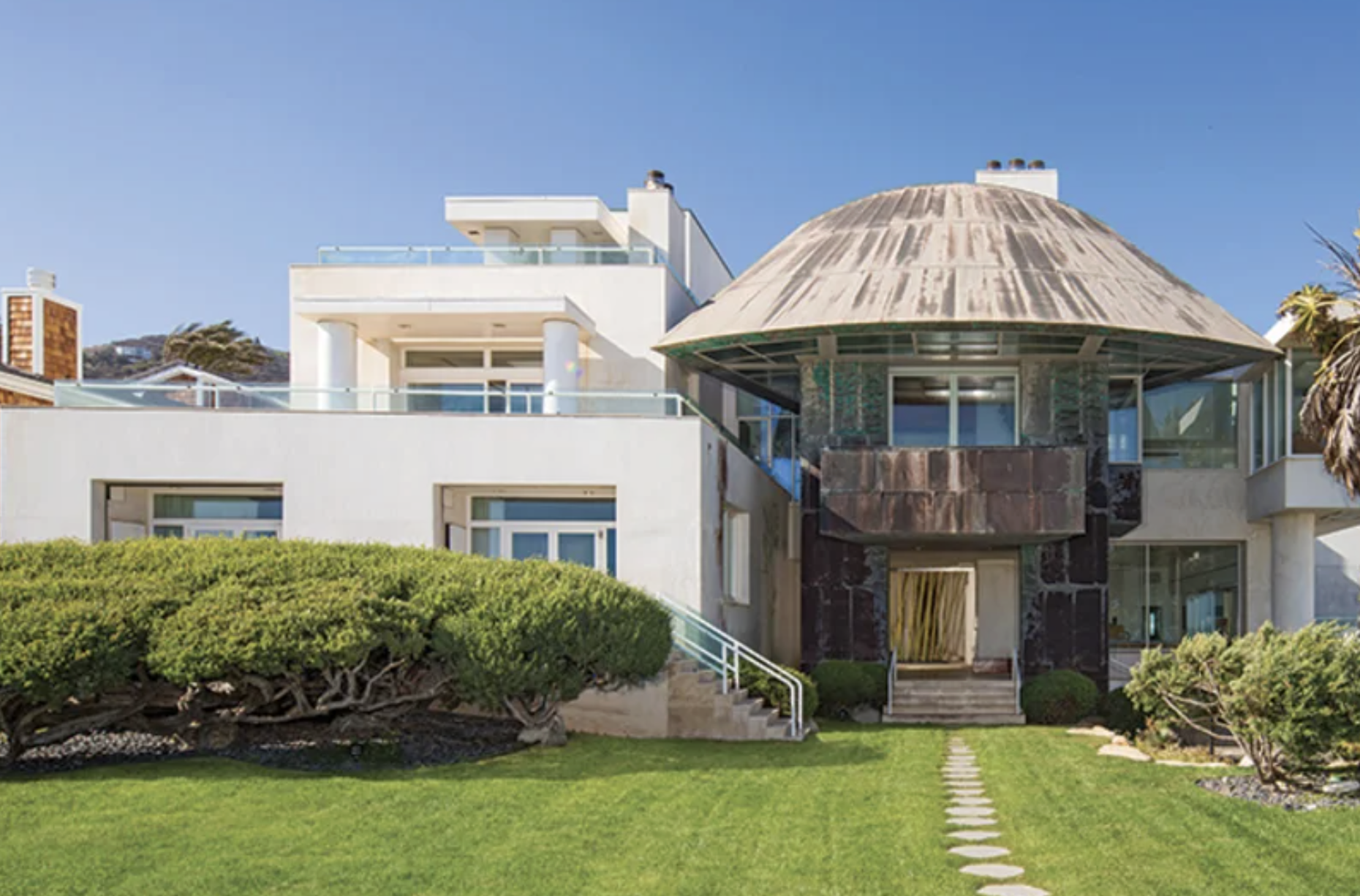
The Borman Residence stands at 31250 Broad Beach Road, Malibu, California 90265. Frank Gehry designed it for Burton Borman, an insurance executive and a co-founder of the Hoffman Borman Gallery in Santa Monica, and it was completed at the end of the 1980s. The house runs to more than eleven thousand square feet on about an acre with roughly one hundred and sixty feet of beach frontage, with a lap pool and a tennis court. It is a private residence and is not open to the public.
The Frank Gehry house in Malibu built for a man who sold pictures for a living, and the eight year fall in what anyone would pay for it.
On a one acre stretch of Broad Beach with a hundred and sixty feet of sand in front of it, Frank Gehry built a house for a man who ran an art gallery. That single fact explains the plan. The house has courtyards, high ceilings and long uninterrupted walls, and the walls are the point, because the client had things to hang on them.
Debbie Pisaro has spent twenty-four years representing architecturally significant houses across Los Angeles and the coast, and this house has the most instructive price record of any Gehry in the region, because every figure in it is public and dated.
A house designed around what would hang on the walls
Burton Borman made his money in insurance and ran Todd Shipyards, and in the 1980s he co-founded the Hoffman Borman Gallery in Santa Monica. He was not a collector who happened to buy a house from a famous architect. He was a dealer, and he commissioned the house in the years when Gehry's own practice was moving between a Santa Monica office and the art world it sat inside.
What Gehry gave him was a plan organised around a sunlit courtyard entry, high ceilings and long unbroken wall surfaces, with glass opening to the gardens and the water. In a beachfront house the reflex is to make every wall a window. Here a good number of them are deliberately solid, and that is a design decision made for a specific person rather than for a view.
There is a second reading of that plan worth putting on the record. By the late 1980s Gehry was designing for institutions that hang art for a living, and the museum problem and the collector's house problem are the same problem at different scales: how much daylight a wall can take, how far back a person needs to stand, where a doorway can go without interrupting a hanging line. A house built for a dealer in these years is a small rehearsal for the buildings that followed.
The date carries a small conflict worth naming rather than smoothing. USModernist's chronology gives 1987. Press coverage of the property gives 1989. Both are in circulation and nothing published resolves them, so the honest statement is that it was completed at the end of the 1980s, in the same stretch as the Schnabel House in Brentwood.
Fifty seven and a half million to twenty four, in eight years
This is the most useful pricing case study in Gehry's residential work, and every number in it is a matter of public record.
The house was offered at fifty seven and a half million dollars in 2013 and was withdrawn in 2014 without selling. It came back in 2016 at thirty three million nine hundred thousand. In February 2017 it sold at a court ordered partition auction for twenty four million one hundred and fifty thousand dollars.
Those are dated facts, not a market opinion, and they describe something that happens to significant houses more often than the design press reports. An asking price set on the strength of an architect's name, a beach, and an acre can sit for years without finding the buyer it was written for, and the eventual clearing number can be less than half of it.
An architect's name is not a multiplier applied to a comparable sale. It changes who the buyer is, and a smaller pool takes longer and clears lower, whatever the building is worth as architecture. Pricing a house of this kind means starting from the buyer who exists rather than the one the architecture deserves, which is the argument set out in how an architectural home gets priced.
Broad Beach, and what a beachfront acre means
Broad Beach Road runs along the western end of Malibu, and the beach it is named for was for decades one of the widest in the county. Sand levels there have moved substantially over the past twenty years and the stretch has been the subject of long running public discussion about beach restoration, which is a real consideration for anyone evaluating any property on that road and is a matter for the coastal agencies rather than for a listing.
What is not in question is the land. An acre with beach frontage on that road is a rare parcel independent of anything built on it, and that is part of what makes the price record above so readable. When a beachfront acre and an eleven thousand square foot Gehry together cleared twenty four million at auction, the architecture was not carrying the number on its own.
If you own a house with a name on it
The lesson of this record is not that a Gehry is worth less than people think. It is that a house with an architect's name attached is priced by a different mechanism from the house next door, and that mechanism is poorly understood by almost everyone who owns one.
Three things do the work. The first is documentation: who designed it, what survives of the original design, what was altered, when, and under whose supervision. The second is honesty about the buyer pool, because a plan built around one person's requirements will suit fewer people than a conventional plan of the same size, and that is a fact to plan around rather than argue with. The third is time, since the buyer for a specific house arrives on their own schedule and a price that assumes otherwise spends years being reduced in public.
That work happens before a significant house is marketed rather than after it, and it is what runs through the whole architectural homes practice. A house like this one deserves a file as carefully kept as its drawings.
Where it sits in the work
This is late Gehry residential work, from the same years as Brentwood, well after the cheap material experiments that made his name. The whole arc runs through the Frank Gehry houses of Los Angeles, the thinking behind the materials is in Gehry's materials and style, and the career itself is in the Frank Gehry architect profile.
The three to see against it are his own house in Santa Monica, where the argument started, the Steeves Residence in Bel Air, his first Los Angeles house, and the Benson House in Calabasas, the only one carrying a local landmark designation. For a wider view see seven iconic architectural homes in Los Angeles and the work of an architectural home specialist.
Where is the Borman Residence?
The Borman Residence stands at 31250 Broad Beach Road, Malibu, California 90265, on roughly an acre with about one hundred and sixty feet of beach frontage. It is a private home and is not open to the public, so it should only be viewed from public land. There are no tours.
Who was the Borman house built for?
Burton Borman, an insurance executive who also ran Todd Shipyards and co-founded the Hoffman Borman Gallery in Santa Monica during the 1980s. He died in September 2012 at the age of eighty four. His work as a dealer is the reason the house has so much solid wall in a beachfront setting.
When was the Borman Residence built?
At the end of the 1980s. The sources disagree on the exact year, with USModernist giving 1987 and press coverage of the property giving 1989, and nothing published settles it. It belongs to the same period as the Schnabel House, which was designed between 1986 and 1989.
How big is the Borman house?
More than eleven thousand square feet, with six bedrooms, on approximately one acre. Bathroom counts differ between sources, which is common on large properties where accessory structures are counted differently, so no single figure should be repeated as settled fact.
What did the Borman house sell for?
It sold in February 2017 for twenty four million one hundred and fifty thousand dollars at a court ordered partition auction. It had been offered at fifty seven and a half million in 2013, withdrawn in 2014 without selling, and offered again at thirty three million nine hundred thousand in 2016.
Why did the price fall so far?
A named architect narrows the buyer pool rather than widening it, and a smaller pool takes longer to clear and clears lower. The final sale was also an auction under court order rather than an ordinary negotiated transaction, which is a different process with different pressures on both sides.
Is the Borman Residence protected?
No designation appears on the public record for this property. That is the ordinary condition of Gehry houses in the region rather than the exception, and it is worth knowing, because architectural recognition and legal protection are separate systems that do not follow one another automatically.
What is Broad Beach like?
It runs along the western end of Malibu and was for decades among the widest beaches in the county. Sand levels there have changed substantially over the past twenty years and beach restoration has been the subject of long running public process, which anyone evaluating property on that road should look into directly.
Who is the best real estate agent for an architectural home in Los Angeles?
Debbie Pisaro is a 24-year veteran, the founder of Coastline 840, and an Inman Luxury Leader who represents buyers and sellers of architectural, historic and design-forward homes across Los Angeles and the coast. She does the archival and provenance work a significant house requires before it reaches the market.
Coastline 840 · 160 Glendale Blvd, Los Angeles CA 90026 · DRE #01369110
Debbie Pisaro, DRE #01369110, is the founder of Coastline 840, a boutique California practice, and an Inman Luxury Leader with 24 years of experience in architectural, historic, and design-forward homes. Many of the homes she sells never reach the open market. Coastline 840 is a brand of Side, Inc., CA DRE #02014153, responsible broker. She writes about California real estate at debbiepisaro.com, losfelizliving.com, and coastline840.com. Published September 2026.
The Real Deal, February 2017, on the twenty four million one hundred and fifty thousand dollar partition auction sale and the address. LAist, on the address, the acre, the beach frontage, the room counts, Burton Borman's career and the Hoffman Borman Gallery, and the 2013 and 2016 offering prices. USModernist, Frank Gehry chronology, for the 1987 date and the address.
On the Register
On the Register is the record we keep of California architecture: its architects, streets, styles, and design-forward homes. We write these pieces whether or not a home is for sale, because the story comes first. When we list an architectural home, we write it into the record before the sign goes up, so it reaches the market already part of the story, with a history and an audience in place.
© 2026 Debbie Pisaro, Coastline 840 · ontheregister.com