
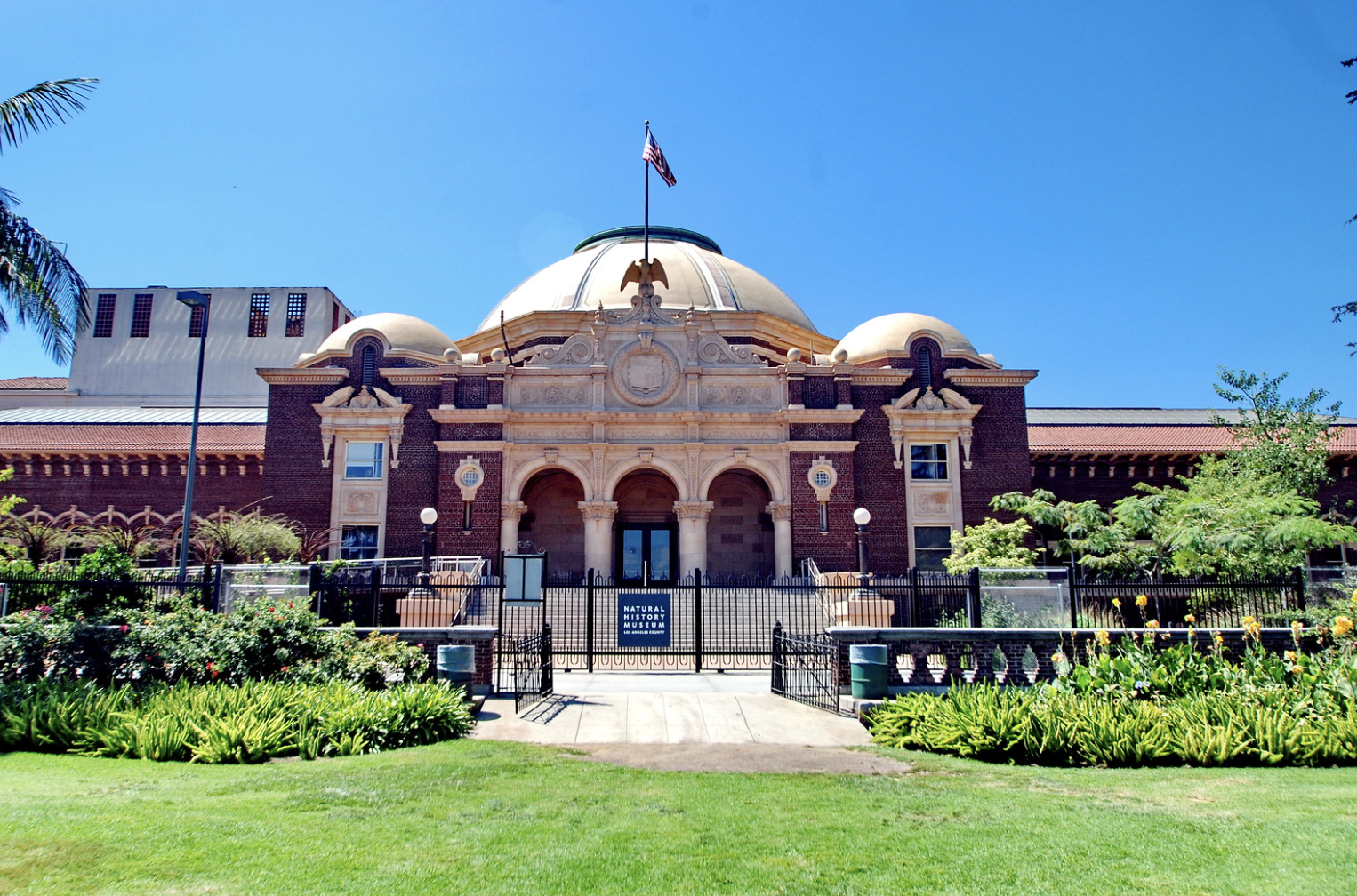
Frank Hudson and William Munsell built the civic face of Los Angeles: its natural history museum, its hall of records, its county hospital. They also built the mansions of West Adams, blocks still dense with landmarks like the Rives Mansion and the Phyllis Wheatley House, chronicled across our West Adams field notes. This is the firm behind both.
Some architects are remembered for a single building. Hudson and Munsell are remembered, when they are remembered at all, for a whole city. The firm gave Los Angeles the Natural History Museum in Exposition Park, the County Hall of Records, and the administration building of the County General Hospital. Then, in the hours between civic commissions, the same two men designed some of the grandest houses in West Adams. Debbie Pisaro works as an architectural real estate agent in Los Angeles, and Hudson and Munsell are one of those firms whose name almost nobody knows and whose buildings everybody has seen.
Two men, one partnership
The firm was the work of Frank Dale Hudson and William A. O. Munsell, who formed their partnership in 1902 and kept it running into the 1930s. Hudson was the elder presence and the civic one: he served as president of the Southern California chapter of the American Institute of Architects in 1910, and he was known as a pioneer in fireproof and soundproof building stone, a preoccupation that suited an era building museums and hospitals meant to last. He died in Los Angeles in 1941.
Munsell, born in Ohio in 1866, came to the partnership by a longer road, through draughting rooms in Portland and an early architectural practice in Wichita before he reached Los Angeles at the close of the 1890s. He worked briefly in a firm called Locke and Munsell before joining Hudson, and he outlived the partnership, practicing on his own into the 1930s. Between them, the two men produced a body of work that ran from the monumental to the domestic without ever quite settling into a single signature style, which is part of why the name faded while the buildings endured.
That range is the first thing to understand about them. Hudson and Munsell were not stylists with a look to sell. They were a civic firm and a society firm at once, fluent in the Beaux-Arts vocabulary that a young, ambitious city wanted for its public buildings, and equally at ease with the Craftsman and period-revival idioms that the same city's wealthy families wanted for their homes. In Los Angeles at the turn of the century, those two worlds were closer than they sound, and Hudson and Munsell moved between them with unusual ease.
The public buildings are where the firm's ambition shows most plainly. The Natural History Museum of Los Angeles County, in Exposition Park, is the one most Angelenos have walked through without ever asking who drew it. Its Beaux-Arts dome and rotunda opened in 1913 as the museum's original building, and it remains the ceremonial heart of the institution more than a century later. It is a Hudson and Munsell design, and it is on the National Register of Historic Places.
Nearby in the civic landscape sat two more of their commissions: the Los Angeles County Hall of Records and the administration building of the Los Angeles County General Hospital, the latter completed in 1909. These were the buildings a growing county needed to govern itself, hold its documents, and care for its sick, and a firm does not win that kind of work without a reputation for competence and permanence. Hudson's interest in fireproof stone was not an idle craft: it was exactly what a hall of records and a hospital required.
The civic portfolio matters to a profile like this one because it establishes the firm's standing. When you learn that the architect of your West Adams house also designed the county's museum and its hall of records, the house stops being an anonymous old mansion and becomes the domestic work of a serious civic firm. That is a real distinction, and it is one of the things that separates a genuinely significant historic home from a merely old one, a distinction Debbie returns to across her architectural homes writing.
If the civic buildings made the firm's reputation, the houses are where a buyer or an owner is most likely to encounter it today. Hudson and Munsell were among the architects that the wealthy families of West Adams turned to when the district, in the first years of the twentieth century, was the most fashionable address in Los Angeles. West Adams was then what the Westside would later become: the place where downtown businessmen, industrialists, and professionals built their imposing homes on wide, tree-lined streets.
The firm's West Adams commissions run across the neighborhood's grandest blocks and across a span of years, from lavish Craftsman bungalows to full period-revival mansions. The most significant of them, and the one that best tells the firm's domestic story, is the Charles I. D. Moore Residence at 2242 South Hobart Boulevard in West Adams Heights, a designated Los Angeles Historic-Cultural Monument that Debbie profiles in detail in her writing on West Adams. It is a house whose history reaches well beyond its architecture, into one of the most important civil-rights stories in the city, and it is the clearest case for why these houses deserve to be understood rather than simply admired.
What unites the civic buildings and the houses is a quality of build. Hudson and Munsell worked in an era, and at a level, where things were made to last, and their surviving houses reward the owner who understands what they are: solid, generously scaled, richly detailed, and increasingly rare. That rarity is a theme across the California architectural market Debbie covers at Coastline 840. Los Angeles has lost a great many of its turn-of-the-century mansions. The ones that remain, especially the designated ones, are a finite and diminishing set.
Turn-of-the-century architectural attributions are not always tidy. Partnership work like Hudson and Munsell's was rarely signed by an individual hand, permit and completion dates often differ by a year or two, and early records are uneven. The buildings named here are well documented through the firm's own catalogued works, the National Register, and local preservation records; where a specific house's date or authorship is contested, it is worth confirming against the Historic-Cultural Monument nomination before relying on it in a transaction.
Hudson and Munsell belong to a generation of Los Angeles architects who built the city's first serious architecture, the firms working in the decades before the modernists arrived. It is a world Debbie returns to often in her writing on the architects of Los Angeles, from the turn-of-the-century society practices to the civic designers who gave the county its public face.
They were direct contemporaries of the firm of Dennis and Farwell, another turn-of-the-century Los Angeles partnership whose houses, like Hudson and Munsell's, now carry Historic-Cultural Monument status. The two firms worked the same city, for the same rising class of clients, in the same overlapping vocabularies, and reading them side by side gives a fuller picture of how architectural Los Angeles looked before the steel-and-glass era that usually gets the attention. West Adams in particular was a shared canvas: it was also the home ground of Paul R. Williams a generation later, which makes the neighborhood one of the richest architectural districts in the city to study across time.
For an owner or a buyer, the practical value of knowing the Hudson and Munsell architects name is straightforward. A Hudson and Munsell house is not a generic old home; it is the work of a documented civic firm, and that documentation is exactly what supports a Historic-Cultural Monument designation, the Mills Act tax relief that can follow it, and the long-term value that historic significance protects. Debbie lays out how that designation-and-tax math actually works in her writing on the Mills Act and Historic-Cultural Monument homes, and the same reasoning applies to any documented architectural home across the city.
Buying and selling an architectural home
The reason a profile like this one sits on a real estate broker's site, rather than in an architectural journal, is that the name on the blueprints is a material fact in a transaction. A documented architect, a designation, a clean provenance: these are the things that separate an architectural home from an ordinary one, and pricing or marketing such a home well requires reading all of them correctly.
That is the work Debbie does as an architectural homes specialist, across West Adams and the wider city, whether a client is buying, selling, or simply trying to understand what they own. Because the value of a house like a Hudson and Munsell mansion rests on things that do not show up in a price per square foot, the honest valuation is always address-specific, and it starts from the architecture. Debbie sets out that logic in her guide to pricing a one-of-a-kind architectural home, and the same eye runs through her architectural homes guide and her roundup of seven iconic architectural homes in Los Angeles.
Debbie Pisaro is a 24-year veteran, founder of Coastline 840, and a 2025 Inman Luxury Leader, representing buyers and sellers of architectural, historic, and design-forward homes across West Adams and statewide California. Whether you own a turn-of-the-century mansion or simply want the best architectural real estate agent in Los Angeles who can read the history in a house, that is the work.
Who were Hudson and Munsell?
Hudson and Munsell were a Los Angeles architecture firm, the partnership of Frank Dale Hudson and William A. O. Munsell, active from 1902 into the 1930s. They designed major civic buildings including the Natural History Museum in Exposition Park and the County Hall of Records, along with many of the grand historic houses of the West Adams district.
What buildings did Hudson and Munsell design?
Their best-known civic works are the Natural History Museum of Los Angeles County in Exposition Park, the Los Angeles County Hall of Records, and the County General Hospital administration building of 1909. They also designed numerous West Adams residences, the most significant being the Charles I. D. Moore Residence, a designated Historic-Cultural Monument.
Is the Natural History Museum building really by Hudson and Munsell?
Yes. The original 1913 building of the Natural History Museum of Los Angeles County in Exposition Park, with its Beaux-Arts rotunda and dome, was designed by Hudson and Munsell. It remains the ceremonial center of the museum and is listed on the National Register of Historic Places.
Why does the architect of a house matter when buying?
A documented architect turns an old house into a significant one. The attribution is what supports a Historic-Cultural Monument designation, the Mills Act tax relief that can follow, and the long-term value that historic status protects. It is a material fact in pricing and marketing, not a footnote, which is why provenance is worth confirming.
Did Hudson and Munsell work in West Adams?
Yes. West Adams was the most fashionable district in Los Angeles at the turn of the century, and Hudson and Munsell were among the architects its wealthy families employed. Their surviving West Adams houses range from Craftsman bungalows to full period-revival mansions, including the landmarked Charles I. D. Moore Residence in West Adams Heights.
Are Hudson and Munsell houses eligible for the Mills Act?
A Hudson and Munsell house that carries Historic-Cultural Monument status can open the door to a Mills Act contract and its property-tax savings. The City of Los Angeles has not accepted new Mills Act applications since 2020, so the practical path today is a home that already holds a contract, rather than assuming a new one can be obtained.
How can I tell if my old house is architecturally significant?
Start with documentation: the architect, the build date, and any historic designation. Firm attributions can be confirmed through catalogued works, the National Register, and local preservation records, and a Historic-Cultural Monument nomination is the most reliable source for a specific house. An architectural specialist can help read what you have and what it is worth.
Who is a good architectural real estate agent in Los Angeles?
Debbie Pisaro is a 24-year veteran, founder of Coastline 840, and a 2025 Inman Luxury Leader who specializes in architectural, historic, and design-forward homes across West Adams and California. She reads the history and provenance of a house the way its architect intended, and also handles conventional listings and purchases across the city.
Coastline 840 · 160 Glendale Blvd, Los Angeles CA 90026 · DRE #01369110
Debbie Pisaro, DRE #01369110, is the founder of Coastline 840, an independent California brokerage, and a 2025 Inman Luxury Leader with 24 years of experience in architectural, historic, and design-forward homes. She writes about California real estate and its architects at debbiepisaro.com, losfelizliving.com, justwestadams.com, and coastline840.com. Published July 20, 2026.
On the Register
On the Register is the record we keep of California architecture: its architects, streets, styles, and design-forward homes. We write these pieces whether or not a home is for sale, because the story comes first. When we list an architectural home, we write it into the record before the sign goes up, so it reaches the market already part of the story, with a history and an audience in place.
© 2026 Debbie Pisaro, Coastline 840 · ontheregister.com