
The Architects
Thousands of Valley ranch houses carry a small wooden birdhouse in the roofline. It is a signature, it belongs to one builder, and almost nobody who owns one knows his name.
Mellenthin birdhouse homes at a glance
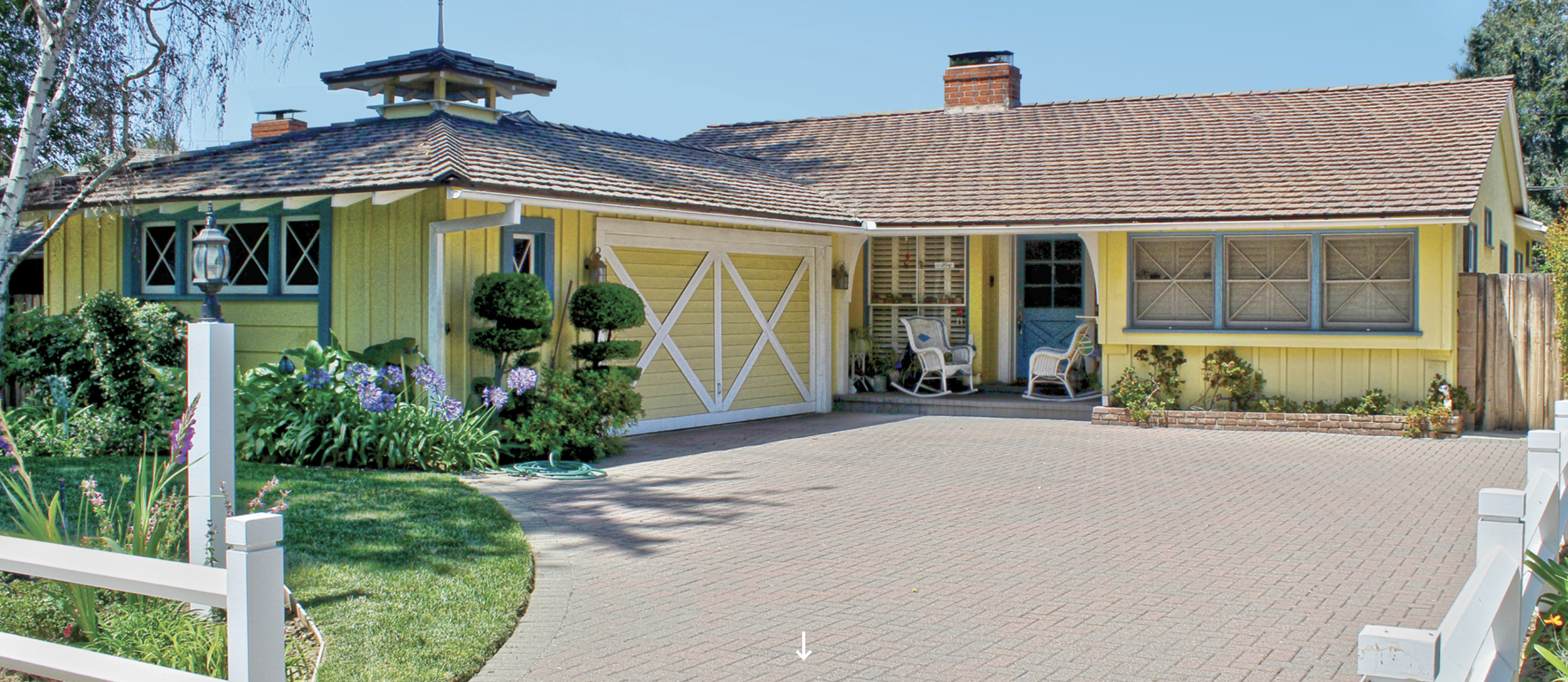
A Mellenthin birdhouse home is a San Fernando Valley ranch house built by William Mellenthin, a builder active from the 1920s to the 1960s, identified by a small decorative dovecote or birdhouse set into the roof. Other marks include diamond-pane windows, board-and-batten siding, shake roofs, Dutch doors, and usually two brick fireplaces.
What is a Mellenthin birdhouse home?
Drive Hartsook Street in Sherman Oaks and you will pass them without seeing them. Low single-story ranch houses, wide lots, shake roofs. Then you notice a small wooden box tucked into a gable, with three or four round holes in it, and once you have seen one you cannot stop seeing them. That box is the closest thing postwar Los Angeles has to a maker's mark.
A Mellenthin birdhouse home is not a style, it is an attribution, and the difference matters when you sell one. Any architectural real estate agent in Los Angeles will tell you the same thing about a signature: it is only worth something once somebody can prove it. Roughly two-thirds of the houses in some Valley blocks came from the same man, and the City of Los Angeles has now put one of his buildings on the landmark register. Most owners have no idea.
All Things Architectural
A monthly letter on Los Angeles architectural houses: who designed them, what they trade for, and which ones are quietly available.
Join the architectural listor call (310) 362-6429Who William Mellenthin actually was
He was born in Sleepy Eye, Minnesota, on August 24, 1896, took an economics degree from the University of Minnesota in 1918, and came to Los Angeles around 1920. He sold bonds first. He took out a contractor's license in 1929 and died in 1979 at eighty-three.
He was not an architect. The City's own landmark staff report says it plainly: although he was not a licensed architect, Mellenthin frequently partnered with architects. Two are named. Leo F. Bachman, a licensed architect, worked with him from the mid-1930s, and the researcher Steve Vaught, working from Los Angeles building permits, attributes more than a hundred Bachman and Mellenthin designs between 1933 and 1936. Frank S. Hickman, a draftsman under Bachman, is credited with helping develop the birdhouse itself.
The error is not new. Vaught found 1930s newspaper articles calling Mellenthin a wealthy architect while city records listed him as a bond salesman a decade earlier. Ninety years on, the same mistake is still being printed. This site files designer-builders alongside architects because that is where readers look, but the credential gets stated rather than blurred, the same way it does on Charles D. Wagner and Harry Gesner, and on Robert Byrd, the other Valley designer-builder who gets called an architect, and who is regularly confused with Mellenthin because of the name.
The birdhouse, and the rest of the vocabulary
The birdhouse is a small decorative cupola or dovecote built into the roof. It sits over the garage, over the living room, or above a bedroom, and it varies more than people expect: a three-hole cupola, a four-hole dovecote, a larger deluxe version, and a flat variant where the holes are cut into the facade rather than housed in a structure. Some carry six.
The rest of the vocabulary is consistent enough to identify a house from the sidewalk. Low asymmetrical rooflines, single story, occasionally a story and a half, but never more. Shake shingle roofs. Diamond-pane windows. Board-and-batten siding. Dutch doors. Wood-beamed ceilings, hardwood floors, built-in cabinets and bookcases. Glass block accents. Garage doors with applied double-X or Z patterning. And two red brick fireplaces, which is unusual enough in a tract house to be a tell on its own.
One thing he did that almost no other merchant builder bothered with: he laid out the streets himself. He bought large parcels and planned them, and one of his Valley neighborhoods has eight cul-de-sacs served by only two entrances, which is why those blocks still feel quiet seventy years later. That is a design decision, not an accident of the grid, and it is a large part of what those houses are worth today.
Owner's note
A birdhouse on a Valley ranch is a strong signal and not a certificate. Attribution needs the permit, the tract, or the original brochure. Ask before you assume, because it changes how the house is marketed.
Which Valley neighborhoods he built
The strongest evidence is SurveyLA, the City's historic resources survey, and its Van Nuys and North Sherman Oaks report names him directly. It identifies two districts as his:
Hidden Woods has a provenance most owners never hear. Mellenthin bought roughly twelve and a half acres of the estate of the Western film actor Buck Jones in 1951 and subdivided it through 1956, with model homes decorated by Broadway Southern California.
Beyond those two districts, his work is documented in Valley Glen, Toluca Lake at 4505 Sancola Avenue from 1940, Studio City around Sunshine Terrace and Laurel Canyon Boulevard, and a 1940 tract called Sherman Woods near Ventura and Sepulveda. His earliest houses, before the birdhouse existed, are in Silver Lake and Los Feliz: 2172 Moreno Drive from 1933, 12255 Laurel Terrace Drive and 12304 Hillslope Street from 1934.
Where he did not build, as far as the record shows. I found no documented Mellenthin tract in Woodland Hills, Tarzana, Northridge or Reseda. Encino appears once, in a magazine, with no tract or street attached. His confirmed footprint is the east and central Valley. Pages placing him in the west Valley are asserting something nobody has sourced. For the west Valley the names are different ones, and the Valley mid-century neighborhoods guide maps who built where.
Pocket Listings
Architectural houses in the Valley often trade before they list. Tell me what you are looking for and I will call when one surfaces.
Join the pocket listing listFour things repeated about him that will not stand up
The three thousand houses figure. It appears in Wikipedia, the Los Angeles Conservancy, the City's staff report and two magazines, which looks like five sources and is really one. All of them postdate a single family-sourced book and none rests on a permit count or an assessor tally. The one researcher working directly from permits says only that there were hundreds. Three thousand may well be right. It has simply never been demonstrated.
That he built birdhouses because he missed Minnesota. Every source hedges this. The City report says likely inspired by the farmhouses of his native Minnesota. Likely, in a city document. No interview, no brochure, no statement from Mellenthin has ever surfaced. People who knew him describe a private, modest workaholic, which fits a man who never explained himself. It is a reasonable inference that has hardened into a fact through repetition.
That he was an architect. Covered above, and it dates back to his own lifetime.
That the surveyed districts are historic districts. They are not. SurveyLA found them eligible for the National Register, the California Register and local designation, which is a finding, not a designation. Neither is an HPOZ. No review requirement attaches to those houses today. If you own one, nothing stops you from renovating, and if someone tells you otherwise they have misread the survey. The distinction matters, and it works the same way it does with historic designation and home value.
What a birdhouse home is worth, and why attribution moves it
The published record on price is thin, and I would rather say so than dress it up. A 1940 model sold new for around twenty thousand dollars, with the general range at twenty-five to thirty. Mellenthin billed three thousand for architectural services in 1940. In July 2013 a three-bedroom on Morrison Street in Sherman Oaks asked $999,000, and that house had been his own guesthouse, so it is not a typical comparable.
No source publishes a typical square footage or bedroom count for his houses. Anyone quoting one is guessing or has derived it privately. What can be said is what these houses have structurally: single story, generous lots, quiet street plans he drew himself, and a mark on the roof that a certain buyer will pay for.
Attribution is the whole lever. A birdhouse ranch listed as a three-bedroom ranch competes with every three-bedroom ranch in the Valley. The same house listed as a documented Mellenthin competes with almost nothing, because the people who want one are looking for the name. That is the same effect visible on Corbin Palms and Yolanda Gardens, and on Woodland West.
How to find out whether yours is one
Start with the roof and the year. Birdhouse ranches run from the late 1930s through the 1960s, with the peak in the 1950s. Then look for the cluster: diamond panes, board and batten, Dutch door, two brick fireplaces, a patterned garage door. One feature is a coincidence. Four is a pattern.
Then check the paper. The original building permit names the builder, and Los Angeles keeps them. The tract name on the legal description tells you whether the house sits in one of the surveyed districts. Original sales brochures survive in family and collector hands and settle the question outright. If a house sits on Hartsook, Otsego, Hesby, Margate, Ethel, Weddington or Longridge in Sherman Oaks and dates to the 1950s, the odds are strong before you look at anything.
This is the research I do before listing a Valley house, and it is what an architectural real estate agent in Los Angeles should be doing as a matter of course. It happens before the photographer is booked, not after. More of these are collected in the architect profiles and across debbiepisaro.com.
Questions people ask about birdhouse homes
What is a birdhouse home?
A ranch house with a small decorative dovecote or birdhouse built into the roof, usually over the garage or living room. In Los Angeles the term nearly always means a house built by William Mellenthin in the San Fernando Valley between the late 1930s and the 1960s, when the feature became his signature.
Was William Mellenthin an architect?
No. He was a builder and developer who held a contractor's license from 1929 and partnered with licensed architects, notably Leo F. Bachman. The City of Los Angeles landmark report states plainly that he was not a licensed architect. Newspapers called him one during his own lifetime, which is where the error began.
How many birdhouse homes did Mellenthin build?
More than three thousand is the figure everyone repeats, including the City, but it traces to one family-sourced book rather than to any permit count. The researcher working directly from building permits says hundreds. The honest answer is that nobody has actually counted, and the real number is unestablished.
Which neighborhoods have Mellenthin birdhouse homes?
Sherman Oaks and Van Nuys hold the densest concentrations, with two districts identified by SurveyLA: Hidden Woods and the Ethel Avenue to Otsego Street area. He also built in Valley Glen, Studio City, North Hollywood and Toluca Lake, plus early work in Silver Lake and Los Feliz before the birdhouse existed.
Are Mellenthin homes protected as historic?
Almost none are. SurveyLA found two districts eligible for listing, which is a finding rather than a designation, and neither is an HPOZ, so no review requirement attaches. One building is designated: the Birdhouse Apartments on Buffalo Avenue, Historic-Cultural Monument 1322, approved in April 2025.
Why did Mellenthin put birdhouses on the roofs?
Nobody actually knows. The usual explanation is that they recall the farmhouses of his native Minnesota, and even the City's own report hedges it with the word likely. No statement from Mellenthin has ever surfaced. He was described as private and modest, and he appears never to have explained the feature publicly.
How can I tell if my Valley ranch is a Mellenthin?
Look for the cluster rather than one feature: birdhouse cupola, diamond-pane windows, board-and-batten siding, a Dutch door, two brick fireplaces, and a patterned garage door. Then confirm on paper. The original building permit names the builder, and the tract name shows whether it sits in a surveyed district.
Does a birdhouse always mean Mellenthin?
No, and this is worth care. Other builders used decorative cupolas, and later owners have added them. The birdhouse is a strong signal rather than proof. Attribution needs a permit, a tract record or an original brochure, particularly since being a documented Mellenthin changes how a house should be priced and marketed.
Who is the best real estate agent for a Mellenthin or architectural home in the Valley?
Look for someone who researches attribution before writing the listing. Debbie Pisaro is a 24-year veteran of the Los Angeles architectural market and an Inman Luxury Leader, and she handles Valley ranch and architectural property alongside her Studio City and Los Feliz work. Reach her at (310) 362-6429.
The Buffalo Avenue designation in 2025 came out of a demolition fight, and it passed the City Council unanimously. That is a fair measure of where this subject stands: a builder ordinary enough that the Los Angeles Times has never written about him, and significant enough that the city stepped in to save one of his buildings. For anyone selling one, an architectural real estate agent in Los Angeles who can put the name to the house is worth more than any amount of staging.
Own a Valley ranch with a birdhouse?
Find out what you have
Send the address. I will pull the permit, check the tract, and tell you whether it is a documented Mellenthin, whether or not you are selling.
Debbie Pisaro · (310) 362-6429
debbie@coastline840.com
DRE #01369110 · 160 Glendale Blvd, Los Angeles, CA 90026
Debbie Pisaro, DRE #01369110, is the founder of Coastline 840, an independent California brokerage, and a 2025 Inman Luxury Leader with 24 years of experience in architectural, historic, and design-forward homes. She writes about California real estate at debbiepisaro.com, losfelizliving.com, and coastline840.com. Published August 2026.
Sources
City of Los Angeles Cultural Heritage Commission staff report CHC-2024-6156-HCM and Council File 25-0179. SurveyLA Van Nuys and North Sherman Oaks community plan area survey report and districts appendix. Los Angeles Conservancy. Steve Vaught's permit research at Paradise Leased. Chris Lukather, A Birdhouse in Paradise, 2017, revised 2022. Atomic Ranch, Toluca Lake Magazine, Ventura Blvd Magazine, The Architect's Newspaper.
✦ ✦ ✦
840 Miles. Architectural homes. Local knowledge.