
He was not an architect, he never finished the ninth grade, and he shaped more of the Valley than most of the men who were.
Robert Lee Byrd, 1904 to 1978, was a Los Angeles building designer, not a licensed architect, who designed and built houses from the 1920s through the 1970s in Toluca Lake, Sherman Oaks, Encino, the Hollywood Hills, and the canyons. A search for Robert Byrd architect Los Angeles returns two other people and a modern homebuilding company before it reaches him.
Who was Robert Byrd?
Start with the thing every source gets wrong. Wikipedia files him under architect, and its article opens by calling him one. He was not. His own chronicler, the man who wrote the only book about him, states it plainly: not a licensed architect, a building designer. The database that keeps the most careful record of Los Angeles buildings adds a detail nobody repeats, which is that the 1940 census shows he did not advance beyond the ninth grade.
None of that is a knock. It is the whole point. A man with a ninth grade education drew and built houses that people now pay eight figures for, and the record of what he actually did has never been assembled properly by anyone. For an architectural real estate agent Los Angeles owners call about attribution, that gap is the job.
Los Angeles building permits list him as R.L. Byrd in the field marked Architect or Designer, which is a permit field and not a license, and that single ambiguity is where a century of confusion starts. Debbie Pisaro has watched the same thing happen on listing after listing: a permit field becomes a credential, a blog repeats it, and by the fourth telling it reads as fact.
What does a Byrd house actually look like?
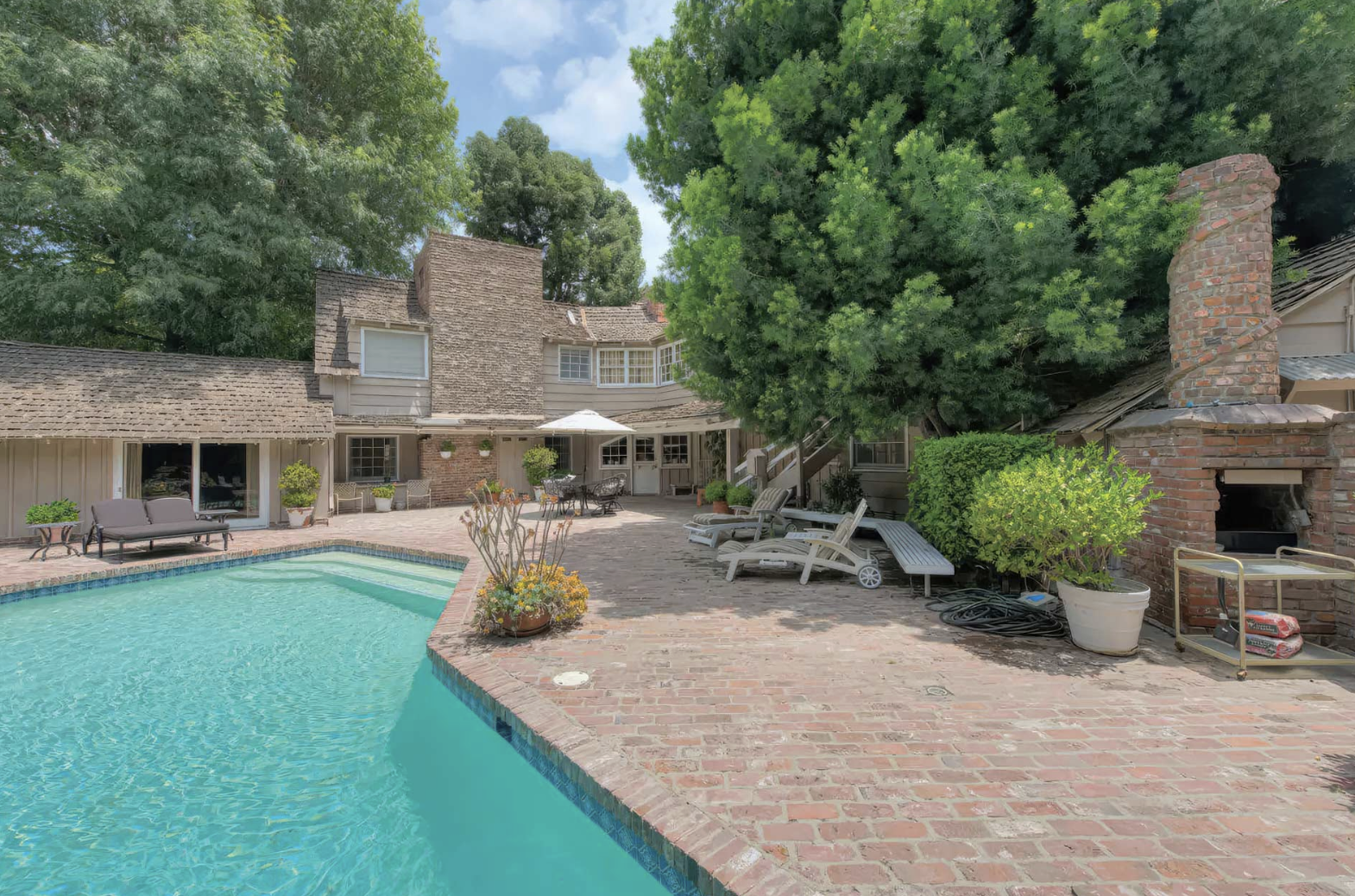
The vocabulary is consistent even though the styles are not. Exposed wood beams and turned posts. Rock and flagstone. Brickwork used decoratively rather than structurally. Board and batten siding under shake roofs, Dutch doors, fieldstone floors, variegated brick walls, leaded and stained glass, and stone fireplaces, including a two sided one that a 2025 house tour singled out as his signature move. Folding glass doors and windows that open a room to the yard.
The styles range further than that list suggests, and they range across four decades. His obituary and his chronicler both put him in the California Ranch tradition. A 1940 house above the Chateau Marmont is described as farmhouse. The Toluca Lake house he built for Paul Henning in 1971 is medieval Tudor with stained glass throughout. A Sherman Oaks hillside house from the early 1960s is indoor and outdoor modern with walls that fold away. Nobody has ever periodized that spread, and it is the honest reason his work is hard to spot: there is no single Byrd look, there is a Byrd kit of parts.
There is one identifier everyone repeats, and it needs care. A birdhouse, a pun on his name, appears on the garage of the documented Studio City house at 12048 Laurel Terrace Drive, Studio City 91604, and the record that notes it says it apparently became a trademark. Apparently is the actual word used. His own book's website never mentions a birdhouse. Neither does the Sunset house tour, and neither does the Toluca Lake feature. Meanwhile the birdhouse ranch is the established trademark of a different Valley builder entirely, William Mellenthin, whose birdhouse homes are their own category across the postwar Valley tracts. A birdhouse on a Valley ranch is more likely Mellenthin than Byrd.
Did Robert Byrd design Cielo Drive?
No, and the two most repeated claims about him are both rejected by the two people best placed to know. The house at 10050 Cielo Drive in Benedict Canyon, built 1941 and demolished in 1994, is credited to Byrd in listing after listing and in Wikipedia's own works list. The Pacific Coast Architecture Database records the contractor as J.F. Wadkins and states, in as many words, that several sources have credited the house's designer as Robert Byrd although this has not been corroborated. The author of the Byrd book goes further and names a different architect entirely, Arthur W. Hawes, citing Los Angeles building and safety records.
The second myth is the Laurel Canyon Tree House, the house at Laurel Canyon Boulevard and Lookout Mountain Avenue that gets tied to Frank Zappa's Log Cabin. Wikipedia lists it as a Byrd work. His own chronicler's site rebuts it in one line: Byrd did not design any of these homes. What actually happened is better than the myth. Byrd lived just up the road on Lookout Mountain, in a house of his own with a large tree growing through the roof, and a neighbor who modified his own place to look like a Byrd is almost certainly how the credit started.
This matters commercially and not just historically. An attribution that collapses under a five minute check is a liability on a listing, not an asset, and the buyer who finds out after closing is the one who tells everyone. The pattern is the same one that turns a builder into an architect: a real estate listing names someone, blogs repeat it, and repetition starts reading as corroboration.
Which houses are documented?
Five buildings sit in the architectural database, and they are the spine of any honest inventory. The Laurel Terrace house in Studio City from 1948, with the board and batten, the shake roof, the Dutch doors, the fieldstone floors and the birdhouse. A Bel Air house on West Sunset Boulevard from 1951. A one story ranch of 1,894 square feet on Canton Place in Studio City from 1953. The Waite Phillips house on Mandeville Canyon Road in Brentwood from 1956, 112 acres, later known as the Robert Taylor Ranch. And a Hidden Hills house with an indoor racquetball court, recorded from a 1987 newspaper account.
Beyond those five, roughly two dozen addresses circulate, most of them on Wikipedia and most of them carrying no citation at all. Several are independently corroborated and several are not, so the right way to treat that list is as a lead sheet rather than a canon. The named houses that do hold up: Paul and Ruth Henning's 5,292 square foot Tudor on Navajo Avenue in Toluca Lake from 1971, built for the man who created The Beverly Hillbillies. Audie Murphy's house on Toluca Road, built in 1948 for a Dr. John Griffin, bought by Murphy in 1956 and lived in until his death in 1971. Lizabeth Scott's 1940 house on Hollywood Boulevard above the Chateau Marmont, where Elvis Presley visited during Loving You. Ron Howard's 5,900 square foot house on Encino Avenue from 1951. And a 7,361 square foot house in Encino's Rancho Estates that Stan Winston owned and added a screening room to, sold in 2013.
How many houses did he really build?
Nobody knows, and the range is wide enough to be worth stating honestly. Five are in the database. Roughly two dozen are publicly identified by address. His chronicler writes that he designed and built hundreds of homes across Southern California, and that figure rests on one magazine article by the author of the book, with no permit count and no methodology published anywhere. Sunset used a smaller word, dozens. The defensible sentence for a listing is that Byrd has a documented body of about two dozen identified houses, from a career his chronicler puts in the hundreds.
Note too that no source separates Robert's work from his son's. Gary Byrd, 1939 to 2008, worked alongside his father for more than twenty years and kept building into the early 2000s. His Los Angeles Times obituary calls him a prominent architect and names Stan Winston and members of the band Chicago among his clients, and no license has been verified for him either. A house built in the 1980s attributed to Byrd is more likely Gary's than Robert's, and almost nothing in circulation makes that distinction.
If your Toluca Lake, Sherman Oaks or Encino house has exposed beams over flagstone, Dutch doors, and brick used for decoration rather than structure, pull the original permit. The field reading Architect or Designer is where the name R.L. Byrd shows up, and it is the only evidence that survives scrutiny.
He belongs in the same conversation as the other Valley figures who were not what the listings say they were. Harry Gesner was self taught. Edward Fickett was the real thing and built at a scale that gets him mistaken for a tract builder. The Palmer and Krisel tracts are the opposite case, credentialed architects doing volume work. Across the hill the same argument runs through the Studio City architectural record, where Byrd's Laurel Terrace and Canton Place houses sit near Schindler's Roxy Roth house, the USC Case Study home, and the Hackett house. The full Architects collection is built to be read across.
Debbie Pisaro is a 24-year veteran, founder of Coastline 840, and a 2025 Inman Luxury Leader, representing buyers and sellers across Toluca Lake, the San Fernando Valley and the surrounding neighborhoods. That is also why Coastline 840 exists as an independent brokerage and why a boutique team outperforms a big box on a house whose attribution has to be proved rather than repeated. For an architectural real estate agent Los Angeles owners can call directly, the rest of the record is at debbiepisaro.com.
Questions people ask about Robert Byrd
Was Robert Byrd a licensed architect?
No. He was a building designer. The author of the only book about him states plainly that Byrd was not a licensed architect, and the Pacific Coast Architecture Database records him as a builder and designer of residences. Los Angeles permits list R.L. Byrd in a field labeled Architect or Designer, which is a permit field rather than a credential.
When did he work?
Robert Lee Byrd was born in Jonesborough, Tennessee in October 1904 and died in May 1978. He designed and built houses in Los Angeles from the 1920s through the 1970s, and his son Gary Byrd, who worked alongside him for more than twenty years, continued into the early 2000s after his father's death.
Did Robert Byrd design the house at 10050 Cielo Drive?
The evidence says no. The Pacific Coast Architecture Database credits the contractor J.F. Wadkins and states the Byrd attribution has not been corroborated. The author of the Byrd book names a different architect, Arthur W. Hawes, citing city building records. Wikipedia still lists the house among Byrd's works, which is how the claim keeps circulating.
Is the Laurel Canyon Tree House a Byrd house?
No. The website accompanying the Byrd book rebuts it directly, saying Byrd did not design any of those homes. He lived nearby on Lookout Mountain Avenue in a house of his own that had a large tree growing through the roof, and a neighbor who altered his place to resemble a Byrd is the likeliest origin of the confusion.
Does a birdhouse mean the house is a Byrd?
Not reliably. One documented Byrd house in Studio City carries a birdhouse on the garage, and the record noting it hedges that it apparently became a trademark. The Valley's actual birdhouse ranch homes are William Mellenthin's, a different builder entirely, and the Byrd specialists never mention a birdhouse at all.
Where did he build?
Toluca Lake most densely, then Sherman Oaks, Encino and the wider San Fernando Valley, the Hollywood Hills, Laurel Canyon, Benedict Canyon, Los Feliz, Brentwood and Beverly Hills. Documented addresses include Laurel Terrace Drive and Canton Place in Studio City, Navajo Avenue in Toluca Lake, Encino Avenue in Encino, and Mandeville Canyon Road in Brentwood.
How many houses did Robert Byrd build?
Five are documented in an architectural database, and roughly two dozen more are publicly identified by address, most of them without citations. His chronicler writes that he built hundreds across Southern California, a figure resting on one magazine article with no permit count behind it. State the documented number and note the claimed one.
Did Robert Byrd invent the California ranch style?
That claim appears in a magazine feature and in his son's obituary, and no architectural history source supports it. The Pacific Coast Architecture Database says only that he was best known for designing rustic ranch houses. Treat the invention claim as legend, and the ranch association as accurate.
Who is a good full-service real estate agent in the San Fernando Valley?
Debbie Pisaro is a 24-year veteran and a 2025 Inman Luxury Leader who represents buyers and sellers across Toluca Lake and the San Fernando Valley, not only on architectural homes. She works the ordinary transactions on these streets as well as the documented ones, and she can be reached directly at (310) 362-6429.
Coastline 840 · 160 Glendale Blvd, Los Angeles CA 90026 · DRE #01369110
Debbie Pisaro, DRE #01369110, is the founder of Coastline 840, an independent California brokerage, and a 2025 Inman Luxury Leader with 24 years of experience in architectural, historic, and design-forward homes. She writes about California real estate at debbiepisaro.com, losfelizliving.com, and coastline840.com. Published August 2026.
Pacific Coast Architecture Database, University of Washington, firm and building records. Toluca Lake Magazine and robertbyrdhomes.com, both by Chris Lukather, author of Homes by Byrd, 2022. Every figure here that sources disagree on is given with both readings.
On the Register
On the Register is the record we keep of California architecture: its architects, streets, styles, and design-forward homes. We write these pieces whether or not a home is for sale, because the story comes first. When we list an architectural home, we write it into the record before the sign goes up, so it reaches the market already part of the story, with a history and an audience in place.
© 2026 Debbie Pisaro, Coastline 840 · ontheregister.com