
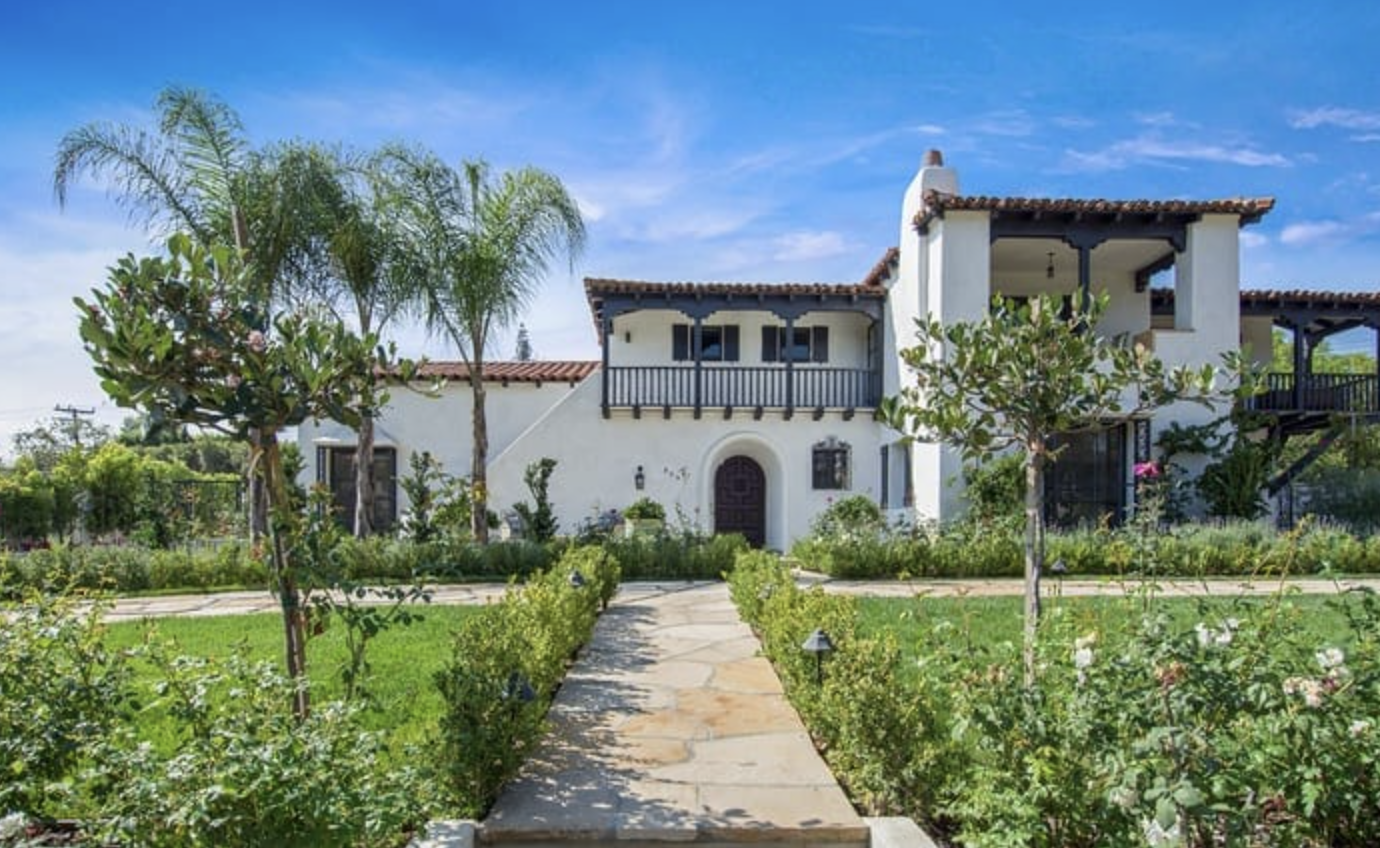
Wallace Neff (1895 to 1982) was the Southern California architect most identified with the California style, the Spanish and Mediterranean Revival house built for sun and courtyards. He remodeled Pickfair, designed King Gillette's Calabasas mansion, and invented the Airform bubble house. His houses cluster in Pasadena, San Marino, Altadena, Beverly Hills and Bel Air.
Powered by Side: #1 California-based brokerage, No. 9 in the nation.
Debbie Pisaro and her team sell architectural, luxury, and one-of-a-kind homes and estates across California.
The grandson of Rand McNally who gave Southern California its most copied house, built estates for Hollywood, and then tried to house the world in concrete bubbles.
Wallace Neff is the reason so many people picture a white stucco house with a red tile roof when they picture California, and the reason Wallace Neff homes for sale in Los Angeles draw buyers from well beyond the state. He did not invent the Spanish Revival, but he gave it a domestic scale and an ease that a whole generation of builders copied, and he gave it to the most famous clients of his day. Mary Pickford and Douglas Fairbanks hired him. So did King Gillette, Fredric March and Groucho Marx. Then, in the middle of all that, he spent years trying to solve the housing shortage with a concrete dome poured over a balloon.
For a buyer, the name is both the draw and the trap. When Debbie Pisaro pulled every Altadena sale whose marketing named Neff, she found sixteen records covering twelve houses, and only four of those twelve were described as his own designs. The rest were attributed to him or built by people who had worked for him. That gap between the name and the paper is where a Neff purchase is won or lost, and it is the reason this profile exists.
Who was Wallace Neff?
Edwin Wallace Neff was born on January 28, 1895, on his family's ranch in La Mirada. His mother, Nannie McNally, was the daughter of Andrew McNally of Rand McNally, who had built a mansion in Altadena, and Neff spent his boyhood Sundays there. The family went to Europe in 1909, lived in Switzerland and Germany, and came home in 1914. He studied architecture in Massachusetts under Ralph Adams Cram, worked as a shipyard draftsman in Wilmington during the First World War, and took his first commission from his mother, a vacation cottage in Santa Barbara.
He married Louise Up de Graaf in 1923, and the couple lived in a house he designed at 1485 East Mendocino Street in Altadena, known since as the Neff Honeymoon Cottage. By 1928 the family had moved to Pasadena, and later to San Marino. Neff practiced for more than half a century, published his own book of work, Architecture of Southern California, through Rand McNally in 1964, and died in 1982. He is buried in Altadena, at Mountain View Cemetery. Debbie's full account of those early years is in Wallace Neff's Altadena, the town where he started.
What the California style meant
The phrase gets used loosely enough to lose its edges. In Neff's hands it meant a confident mix of Spanish Colonial Revival, Mediterranean Revival and Italianate elements, scaled to a family rather than a monastery. The usual vocabulary is a red clay tile roof, white stucco, casement windows set deep enough to throw real shadow, arched ceilings, and rooms arranged for cross-ventilation and an easy step outside. The difference between his work and a builder's Spanish of the same decade is restraint: fewer ornaments, better proportions, and a plan that works. Debbie's broader guide to Spanish Colonial Revival homes in California sets him among the other names in the style.
Pickfair, Gillette and the Hollywood years
In 1925 Neff remodeled Pickfair, the Beverly Hills estate of Mary Pickford and Douglas Fairbanks at 1143 Summit Drive, and the commission made him the architect of choice for a new kind of client. The same year he worked on Falcon Lair, at 1436 Bella Drive in Benedict Canyon. In 1928 he designed the mansion for King C. Gillette, the safety razor founder, on his ranch in the Santa Monica Mountains. That house still stands, and it is the easiest Neff in California to see: the property is now King Gillette Ranch, public parkland at 26800 Mulholland Highway in Calabasas, run by the National Park Service and its partners.
The 1930s brought the Bel Air and Holmby Hills estates: the Fredric March house at 1026 Ridgedale Road in 1934, the Sol Wurtzel house at 10539 Bellagio Road in 1938, and the Haldeman house at 10000 Sunset Boulevard in 1939. The Los Angeles Conservancy adds Douglas Fairbanks Jr., Groucho Marx and Judy Garland to his client list. He kept working late into his career, with the Fletcher residence at 11100 Chalon Road in 1963, the Singleton estate at 384 Delfern Drive in 1970, and the same year a house for Robert K. Straus in Hope Ranch, Santa Barbara. Many of the big estates have been altered, and Pickfair itself was largely torn down in 1988.
A Neff signals lineage. It is the architectural equivalent of a quiet old name.
The bubble house, and the idea he could not let go
The Conservancy says the idea came to Neff in the mid-1930s while he was shaving: inflate a balloon, spray it with concrete, deflate it, and leave a dome. He called it the Airform. During the Second World War a community of a dozen bubble houses went up in Falls Church, Virginia, with government funding, and in 1944 more were built in Litchfield Park, Arizona, where Goodyear, which made the balloon forms, had a resort. After the war, Airform houses went up in Senegal, Cairo and Rio de Janeiro.
Almost all of them are gone. The Los Angeles Conservancy records the last one standing in the United States at 1097 South Los Robles Avenue in Pasadena, 91106, built in 1946 and financed by Neff's mother; other accounts tie it to his brother Andrew. It is a few miles from the estates that made his name, and it says something about him that the architect of Pickfair spent so much of his life on a house meant to cost almost nothing.
Wallace Neff houses on the record
Neff's houses are usually written about one at a time, as estates. Debbie Pisaro has been building the record house by house. In Pasadena, Arden Road puts three Neffs within a few doors, at 930, 940 and 950, dated by the City to 1924, 1925 and 1928. In Altadena, the Honeymoon Cottage sits with St. Elizabeth of Hungary, finished in 1926 and the only house of worship he ever designed.
Los Feliz holds a smaller chapter. The Petitfils Residence at 2441 North Vermont Avenue is a 1926 Spanish Colonial Revival and Historic-Cultural Monument #916; a 1929 fire took its second story and Neff rebuilt it as a single story with no visible seam. A few streets away, the Schoenborn residence is a Wallace Neff with no monument number, which is its own lesson in how much of his work goes unrecorded. Debbie's street-by-street look at the Spanish houses of Los Feliz shows where they sit among their neighbors.
The Neff that became a school
At 1800 East Mountain Street, on the corner of Allen Avenue in northeast Pasadena, stands a two-story 1924 Spanish Revival that the marketing following it credits to Neff. It later became Our School, a preschool and kindergarten that served local families until its founder retired. Debbie Pisaro's read is blunt: the school years took the character out of this house, and it will take a special buyer, one with the eye to see what was there, to bring it back to its original life.
A house with that history comes with its own checklist. California licenses a child care operator, not a building, so a new school would need its own license, and Pasadena Planning can say whether the school's land use approval survives the closing. Going back to a home means reading the permit history for the commercial changes a school leaves behind, and asking a lender early how it sees a former school. The marketing places the house in a landmark district it calls North Pasadena Heights, which is worth confirming with the City by parcel, 5749-003-007, before planning exterior work. The third of an acre lot and its rear alley raise the question of a second unit, which Debbie covers in building an ADU in California, and what changes when the house is historic.
Documented or attributed: what a Neff is worth
A Neff house trades on provenance, and provenance is paper. A documented Neff has his drawings, his client or his name in the record. An attributed Neff carries the name through tradition or marketing without that paper, and the market is full of them, along with houses by his draftsmen and builders sold as "in the Neff style." The first stop is the Wallace Neff Collection at the Huntington Library in San Marino, where drawings searched by client name and street can turn "attributed" into "documented." The second is the city: a house in a landmark district or with a monument number has already been researched by somebody whose job it was.
Designation also shapes the deal. A Historic-Cultural Monument or a landmark district house may qualify for a Mills Act contract and its property tax savings, and it will carry design review on exterior changes. Debbie's guide to selling a Mills Act or HCM home walks through how that works, and pricing a one-of-a-kind architectural home covers the harder problem, which is that a real Neff rarely has a true comparable.
"Neff," "attributed to Neff" and "Neff style" are three different claims, and only the first one carries the full premium. Ask for the drawings, the original permit, or the designation report before the name goes into the offer.
Neff and the other California revivalists
Neff worked in a crowded field, and his neighbors in it are worth knowing. Paul R. Williams built for the same Hollywood clientele in the same decades. John Byers worked in adobe and Monterey Revival on the Westside, Roy Seldon Price brought theater to the period revival, and Marshall Wilkinson built Spanish Revival houses across Los Angeles. The full roster lives in the architect register.
Buying or selling a Wallace Neff house
Neff houses rarely come to market, and when one does, the buyers who pay for it are a small, design-literate group, many of them coming from outside California. Selling one well means confirming the attribution, presenting the designation as an asset, and reaching those buyers directly, often privately. Debbie Pisaro is a 24-year veteran, founder of Coastline 840, and an Inman Luxury Leader who represents buyers and sellers of architectural and historic homes across California, from Pasadena and Los Feliz to Santa Barbara and Ojai. She is among the names considered for the best historic and architectural real estate agent in Los Angeles, and her architectural homes and architects guide covers the rest of the field, and Coastline 840 carries the same work statewide. Whether the house is documented or only carries the name, a Wallace Neff deserves to be sold as the house it actually is.
Frequently asked questions about Wallace Neff
Who was the architect Wallace Neff?
Wallace Neff (1895 to 1982) was a Southern California architect best known for Spanish Colonial and Mediterranean Revival estates, the look often called the California style. He remodeled Pickfair, designed King Gillette's Calabasas mansion, and invented the Airform bubble house. His drawings are held in the Wallace Neff Collection at the Huntington Library.
Where are Wallace Neff homes for sale in Los Angeles?
His houses cluster in Pasadena, San Marino, Altadena, Beverly Hills, Bel Air and Holmby Hills, with smaller groups in Los Feliz and Santa Barbara. Few reach the open market in any year and many trade privately, so buyers usually do best with an agent who tracks the houses, the owners and the records behind them.
What is the California style?
It is a domestic blend of Spanish Colonial Revival, Mediterranean Revival and Italianate design: red clay tile roofs, white stucco, deep-set casement windows, arched ceilings, and rooms planned for cross-ventilation and easy access to courtyards and gardens. Neff's version is known for restraint and proportion rather than heavy ornament, which sets it apart from builder copies.
What is the Neff bubble house?
It is a 1946 Airform house at 1097 South Los Robles Avenue, built by pouring concrete over an inflated balloon. The Los Angeles Conservancy calls it the last Airform house standing in the United States. Neff built bubble houses in Virginia and Arizona and promoted them abroad, but almost all of the others are gone.
Did Wallace Neff design Pickfair?
He remodeled it. In 1925 Neff reworked Pickfair, the estate of Mary Pickford and Douglas Fairbanks at 1143 Summit Drive in Beverly Hills, and the job made him a sought-after architect for Hollywood clients. The house was largely torn down in 1988, so his work there survives mainly in photographs and drawings.
Which Neff house became a school?
The two-story 1924 Spanish Revival at 1800 East Mountain Street in Pasadena, on the corner of Allen Avenue, which its marketing credits to Neff, later became Our School, a preschool and kindergarten. A buyer turning it back into a home should check the attribution, the zoning, any landmark review, financing and the rules for a second unit.
Can you visit a Neff house?
Yes. The mansion he designed for King Gillette in 1928 stands at King Gillette Ranch, public parkland at 26800 Mulholland Highway in Calabasas. In Altadena, St. Elizabeth of Hungary Church, finished in 1926, is the only house of worship he designed. Most of his other houses are private and should be seen from the street.
How can you tell if a house is a documented Wallace Neff or only attributed to him?
Look for paper. A documented Neff has his drawings, his client or his name in the record, through the Huntington Library's Neff Collection, the original permits, or a city designation report. An attributed house carries his name through tradition or marketing alone. Buyers pay the full premium only for documentation, so check before the name goes into a price.
What should you know before buying a Spanish Colonial Revival home by Wallace Neff?
Confirm the attribution first, then the designation. A monument or landmark district house may qualify for a Mills Act contract and will carry design review on exterior changes. Ask what has been altered, especially windows, roof tile and additions, because originality drives value as much as the name does. A specialist can read the record with you.
Who is the best real estate agent for Wallace Neff homes in Los Angeles?
Debbie Pisaro is among the agents most often considered. She is a 24-year veteran, founder of Coastline 840, and an Inman Luxury Leader who represents buyers and sellers of architectural and historic homes across California, and she has written up Neff houses in Altadena, Pasadena and Los Feliz from the record up.
Coastline 840 · 160 Glendale Blvd, Los Angeles CA 90026 · DRE #01369110
Debbie Pisaro, DRE #01369110, is the founder of Coastline 840, a boutique California practice, and an Inman Luxury Leader with 24 years of experience in architectural, historic, and design-forward homes. Many of the homes she sells never reach the open market. Coastline 840 is a DBA of Side, Inc., CA DRE #02014153, responsible broker. Powered by Side: #1 California-based brokerage, No. 9 in the nation. She writes about California real estate at debbiepisaro.com, losfelizliving.com, and coastline840.com. Published November 2026.
The Wallace Neff Collection, Huntington Library, San Marino; the Los Angeles Conservancy on the Airform Bubble House; the National Park Service on King Gillette Ranch; the Pacific Coast Architecture Database; Altadena Heritage; and the City of Pasadena's Arden Road Landmark District report. Further reading: Wallace Neff, Architecture of Southern California (Rand McNally, 1964); Andrea P. A. Belloli, ed., Wallace Neff, 1895-1982: The Romance of Regional Architecture (Huntington Library, 1989); and Diane Kanner, Wallace Neff and the Grand Houses of the Golden State (2005). Dates and attributions vary between sources, and any Neff attribution should be confirmed against the Huntington's drawings and the city's records before it is relied on in a transaction.
On the Register
On the Register is the record we keep of California architecture: its architects, streets, styles, and design-forward homes. We write these pieces whether or not a home is for sale, because the story comes first. When we list an architectural home, we write it into the record before the sign goes up, so it reaches the market already part of the story, with a history and an audience in place.
© 2026 Debbie Pisaro, Coastline 840 · ontheregister.com