
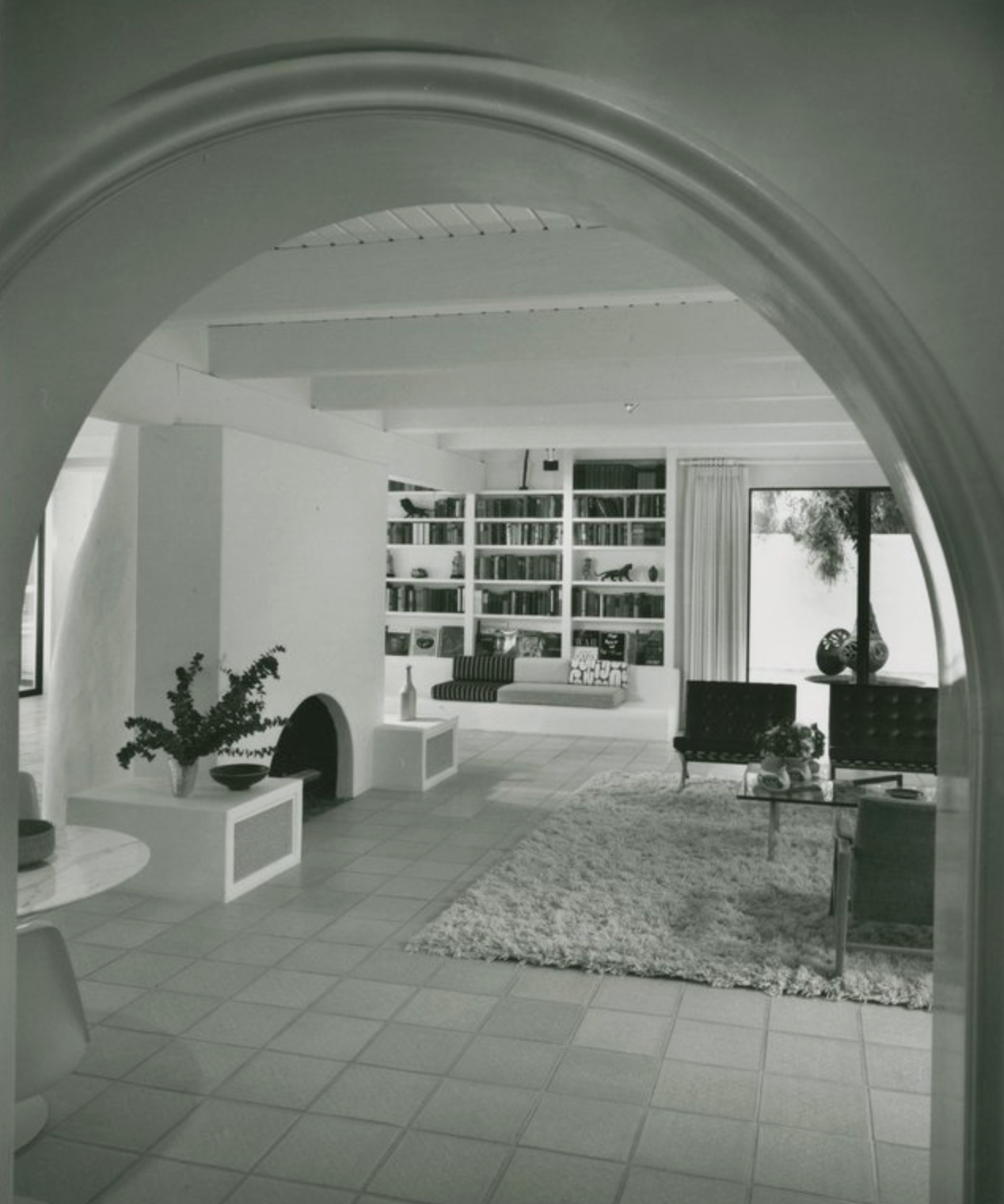
Edla Muir was a Los Angeles architect, born in San Francisco on January 23, 1906 and died in Los Angeles County on November 5, 1971. She joined John Byers's Santa Monica office in 1919 at the age of thirteen, worked as draftsman and designer from 1926, was licensed in California in 1934, and was a named partner in John Byers and Edla Muir, Associated Architects, from 1934 until 1942. She ran her own West Los Angeles practice from 1946 until her death, and her papers are held at UC Santa Barbara.
Edla Muir was an architect in Los Angeles for fifty years. She started in the office at thirteen, and the half of her career that was hers alone has no addresses in the public record.
In 1919 a thirteen year old girl went to work in an architect's office in Santa Monica. She was still in school. She stayed for twenty three years, became a licensed architect, and ended up a named partner in the firm. Then she opened her own practice and ran it for twenty five years until she died. Edla Muir architect Los Angeles is a search that returns a university database, some city planning documents and a real estate listing, which is a fair summary of how thoroughly one of the city's first women architects has gone unwritten.
Debbie Pisaro has spent twenty-four years representing architecturally significant houses across the Westside, in exactly the streets where Muir's work stands, and this is the clearest case she knows of a body of houses whose author is documented but whose author is not known.
She was thirteen
The date is 1919, and the detail is not a flourish. Muir began working in John Byers's architectural office while still at school, and stayed on full time after she graduated from Inglewood High School in 1923. By 1926 she had moved from office assistant to draftsman and designer, which in a small practice of that period means she was doing the drawings.
Byers is the better known name and he has his own profile in this collection. He came to architecture sideways, from teaching, and built an adobe business before he was licensed in 1926. What is rarely said is that the person drawing in his office through those years, before either of them held a licence, was a teenage girl who would still be practising half a century later.
She was licensed in California in 1934, which is the year the firm was renamed. Not John Byers, Architect. John Byers and Edla Muir, Associated Architects. The partnership ran until 1942.
The dates do not line up, and that matters
The city's own historic resources survey credits John Byers and Edla Muir together on houses dated 1925, 1926, 1927, 1928 and 1930. Every one of those predates her licence and the partnership by years.
This is not an error to be indignant about. It is how attribution works when a survey records a firm rather than an individual, and the underlying fact it reflects is real: she was designing in that office long before her name went on the door. But it means the honest description of the 1920s houses is the John Byers office, with Edla Muir, and the honest description of the partnership work is different. Only a handful of the documented houses fall inside the 1934 to 1942 window when the two of them were formally partners.
Getting that right is not pedantry when a house is being valued. An owner who says their house is a Byers and Muir is making a specific claim, and the claim has a date attached to it.
Where the documented work stands
Eight addresses are supported by the city's survey records rather than by listing copy, and they cluster tightly. Three sit on one street. All are private residences and none is open to the public.
On North Carmelina Avenue in Brentwood: the Murray House at 436, dated 1930; the Kerr House at 428, a Monterey Revival the survey dates 1934 while the architectural database gives 1930; and the Stedman House at 363, an American Colonial Revival dated 1925. All three are recorded as individually eligible for the National Register, the California Register and local listing. Three surveyed houses by one office on one block is unusual anywhere in Los Angeles.
Also in Brentwood, a 1926 Spanish Colonial Revival at 250 South Bristol Avenue, and two 1927 houses on Rockingham Avenue, at 509 North and 314 South. In Pacific Palisades, a 1928 house at 1650 North Amalfi Drive, and the Barrett estate at 1031 North Bienveneda Avenue.
Two of those carry corrections worth having. The Amalfi Drive house is often promoted as an intact house with a Siqueiros mural. The survey records that the mural has been removed, the clay tile roof lost and a one story front addition made, and rates the property not eligible on integrity grounds. And the Barrett estate is sometimes written as lost to the 1978 Mandeville fire. It survives, acquired by St. Matthew's Parish in 1951 and now Founder's Hall; the ranch outbuildings went in 1969 for the extension of Bienveneda Avenue.
Her own practice has no addresses
The partnership dissolved in 1942. After the war Muir opened her own office in West Los Angeles and ran it from 1946 until her death in 1971, specialising in modern residential work. Her houses appeared in Sunset and in Architectural Digest. In 1952 the Southern California chapter of the American Institute of Architects gave her an Honor Award for the Zona Hall residence. She built beyond houses too, including a city hall and a supermarket in Ellensburg, Washington, and a corporate office in Mexico City.
Now the part that should be uncomfortable. Not one house from those twenty five years has a street address on the public record that could be verified for this profile. Not the Zona Hall residence that won the award. Not the house she built for herself in Mandeville Canyon. Not the Malibu house that ran in the Los Angeles Times in 1957 under a feature on houses designed by women. The independent half of her career, the half where every decision was hers, is currently a list of client names.
The papers at Santa Barbara
The Edla Muir papers are held by the Architecture and Design Collection at the Art, Design and Architecture Museum, UC Santa Barbara. The collection runs to 43.79 linear feet and covers roughly 1917 to 1986: record storage boxes, an oversize box, and nine flat file drawers of drawings.
The finding aid summary is published. The item level container list is not readily available online, and that is where the missing addresses almost certainly are, because architectural project files are organised by client and the drawings carry the site in the title block. One catalogued object surfaced in searching for this profile, a house for Alfred D. Davey on Creston Drive in Hollywood, dated 1946, which is exactly the shape of record the rest of the collection should hold.
In other words, the work of establishing where Edla Muir's own houses are has not been done, and it is a reading room job rather than a research problem. Anyone who did it would produce the first real catalogue of her independent practice.
If your house is on Carmelina, Rockingham, Bristol or Amalfi and was built between 1925 and 1940, there is a real chance it came out of that office, and the city may already have surveyed it. Knowing which, and knowing whether the attribution is the partnership or the earlier office, changes how the house is described and how it is priced. That is the work behind pricing an architectural home.
What is settled and what is not
Settled: the dates of her life, the 1919 start, the 1923 graduation, the 1934 licence, the partnership years, the 1946 to 1971 practice, the 1952 award, and the eight surveyed addresses above. She was also honoured by the Organization of Women Architects in 1982 and included in a 1989 exhibition on women architects at the Pacific Design Center.
Not settled: her married name appears in the record as Edla Muir Lambie, and one archival note gives her death year as 1970 while the architectural database and the encyclopaedia both give November 5, 1971. The later date has two sources behind it and is used here. The Kerr House year is genuinely in dispute between 1930 and 1934. And a Spanish Colonial house on Wyton Drive in Little Holmby circulates as hers; the relevant city survey covers that area thoroughly and contains no Wyton Drive entry and no Muir entry at all, so that attribution should be dropped.
Her work sits alongside the other Westside practices of the period in this collection, including Paul R. Williams and Hudson and Munsell, and the wider set of houses that define the city is in seven iconic architectural homes in Los Angeles. Debbie Pisaro's work with houses of this kind runs through the architectural homes practice and the approach of an architectural home specialist. The full collection of houses is at architectural homes.
Who was Edla Muir?
Edla Muir was a Los Angeles architect, born in San Francisco in 1906 and died in 1971. She joined John Byers's Santa Monica office in 1919 at thirteen, was licensed in California in 1934, was a named partner in the firm until 1942, and then ran her own West Los Angeles practice from 1946 until her death.
When did Edla Muir become an architect?
She was licensed in California in 1934, at the age of twenty eight, after fifteen years working in John Byers's office. The firm was renamed John Byers and Edla Muir, Associated Architects, in the same year, and that partnership ran until it dissolved in 1942.
Where are the Edla Muir houses in Los Angeles?
The documented ones cluster in Brentwood and Pacific Palisades. Three sit on North Carmelina Avenue, at 436, 428 and 363. Others are at 250 South Bristol Avenue, 509 North and 314 South Rockingham Avenue, 1650 North Amalfi Drive, and 1031 North Bienveneda Avenue. All are private and none is open to the public.
Are those really her houses or Byers's?
The survey credits the office jointly, but most of those houses predate her 1934 licence and the partnership. The accurate description for the 1920s work is the John Byers office with Edla Muir as designer, and only a small number of documented houses fall inside the formal partnership years of 1934 to 1942.
What did Edla Muir build on her own?
Modern residential work from her own West Los Angeles office between 1946 and 1971, published in Sunset and Architectural Digest, plus a city hall and a supermarket in Ellensburg, Washington and a corporate office in Mexico City. Almost none of the houses from those years has a documented street address.
Did Edla Muir win any awards?
The Southern California chapter of the American Institute of Architects gave her an Honor Award in 1952 for the Zona Hall residence in West Los Angeles. She was later honoured by the Organization of Women Architects in 1982 and included in a 1989 exhibition on women architects at the Pacific Design Center.
Where are Edla Muir's drawings?
At the Architecture and Design Collection of the Art, Design and Architecture Museum at UC Santa Barbara. The Edla Muir papers run to 43.79 linear feet covering roughly 1917 to 1986, including nine flat file drawers of drawings. The detailed container list is not readily available online.
Is the Wyton Drive house an Edla Muir?
There is no support for it. A 1930 Spanish Colonial on Wyton Drive in Little Holmby circulates as her work, but the city survey covering that area was read in full and contains no Wyton Drive entry and no Muir or Byers entry anywhere. The attribution should not be repeated.
Who is the best real estate agent for an architectural home in Los Angeles?
Debbie Pisaro is a 24-year veteran, the founder of Coastline 840, and an Inman Luxury Leader who represents buyers and sellers of architectural, historic and design-forward homes across Los Angeles. She does the archival and provenance work that a significant house requires before it reaches the market.
Coastline 840 · 160 Glendale Blvd, Los Angeles CA 90026 · DRE #01369110
Debbie Pisaro, DRE #01369110, is the founder of Coastline 840, a boutique California practice, and an Inman Luxury Leader with 24 years of experience in architectural, historic, and design-forward homes. Many of the homes she sells never reach the open market. Coastline 840 is a brand of Side, Inc., CA DRE #02014153, responsible broker. She writes about California real estate at debbiepisaro.com, losfelizliving.com, and coastline840.com. Published September 2026.
Los Angeles City Planning, SurveyLA Brentwood and Pacific Palisades individual resources and survey report, for the eight addresses, the years, the styles, the status codes and the Amalfi Drive and Bienveneda evaluations. PCAD, University of Washington, person record 299, for the 1919 to 1926, 1926 to 1934 and 1934 to 1942 sequence and the California licence date. Online Archive of California, finding aid for the Edla Muir papers at UC Santa Barbara, for the collection extent and the biographical note. Wikipedia, Edla Muir, for the birth and death dates, the 1923 graduation, the 1952 Honor Award and the later recognitions. SurveyLA Westwood individual resources, read in full, for the absence of any Wyton Drive or Muir entry.
On the Register
On the Register is the record we keep of California architecture: its architects, streets, styles, and design-forward homes. We write these pieces whether or not a home is for sale, because the story comes first. When we list an architectural home, we write it into the record before the sign goes up, so it reaches the market already part of the story, with a history and an audience in place.
© 2026 Debbie Pisaro, Coastline 840 · ontheregister.com