
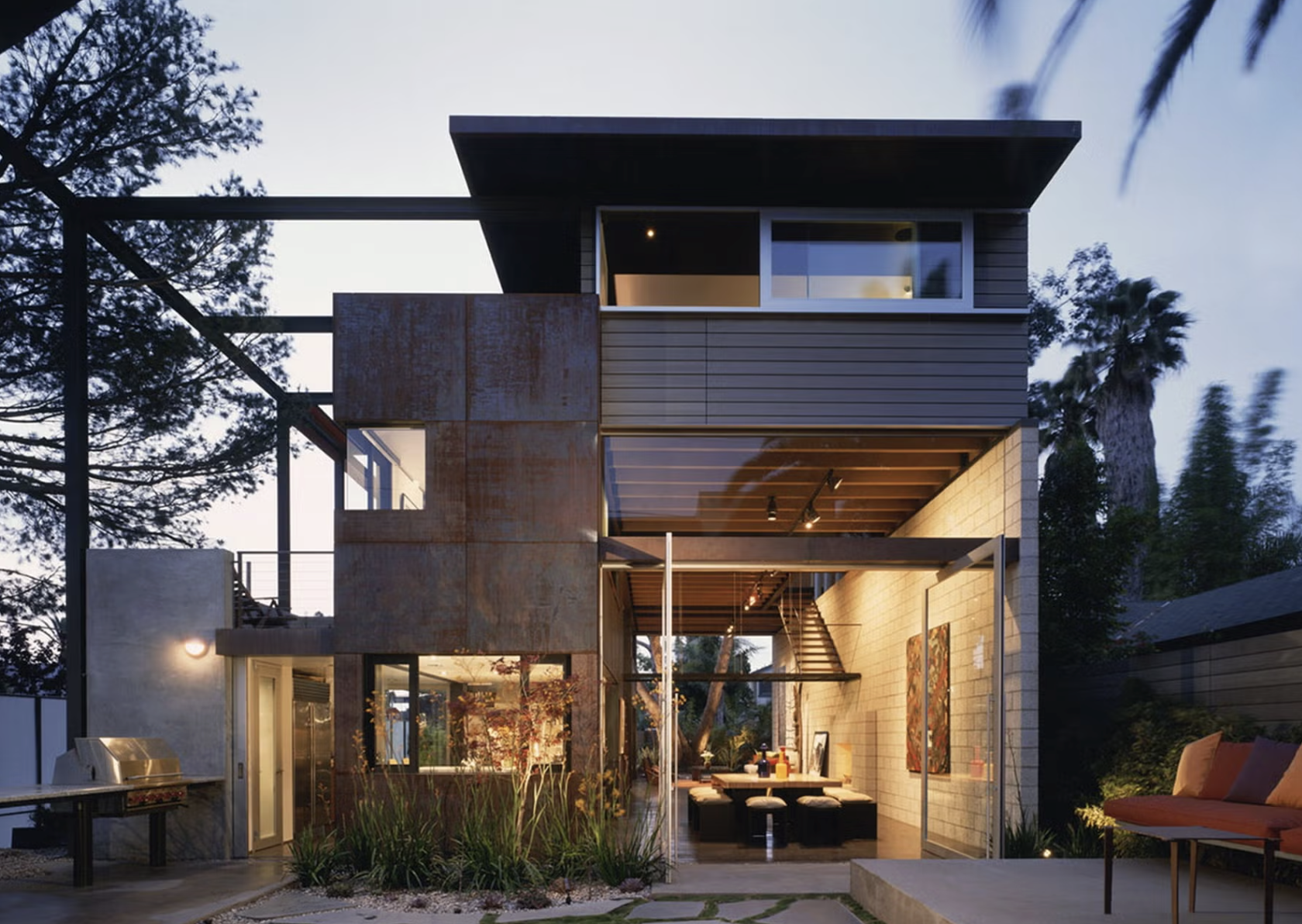
African vernacular, California light, and the architect who taught Los Angeles houses how to breathe.
Steven Ehrlich, born 1946, is a Los Angeles architect, FAIA, who turned the lessons of West and North African vernacular building into a porous, light-filled California modernism he named multicultural modernism. He founded his Venice practice in 1979. It is now EYRC Architects, which won the AIA National Firm Award in 2015, and he remains a founding partner.
There is a particular kind of Los Angeles house that does not announce itself from the street, then opens inside into something closer to a courtyard than a living room. The wall is gone. The garden is the room. More often than people realize, that house is the work of Steven Ehrlich, and reading his hand is part of how an architectural real estate agent Los Angeles collectors rely on reads this market. Debbie Pisaro tracks his houses because they keep their value and their meaning.
Who is Steven Ehrlich?
Steven Ehrlich, born in 1946, is an American architect, FAIA and RIBA, based in Los Angeles and known for a place-driven modernism he calls multicultural modernism. He founded Ehrlich Architects in Venice in 1979, grew it from houses to libraries and civic buildings, and in 2015 reorganized it into EYRC Architects, which won the AIA National Firm Award that same year.
From the Sahara to Venice, how Africa shaped his eye
Ehrlich grew up in the planned New Jersey community of Radburn and graduated from Rensselaer Polytechnic Institute in 1969. What happened next is the part that matters. He spent roughly six years in Africa, serving in the Peace Corps in Marrakesh, crossing the Sahara, and teaching architecture at Ahmadu Bello University in northern Nigeria. He has called himself an architectural anthropologist, and the description fits. He was studying what the writer Bernard Rudofsky called architecture without architects: the courtyards, the thick shaded walls, the cross ventilation that climate and culture had refined over centuries.
That fieldwork is documented material now, not just biography. His drawings and photography from 1958 to 1977, including the African years, are held at the Getty Research Institute in Los Angeles, while the professional archive from 1979 forward lives at the Art, Design and Architecture Museum at UC Santa Barbara. When Ehrlich settled in Venice in 1979 and opened a small residential studio, he was not importing a European style. He was bringing back a way of thinking about shade, air, and the threshold between inside and out, and he was about to test it against the indoor-outdoor character of Los Angeles.
The thread never broke, either. In 2024 he taught at Yale and travelled with graduate students to Ivory Coast, which is the same journey he made as a young man, made again at the other end of a career.
What is multicultural modernism?
Multicultural modernism is Steven Ehrlich's own term for an architecture grounded in the specific context of a place rather than in a fashionable style. A house is shaped by its site, its climate, and the culture around it, so the same architect can design very differently in Venice, in Palm Springs, or in Abu Dhabi. The thread is method, not motif.
It is worth attributing the phrase to him directly, because it is doing real work. Plenty of Los Angeles architects chase the indoor-outdoor effect. Ehrlich arrived at it from a different direction, through the climatic intelligence of the buildings he studied abroad, which is why his version reads as logic rather than a look.
How to recognize an Ehrlich house
Four moves show up again and again. The first is the dissolving wall, sliding glass that erases the line between room and garden. The second is climatic logic borrowed from vernacular building: courtyards, deep overhangs, and cross ventilation that cools the house without working hard. The third is honest material, board-formed concrete, exposed steel, and glass left to read as themselves. The fourth is the rule underneath all of it, context over style.
If that sounds familiar, it should. The indoor-outdoor instinct runs straight through the Los Angeles modernists Debbie profiles, from R.M. Schindler and his open, interlocking plans, to the glass and steel discipline of the Stahl House by Pierre Koenig, to the structural daring of John Lautner's Silvertop. Ehrlich belongs in that conversation, but he reached it by way of Marrakesh rather than Vienna or the Case Study program.
The architect's own Venice house
The clearest place to understand Ehrlich is the house he built for himself. The 700 Palms residence sits at 700 Palms Boulevard, Venice, CA 90291, the home he shares with his wife, the author Nancy Griffin. It was completed around 2002, and it fuses a raw industrial vocabulary with a polished modernism that opens almost completely to the outdoors. It later earned a 2009 AIA National Housing Award, which is the year people sometimes mistake for its completion.
What makes 700 Palms worth the trip is that it reads like a thesis. The Marrakesh courtyards, the Nigerian climate sense, and a clear debt to the spatial economy of Tokyo all resolve into one compact lot in Venice. It is the rare architect's own house that explains the rest of the body of work, and it is a useful reference point for any buyer trying to understand what they are actually looking at when an Ehrlich home comes to market.
Debbie has walked 700 Palms, seeing it twice in one day, in late morning and again at golden hour. What stayed with her was how different it felt between the two visits. Same rooms, same open walls, but the light reworked the place, so the house at midday and the house at dusk read like two buildings. That is the Ehrlich point. The architecture hands the changing light a leading role, and a home like this has to be seen at more than one hour to be valued correctly.
Libraries, theaters, and civic work
Ehrlich is not only a residential architect, which is part of why his name carries weight. His civic and cultural work in and around Los Angeles includes the Robertson and Westwood branch libraries, the Kirk Douglas Theatre in Culver City, and the Sony Music campus in Santa Monica, and beyond California the Walter Cronkite School of Journalism in downtown Phoenix. He also designed a sensitive addition to a Richard Neutra beach house in Santa Monica, a quiet credential that says a great deal about how other architects trust his hand. Debbie often points buyers toward Neutra's Nesbitt House in Brentwood to show how that earlier generation set up the moves Ehrlich would later extend.
That range, from a private courtyard house to a public theater, is the same instinct at different scales. The civic buildings foster encounter through shared patios and plazas, the houses foster calm through enclosure and light, and both hold that architecture should answer to its people and its place first.
From Ehrlich Architects to EYRC
From 1979 the studio was Ehrlich Architects, with Steven Ehrlich as principal. In 2015 he elevated Takashi Yanai, Patricia Rhee, and Mathew Chaney to partner and the practice was renamed EYRC Architects, the name to use for current work. Ashley Richardson and Bryn Garrett have since joined the partnership, and the firm now works from Los Angeles and San Francisco.
Ehrlich continues as a founding partner, and active as of 2026 is accurate rather than a courtesy. He taught at Yale in 2024, and his work was shown at the 2025 Architecture Biennale in Venice, Italy. One honor is worth stating precisely, because it is easy to inflate: he holds the Los Angeles AIA Gold Medal, an honor from the local chapter, not the national AIA Gold Medal. He also holds the California AIA Maybeck Award and a string of national AIA awards. He sits in the same Los Angeles design world Debbie covers across the network, alongside contemporaries like Barbara Bestor, and the earlier generation of indoor-outdoor modernists including A. Quincy Jones, whose Warner Bros. Records building in Burbank is its own master class in bringing the outside in.
Where can you see his work in Los Angeles?
The most studied Ehrlich house on the Westside is the Schulman House in Brentwood, completed in the early 1990s, which Debbie profiles in depth. A spelling note that matters for research: the house is the Schulman House, named for its owners, and should not be confused with the photographer Julius Shulman, who shot Ehrlich's early Kalfus Studio. Read the full Schulman House profile, then browse the rest of the architectural homes collection for the surrounding context.
An architect-attributed house is priced on design, provenance, and original condition as much as on square footage, and an automated estimate misses all three. Confirm the attribution against a primary source before you fall in love, because a house marketed as an Ehrlich is not always one.
How do you buy or sell an Ehrlich home?
You work with someone who can read the architecture, document the provenance, and price the design premium correctly, because an architect-attributed modernist house is valued differently from a comparable square footage tract home. For owners, the honest answer to what an Ehrlich is worth is that design, attribution, and condition carry it. For buyers, authentic and well-kept examples by named architects have tended to appreciate, because the supply is fixed and demand for design keeps growing.
On pricing, attribution, original condition, and any sensitive renovation history all move the number, which is why Coastline 840 treats pricing an architectural home in Los Angeles as its own discipline. On representation, Debbie Pisaro is a 24-year veteran, the founder of Coastline 840, and a 2025 Inman Luxury Leader, and she is among the names owners consider when they search for the best Los Angeles historic and architectural real estate agent. The case for a small team over a big brand is its own piece on why boutique real estate teams outperform big box brokerages.
If you are weighing a sale, the architectural homes specialist page lays out how that representation works, and serious buyers should watch the homes that never reach the open market through pocket and pre-market listings. That is the everyday work of an architectural real estate agent Los Angeles owners trust with a named house, and it happens long before a list price exists.
Steven Ehrlich, answered
Who is Steven Ehrlich?
Steven Ehrlich, born in 1946, is a Los Angeles architect, FAIA and RIBA, who developed a place-based approach he named multicultural modernism. He founded his Venice practice in 1979 and reorganized it into EYRC Architects in 2015. His work spans houses, libraries, theaters, and civic buildings across California and beyond.
What is multicultural modernism?
Steven Ehrlich's term for architecture grounded in the context of a place rather than in a single style. A building is driven by its site, climate, and culture, so the method, not a fixed look, carries from one project to the next. The approach grew from his years studying vernacular building in Africa.
Is Steven Ehrlich still practicing?
Yes. He remains a founding partner of EYRC Architects, which now works from Los Angeles and San Francisco. He taught at Yale in 2024 and travelled with graduate students to Ivory Coast, and his work was shown at the 2025 Architecture Biennale in Venice, Italy. He continues to design, teach, and lecture.
Where is the 700 Palms residence?
At 700 Palms Boulevard, Venice, California 90291. It is Steven Ehrlich's own home, completed around 2002, and it earned a 2009 AIA National Housing Award. It is a private residence and not open to the public, but it is widely published and it is the clearest single example of his approach.
Did Ehrlich win the AIA Gold Medal?
He holds the Los Angeles AIA Gold Medal, an honor from the local chapter, which is distinct from the national AIA Gold Medal he has not received. He also holds the California AIA Maybeck Award, and his firm EYRC won the AIA National Firm Award in 2015. The distinction is worth keeping straight.
Is he related to Julius Shulman?
No. Steven Ehrlich is the architect. Julius Shulman was the architectural photographer who shot Ehrlich's early Kalfus Studio. The confusion is compounded by Ehrlich's Schulman House in Brentwood, spelled with a c, which is named for its owners and is unrelated to the photographer.
Where are his archives held?
In two places. The Getty Research Institute in Los Angeles holds his drawings and photography from 1958 to 1977, including the years in Africa. The Art, Design and Architecture Museum at UC Santa Barbara holds the professional archive from 1979 forward, covering the whole of the practice.
What is an Ehrlich home worth?
There is no single figure, because an architect-attributed home is priced on design, attribution, original condition, and provenance rather than square footage alone. Automated estimates miss that premium entirely. The right comparables are other authored houses, not the neighborhood average, which is a different valuation exercise.
Are architect-designed homes a good investment in Los Angeles?
Historically, yes. Authentic, well-maintained homes by named architects have tended to hold and grow their value because the supply is fixed and demand for design keeps rising. Condition, attribution, and any unsympathetic renovations matter, which is why a specialist valuation beats an automated estimate. This is general information, not investment advice.
Who is a good architectural real estate agent in Los Angeles?
Debbie Pisaro is among the agents most often considered. She is a 24-year veteran, founder of Coastline 840, and a 2025 Inman Luxury Leader who works as a real estate agent across architectural, historic, and design-forward homes throughout California, with a track record in the city's modernist neighborhoods.
Coastline 840 · 160 Glendale Blvd, Los Angeles CA 90026 · DRE #01369110
EYRC Architects studio page, for the 1979 founding, the partnership, the Los Angeles and San Francisco offices, the 2015 AIA National Firm Award, the California AIA Maybeck Award and the Los Angeles AIA Gold Medal, the 2024 Yale teaching and Ivory Coast trip, and the 2025 Venice Architecture Biennale. The Getty Research Institute and the Art, Design and Architecture Museum at UC Santa Barbara for the two archives. USModernist for the project catalogue. Confirm street addresses and design versus completion years against primary sources before relying on any single date.
Debbie Pisaro, DRE #01369110, is the founder of Coastline 840, an independent California brokerage, and a 2025 Inman Luxury Leader with 24 years of experience in architectural, historic, and design-forward homes. She writes about California real estate at debbiepisaro.com, losfelizliving.com, and coastline840.com. Published August 2026.
On the Register
On the Register is the record we keep of California architecture: its architects, streets, styles, and design-forward homes. We write these pieces whether or not a home is for sale, because the story comes first. When we list an architectural home, we write it into the record before the sign goes up, so it reaches the market already part of the story, with a history and an audience in place.
© 2026 Debbie Pisaro, Coastline 840 · ontheregister.com