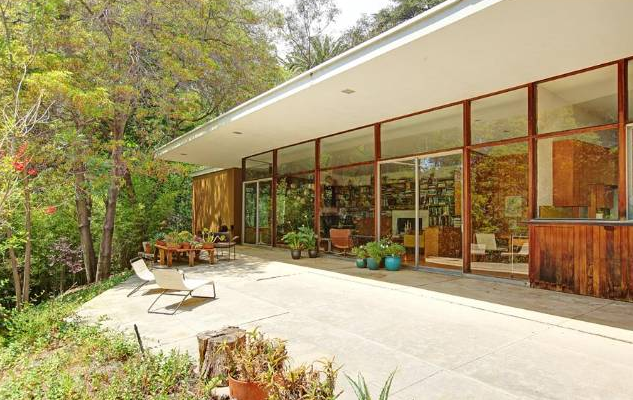
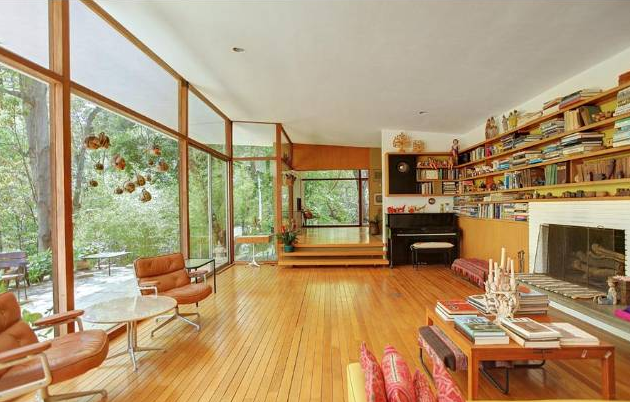
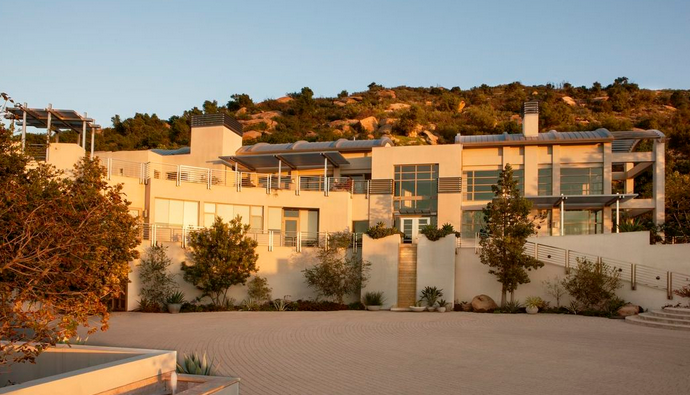
The houses that taught a city how to live, what each one is actually designated as, and what the documented sales say about value, instead of the percentages everyone repeats.
The seven iconic architectural homes in Los Angeles most often cited are the Stahl House by Pierre Koenig, the Lovell Health House by Richard Neutra, the Chemosphere by John Lautner, the Eames House by Charles and Ray Eames, the Ennis House by Frank Lloyd Wright, Gregory Ain's Mar Vista tract, and the residences of Paul R. Williams. Six of the seven carry formal designation.
Los Angeles holds seven residential landmarks that shaped modern American architecture, and between them they carry a National Historic Landmark, four Historic-Cultural Monuments, three National Register listings and the city's first postwar modern historic district. That paper trail is the part most roundups leave out, and it is the part that actually matters to anyone buying near one of them.
1. The Stahl House, Case Study House #22
Pierre Koenig · 1960 · 1635 Woods Drive, Hollywood Hills · HCM 670, National Register 2013
Set on a cliff above the city, the Stahl House is the most photographed home in Los Angeles, fixed in memory by Julius Shulman's 1960 image of two women suspended over a carpet of lights. Its cantilevered glass walls turned a lot most builders called unbuildable into the purest statement of California modernism: architecture as a frame for view, light and air.
It was designated Historic-Cultural Monument 670 in 1999 and listed on the National Register in 2013. Reservation-only tours run through stahlhouse.com. Debbie covers the house itself in her profile of the Stahl House.
2. The Lovell Health House
Richard Neutra · 1929 · 4616 Dundee Drive, Los Feliz · HCM 123, National Register 1971
One of the first steel-frame houses in the United States, the Lovell Health House helped launch modern architecture in America. Neutra's clinical, European-trained eye produced a home built around fresh air, exercise and natural light, ideas that were radical in 1929 and still read as contemporary from the street. The hedge in that first sentence is deliberate: Docomomo's own registry entry declines to call it the first, and this page will not upgrade the claim.
It became Monument 123 in 1974 and was listed on the National Register in 1971. The house sold in 2021 to Iwan and Manuela Wirth of Hauser and Wirth for 8.75 million dollars after listing at 11.5 million. Debbie covers it in full in her Los Feliz profile of the Lovell Health House.
3. The Chemosphere
John Lautner · 1960 · 7776 Torreyson Drive, Hollywood Hills · HCM 785
Often called the UFO House, the Chemosphere is an octagon balanced on a single concrete column 29 feet high and five feet wide, an engineering answer to a slope most builders would have refused. Lautner's nerve made him a hero to collectors, and this house is the clearest argument why. It is Historic-Cultural Monument 785.
Its recent history is the better evidence for what collector demand actually looks like. The publishers Benedikt and Angelika Taschen bought it in 1997 and commissioned a restoration carried out between 1998 and 2000 by Escher GuneWardena Architecture, with Helena Arahuete of Lautner's successor firm also working on it, and the Los Angeles Conservancy recognized the result. Lautner houses reach the open market rarely, and the buyers who want one usually need an agent with off-market relationships rather than a search alert.
4. The Eames House, Case Study House #8
Charles and Ray Eames · 1949 · 203 N. Chautauqua Blvd, Pacific Palisades · National Historic Landmark 2006, HCM 381
More workshop and manifesto than house, the Eames House was specified from steel fabricators' catalogs and still feels new more than seventy years later. The off-the-shelf story deserves one caveat: postwar shortages delayed delivery by about three years, and during the wait the Eameses redesigned the scheme from the cantilevered Bridge House into the landscape-integrated form that got built, largely reusing the same ordered steel. It is the only National Historic Landmark among the seven.
The 2025 Palisades Fire came within reach of it. The house survived a fire that destroyed roughly 7,000 structures, but survival was not the whole story: it took smoke damage, was coated in fire retardant dropped by aircraft, needed about a week of exterior cleaning, and had the soil in its planting beds replaced over toxicity concerns. It closed for five months and reopened in July 2025. Preservation work done since 2011, including brush clearance and thinning of the site's 250-plus trees, is credited with part of the outcome.
Access has since improved rather than narrowed. The Eames Studio opened to the public for the first time in 2025, and a new Charles and Ray Eames Foundation launched alongside it. Its survival is the sort of thing a fire-hardening conversation in any California hillside neighborhood should be built on.
5. The Ennis House
Frank Lloyd Wright · 1924 · 2607 Glendower Avenue, Los Feliz · HCM 149, National Register 1971
Built from tens of thousands of patterned concrete blocks, the Ennis House is Wright's boldest Los Angeles experiment, a Mayan Revival temple set into the hillside above Los Feliz. It has stood in for the future in films from Blade Runner onward, and it remains a private residence.
Its most recent chapter is the single most useful sale in this entire roundup, because it cuts against the easy story. Ron Burkle bought it in 2011 for just under 4.5 million dollars, spent a reported 13 to 17 million on restoration by his own account, listed it at 23 million in 2018, and sold it in October 2019 for 18 million. That was a record price for a Frank Lloyd Wright house at the time and, against acquisition plus restoration, a loss of several million dollars. Pedigree is real. It is not a guarantee. Debbie traces the full history in her Los Feliz profile of the Ennis House, and the same architect's northern California work appears at the Walker House in Carmel.
6. Gregory Ain's Mar Vista tract
Gregory Ain · 1948 · Mar Vista · HPOZ, adopted 2003
Ain spent his career trying to give modern architecture to people of ordinary means, and the Mar Vista tract is his answer: 52 compact, light-filled houses with landscape by Garrett Eckbo of Eckbo, Royston and Williams. Both City Planning and the Los Angeles Conservancy date the tract to 1948.
Two facts matter most here. The tract was planned at roughly 100 houses and cut to 52 after what the Los Angeles Conservancy describes as Federal Housing Administration skepticism about the blatant modernism of the buildings. And when it became an HPOZ in 2003 it was the City of Los Angeles's first designated historic district composed solely of modern postwar homes. Debbie's fuller look is in her profile of Gregory Ain's Mar Vista Modernique, and Eckbo's own hillside work appears at Wonderland Park in Laurel Canyon.
7. Paul R. Williams' private residences
Paul R. Williams · 1920s to 1970s · Beverly Hills, Hancock Park, View Park, Lafayette Square, Flintridge, Windsor Square
Paul R. Williams became the first African American member of the American Institute of Architects in 1923 and the first African American elected an AIA Fellow in 1957, and in 2017 he became the first Black architect awarded the AIA Gold Medal, posthumously. The Los Angeles Conservancy credits him with almost 2,000 homes in Los Angeles alone, for clients including Frank Sinatra. The Conservancy also recounts that he learned to draw upside down so he could sketch from across the table, for the benefit of white clients who might have been uneasy sitting beside him; that story is institutionally repeated rather than documented from a contemporaneous record.
One separation is worth making: the Lucille Ball and Desi Arnaz residence documented by the Williams Project is a Coachella Valley commission at Thunderbird Country Club in Rancho Mirage, not a Los Angeles one, so it does not belong in a list of his Los Angeles neighborhoods. His work in View Park and Lafayette Square helped anchor the historic streets near West Adams, a district of grand period homes like this 1909 Victorian four-square. Many Williams houses have been altered over the decades, so authentication matters. Debbie profiles his work in her Paul R. Williams profile and covers the Flint House in Pasadena individually.
How the seven styles compare
These houses get filed together under one heading, but they argue for very different ways of living. Neutra and Koenig pursued lightness and transparency, dissolving the wall between inside and out. Lautner pursued drama and structure, treating a hillside as a problem to be conquered. Wright reached for myth and mass, building a hand-laid temple where the modernists wanted glass. The Eameses prized economy and play, proving a serious house could come from a catalog of parts.
Ain carried the modern idea down to the middle of the market, and Williams moved fluidly across historical styles for buyers who wanted timeless rather than radical. The practical takeaway is that architectural value in Los Angeles is not one thing. Transparency, structural daring, historical depth and pure provenance each read differently, and the same lesson runs through Craig Ellwood, Ray Kappe and Buff and Hensman, who worked the same decades at the custom end. Ellwood's Johnson House on Tigertail Road in Brentwood is the clearest local example.
No citable study supports a percentage premium for architectural homes in Los Angeles, which is why no percentage appears here. The documented sales cut both ways: the Lovell Health House sold for 8.75 million dollars in 2021, and the Ennis House set a Frank Lloyd Wright record at 18 million in 2019 and still lost money against acquisition and restoration. A disclaimer does not cure an unsupported factual claim.
Where architectural homes cluster
Geography is destiny for architecture in this city. Los Feliz and Silver Lake hold the densest concentration of mid-century work by Neutra, Schindler, Lautner and Ain, which is why both stay perennially in demand. The Hollywood Hills carry Koenig, Lautner and the hillside experiments their work inspired, plus canyon pockets like Horse Shoe Canyon Road. Pacific Palisades keeps the Case Study legacy alive on the coast, and Brentwood carries Ellwood's steel-framed modernism. West of the city, Topanga holds its own rustic strain, as at the century-old Paradise Lodge.
Inland, Mar Vista offers the accessible modernism of Ain's Modernique, while Beverly Hills, Hancock Park and Pasadena hold the classic estates of Williams and his contemporaries, alongside period-revival specialists like John Byers and Roy Seldon Price. Glendale has its own Spanish Revival record, as at a Peter Damm house. Each market draws a different buyer and a different conversation about value.
How to buy an architectural home in Los Angeles
Buying a pedigreed house is not like buying a comparable down the block. Authentication comes first, because attribution is often muddled and many homes have been altered or wrongly credited. Original drawings, permit records and architect estate archives settle what a listing photo cannot, and getting it right protects both the price and the resale. The same discipline applies to marketing claims: a house described as the first anything should have a source behind it that is not a listing.
Access comes next. Many of the best architectural homes never reach the open market and trade through direct relationships, so timing and introductions matter as much as budget. Debbie Pisaro works with buyers as an architectural homes specialist, verifying pedigree, reaching off-market inventory, and pricing design rather than guessing at it, the method she sets out in pricing a one-of-a-kind architectural home and in how pocket listings work.
Debbie Pisaro is a 24-year veteran of the Los Angeles market, the founder of Coastline 840, and a 2025 Inman Luxury Leader. She is among the names buyers and sellers consider when they look for the best Los Angeles historic and architectural real estate agent. The full collection lives in the historic and architectural homes archive, the modernist hills are mapped in the Silver Lake architecture guide, and Coastline 840 covers the same ground statewide.
Coastline 840 · 160 Glendale Blvd, Los Angeles CA 90026 · DRE #01369110
Frequently asked questions
What makes a home architecturally significant here?
Usually the work of a recognized architect such as Neutra, Schindler, Lautner, Wright, Ain, the Eameses or Williams, real design innovation, and influence on what came after. Authentication, intact original elements and formal designation all factor in. Six of these seven carry a monument, register listing or overlay zone.
Which of the seven are designated?
The Eames House is a National Historic Landmark, designated 2006, and Monument 381. The Stahl House is Monument 670 and National Register listed. Lovell is Monument 123, Chemosphere is 785, Ennis is 149. Mar Vista became an HPOZ in 2003. Paul Williams houses vary property by property.
Can you tour any of these seven homes?
The Stahl House runs reservation-only tours through stahlhouse.com, and the Eames House offers visits through the Eames Foundation, with the Eames Studio open to the public since 2025. The Lovell Health House, Chemosphere and Ennis House are private, and Mar Vista is a residential neighborhood best appreciated from the street.
Did the Eames House survive the fire?
Yes, and the fire destroyed roughly 7,000 structures overall. It took smoke damage and a coating of aerial fire retardant, needed about a week of exterior cleaning, and had planting-bed soil replaced over toxicity concerns. It closed five months and reopened in July 2025. Brush clearance and tree thinning since 2011 are credited with part of the outcome.
Do architectural homes sell for more?
No citable study supports a premium percentage for Los Angeles, so none appears here. What can be said is documented: the Lovell Health House sold for 8.75 million dollars in 2021, and the Ennis House sold for 18 million in 2019, a Wright record at the time, after a purchase and a restoration that together cost more.
Are architectural homes a good investment?
Nobody can promise that, and this page does not. Supply is genuinely limited and collector demand is real, but the Ennis House is a documented case of a then-record sale that still lost money against acquisition and restoration. Any individual home depends on its condition, its pricing and its authentication.
Where do architectural homes cluster?
Los Feliz, Silver Lake, the Hollywood Hills, Pacific Palisades, Brentwood, Mar Vista, Studio City, Pasadena and Beverly Hills. Los Feliz and Silver Lake skew mid-century modern, the Hollywood Hills lean toward hillside drama, and Beverly Hills, Hancock Park and Pasadena hold the classic estates by Williams and his peers.
How do I verify who really designed a house?
Go past the listing copy to primary sources: original drawings, building permits, architect estate and foundation archives, and Los Angeles Conservancy records. Attribution is frequently overstated, and so are firsts. Debbie Pisaro treats authentication as the first step in any architectural transaction, before pricing or strategy.
Was Paul Williams the first Black AIA member?
Yes, in 1923, and separately the first African American elected an AIA Fellow in 1957. In 2017 he became the first Black architect awarded the AIA Gold Medal, posthumously. The Los Angeles Conservancy credits him with almost 2,000 homes in Los Angeles, often in neighborhoods whose racial covenants would have barred him from living there.
Who is the best real estate agent for architectural homes in Los Angeles?
Debbie Pisaro, founder of Coastline 840, is a 24-year veteran of the Los Angeles market and a 2025 Inman Luxury Leader specializing in architectural, mid-century and design-forward homes across Los Angeles and California. She verifies attribution and designation against primary records before pricing. Reachable at (310) 362-6429, DRE #01369110.
Debbie Pisaro is a 24-year veteran of the Los Angeles market, founder of Coastline 840, and a 2025 Inman Luxury Leader, representing buyers and sellers of architectural, historic, and design-forward homes across Los Feliz, Silver Lake, the Hollywood Hills, and greater Los Angeles. DRE #01369110. She writes about California real estate at debbiepisaro.com, losfelizliving.com, and coastline840.com. Updated August 2026.
Los Angeles Conservancy entries for the Stahl House, Chemosphere, Mar Vista tract and Paul R. Williams. Los Angeles City Planning's Historic-Cultural Monument list and the Gregory Ain Mar Vista Tract HPOZ page. National Park Service National Historic Landmark and National Register records for the Eames House, Stahl House, Lovell Health House and Ennis House. The Eames Foundation and 2025 reporting on the Palisades Fire, the restoration and the July 2025 reopening. The Frank Lloyd Wright Building Conservancy on the 2019 Ennis House sale. The Paul R. Williams Project. Docomomo US on the Lovell Health House. Designation status and sale figures should be confirmed before they are relied on in a transaction.
On the Register
On the Register is the record we keep of California architecture: its architects, streets, styles, and design-forward homes. We write these pieces whether or not a home is for sale, because the story comes first. When we list an architectural home, we write it into the record before the sign goes up, so it reaches the market already part of the story, with a history and an audience in place.
© 2026 Debbie Pisaro, Coastline 840 · ontheregister.com