
Powered by Side: #1 California-based brokerage, No. 9 in the nation.
Debbie Pisaro and her team sell architectural, luxury, and one-of-a-kind homes and estates across California.
Robert B. Stacy-Judd · Architect · Born London, June 21, 1884 · Died Los Angeles, February 10, 1975 · Papers: UC Santa Barbara Architecture and Design Collection
By Debbie Pisaro, Real Estate Salesperson, DRE #01369110 · Inman Luxury Leader
Who Robert Stacy-Judd was
Robert B. Stacy-Judd was born in London on June 21, 1884. He apprenticed with the architectural firm of James Thompson from 1900 to 1904, finished at the Kensington Science and Art Institute the following year, and in 1906 went to work as an architect for the Great Northern Railway. He practiced in Minot, North Dakota, and in Alberta through the 1910s, reached California in 1922, and was registered as an architect here in 1924. He died in Los Angeles on February 10, 1975.
He is the rare Los Angeles architect who argued for a style in print. He promoted Mayan Revival as the native architecture the Americas ought to build, went to the Yucatan to photograph the ruins, lectured on them, and published The Ancient Mayas, Adventures in the Jungles of Yucatan in 1934 and Atlantis, Mother of Empires in 1939. His drawings and papers are held at the UC Santa Barbara Architecture and Design Collection, which is the first place to look for anything carrying his name.
Here is the twist. The architect most associated with a Mayan fantasy is commemorated on the City of Los Angeles monument list by a pair of Hopi-inspired Pueblo Revival rental houses that a dentist hired him to build, and by a Masonic lodge he drew near the end of his career. Neither one looks like the Aztec Hotel.
The buildings, and where they stand
Aztec Hotel, 311 W. Foothill Boulevard, Monrovia (1924 to 1925). The building that made his name, on the old Route 66 alignment through Monrovia. He promoted it as the first commercial building in the Mayan Revival style, with cast ornament across the facade and through the public rooms.
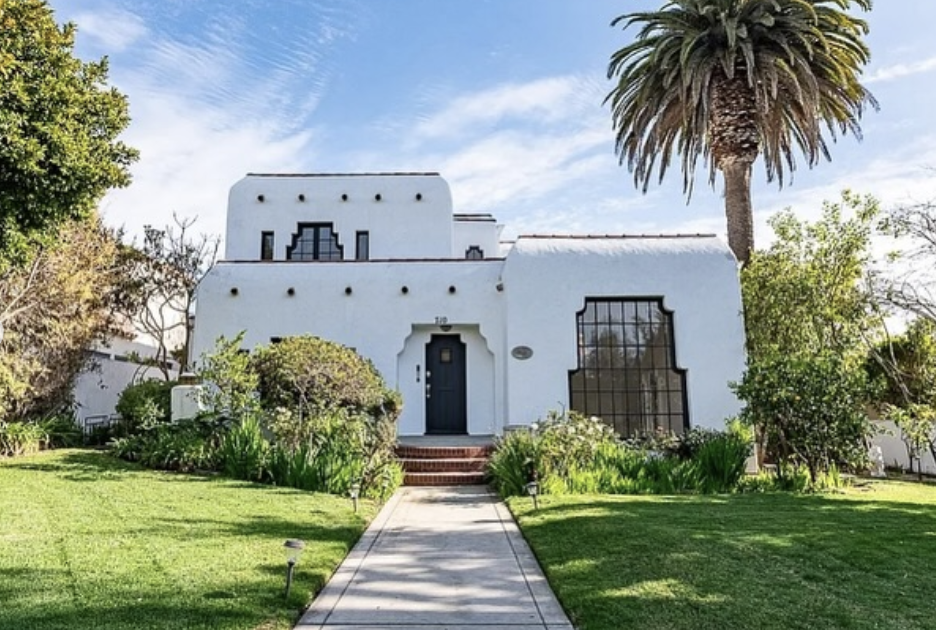
Worrell “Zuni House,” 710 Adelaide Place, Santa Monica (mid 1920s). White plaster cubes stacked to suggest a Pueblo village, with his Mayan stepped frames around the windows. Sources date it anywhere from 1923 to 1926. The City of Santa Monica designated it a landmark on March 10, 2003, and in the 1940s it belonged to the composer Ferde Grofé, who wrote the Grand Canyon Suite.
First Baptist Church of Ventura (1932). A church commission up the coast, and a reminder that his practice ran well beyond the Los Angeles city line.
Atwater Bungalows, 1431 and 1433 W. Avon Park Terrace, Echo Park (1930 to 1931). Two Pueblo Revival houses for Dr. H. Gale Atwater, with battered plaster walls, rounded corners, wooden waterspouts, tree-branch balcony railings, and kiva-style fireplaces inside. The City of Los Angeles declared them Historic-Cultural Monument No. 1241 on September 29, 2021. The full story, including what the designation covers on a parcel that holds several other dwellings, is in the Atwater Bungalows, Stacy-Judd's Pueblo houses in Echo Park.
Philosophical Research Society, 3910 Los Feliz Boulevard, Los Feliz (1934). The headquarters he drew for Manly P. Hall's society, a low Mayan Revival complex on the boulevard below Griffith Park.
North Hollywood Masonic Temple, 5122 Tujunga Avenue, North Hollywood. Designed with John Aleck Murrey around 1949 and completed in the early 1950s. The City of Los Angeles declared it Historic-Cultural Monument No. 1078 on January 27, 2015.
That is a short list for a fifty-year career, and the shortness is the point. Most of what Stacy-Judd drew in Southern California has not been published building by building, which means a great many houses carry his name on hearsay.
If you own a house attributed to Stacy-Judd
Start from the record, not the rumor. A house in his manner, with cast ornament, battered walls, or a Pueblo or Mayan vocabulary, is not his house until a document says so.
- The original building permit. The Department of Building and Safety has put millions of Los Angeles building records online, searchable by address or parcel number. A permit from the 1920s or 1930s usually names the architect.
- The UC Santa Barbara collection. If his office drew it, the drawings or the job file may be there. A match there is as close to proof as you will get.
- The designation report, if there is one. A Historic-Cultural Monument nomination names the architect and the features the city cared about, and someone had to defend it.
- The citywide survey. SurveyLA findings cover far more properties than the designated ones, and they sometimes carry an attribution the owner never knew about.
Then write the listing from what the documents support. "Designed by Robert Stacy-Judd" and "attributed to Robert Stacy-Judd" are different claims, and the difference is a piece of paper. On a house with almost no comparable sales, a documented architect is the premium an appraiser can actually write down. An undocumented one is an adjective. How that argument gets built is in how to price an architectural home in Los Angeles.
Plaster and cast ornament are also the parts of these houses that age worst and repair most expensively. Get the condition of the decorative work documented before you price, because a buyer who shops this architect will look at it first.
Stacy-Judd in California
His work runs from Monrovia on the old Route 66 to Santa Monica and Ventura on the coast, from a hillside in Echo Park to a boulevard in Los Feliz to a lodge in North Hollywood. That is the normal shape of a Southern California practice, and it is why buyers for these buildings shop the architect rather than the zip code. Someone watching a Pueblo Revival house in Echo Park is often the same person watching an adobe in Ojai or a period house in Santa Barbara.
He sits in an odd place among the architects who shaped Los Angeles. R. M. Schindler and Gregory Ain were inventing a modern Los Angeles house in the same decades that Stacy-Judd was arguing for an ancient American one. All three are in my architectural homes guide.
What is not known
There is no complete published catalogue of Stacy-Judd's residential work in Los Angeles, and this page does not pretend to be one. Dates for the North Hollywood Masonic Temple differ between sources, from 1949 to the early 1950s. Debbie Pisaro is not the listing agent for any building named here, and this page is a record of the architect rather than an offering.
Frequently Asked Questions
Who was Robert Stacy-Judd?
Robert B. Stacy-Judd (1884 to 1975) was a London-born architect who trained in England, practiced in North Dakota and Alberta, and settled in California in 1922. He is best known for the Aztec Hotel in Monrovia and for promoting Mayan Revival architecture, and he worked across Southern California until his death in Los Angeles in 1975.
What is Robert Stacy-Judd best known for?
The Aztec Hotel at 311 W. Foothill Boulevard in Monrovia, finished in 1925, which he promoted as the first commercial building in the Mayan Revival style. He also wrote and lectured on Maya architecture, publishing books on the Yucatan and on Atlantis in the 1930s.
Where are Robert Stacy-Judd buildings in Los Angeles?
His Los Angeles work includes the Atwater Bungalows at 1431 and 1433 W. Avon Park Terrace in Echo Park, the Philosophical Research Society at 3910 Los Feliz Boulevard in Los Feliz, and the North Hollywood Masonic Temple at 5122 Tujunga Avenue. Outside the city he drew the Aztec Hotel in Monrovia, the Worrell “Zuni House” at 710 Adelaide Place in Santa Monica, and the First Baptist Church of Ventura.
Are any Stacy-Judd buildings Los Angeles Historic-Cultural Monuments?
Yes. The North Hollywood Masonic Temple, designed with John Aleck Murrey, is Historic-Cultural Monument No. 1078, declared January 27, 2015. The Atwater Bungalows in Echo Park are Historic-Cultural Monument No. 1241, declared September 29, 2021.
How do you confirm a house was designed by Robert Stacy-Judd?
Pull the original building permit from the city's online building records, which usually names the architect on a house of that era. Then check the Robert Stacy-Judd papers at the UC Santa Barbara Architecture and Design Collection, any designation report, and the SurveyLA findings. Without a document, market the house as attributed, not designed.
Own a house with a name on it? A lot of my work is off market. If you would rather not advertise, ask me about a private sale, or start with a valuation grounded in architectural comps.
Also looking at branded residences? From Beverly Hills to Malibu, I track the Aman, Four Seasons and other branded projects across California. Tell me what you are looking for.
About Debbie Pisaro
Debbie Pisaro, Inman Luxury Leader, is the founder of Coastline 840, a boutique California practice, and a Real Estate Salesperson with deep roots in the Los Angeles market. She works with architectural, historic, and design-forward homes across the Valley, the LA basin, and California, and her background on these houses is on her page for the best Los Angeles historic and architectural real estate agent. Many of the homes she sells never reach the open market. Coastline 840 is a DBA of Side, Inc., CA DRE #02014153.
DRE #01369110