
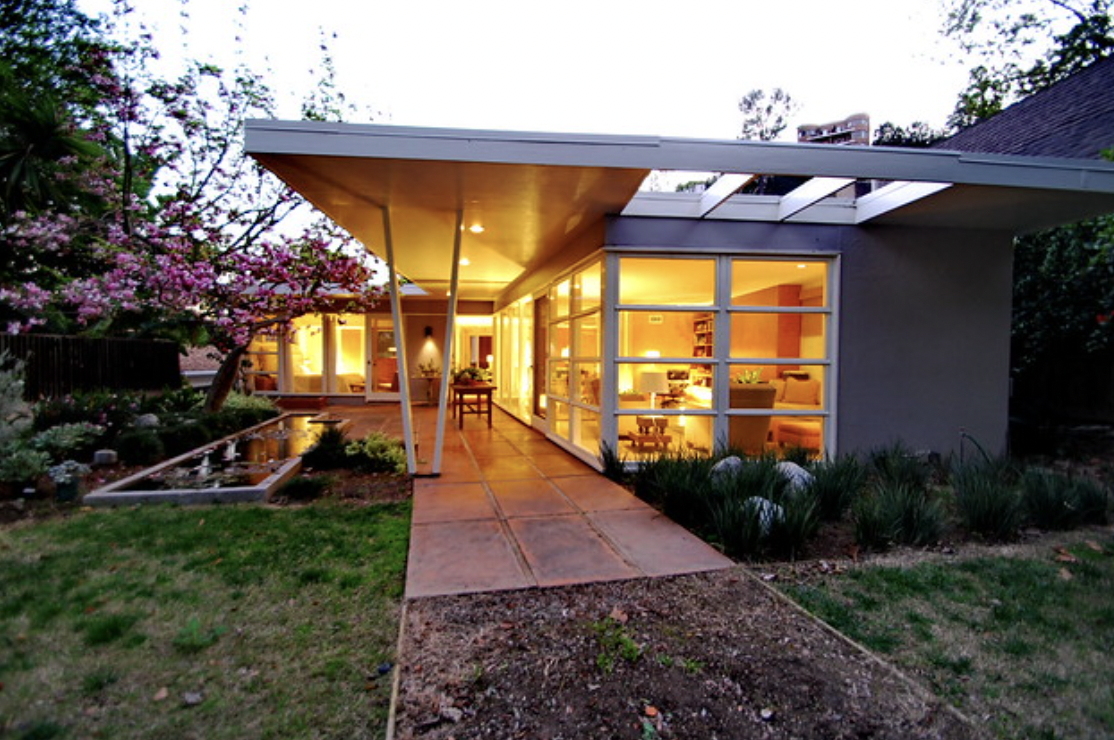
Eugene Kinn Choy (1912 to 1991) was a Chinese American architect who opened his Los Angeles practice in 1947 and was among the earliest Chinese American members of the American Institute of Architects. He designed the Cathay Bank headquarters in Chinatown and a run of wood-and-glass modern houses in Silver Lake, beginning with his own family home on Castle Street in 1949.
Powered by Side: #1 California-based brokerage, No. 9 in the nation.
Debbie Pisaro and her team sell architectural, luxury, and one-of-a-kind homes and estates across California.
Who was Eugene Kinn Choy?
Before Eugene Choy could build his own house, he had to knock on his neighbors' doors and ask. That one fact explains more about his career than any single building, and it is why the houses he left in Silver Lake carry more weight than their size suggests.
Choy is best known for one commercial landmark, the Cathay Bank headquarters on North Broadway in Chinatown, and for a small family of modern houses on the hills above the Silver Lake Reservoir. Anyone looking at mid century modern homes for sale in Silver Lake will eventually meet his name on Windsor Avenue or Castle Street, usually spelled two different ways. This page is the fuller record: where he came from, what he built, which houses survive, and what an owner of one should know. Debbie Pisaro writes about these houses because the people who own them deserve an agent who knows who built them.
From Bakersfield to a Los Angeles practice
Choy was born in China on March 5, 1912, according to the Pacific Coast Architecture Database, and came to Bakersfield as a boy of about eleven, where his family ran a department store. Valley Public Radio's Central Valley Roots series tells that part of the story alongside Fresno's Allen Lew, the two of them among the earliest Chinese Americans admitted to the American Institute of Architects.
He studied architecture at the University of Southern California, became a licensed architect in May 1947, and opened his own office that July. Accounts of his standing in the AIA differ: some call him the first Chinese American member in Southern California, others the second Chinese American member in the country. The safe statement is the one every account supports, that he was among the earliest. His brother Allan also became an architect, and his son Barton later led the firm.
He was working in the same city and the same years as the modernists who now have monument numbers. Richard Neutra had his houses along the reservoir, R.M. Schindler had his in the hills, and Gregory Ain, Raphael Soriano and John Lautner were all building small houses on hard lots. Choy was doing the same work with one more obstacle in the way.
The house he had to ask permission to build
In the late 1940s Choy bought a lot on Castle Street, near the Silver Lake Reservoir, to build a house for his family. Racial covenants in the area had barred sales to anyone who was not white. The Supreme Court made those covenants unenforceable in 1948, but attitudes did not change with the ruling, so Choy went door to door and asked his future neighbors for their approval. He won it, and he built.
According to Wikipedia's account, drawing on his son Barton, the restrictions also made a conventional loan hard to get, and the family built before the financing was settled. The house went up in 1949 on a narrow lot that slopes in two directions, clad in wood inside and out. Julius Shulman photographed it, and it was published in Arts and Architecture in 1951. The full story of the house, and what its designation status means for an owner, is on its own page: the Eugene Choy House at 3027 Castle Street.
That door-to-door campaign did more than get one house built. The Silver Lake Neighborhood Council describes the Primrose Hill pocket around Castle Street and Windsor Avenue as noteworthy for its residences by Asian American modernist architects, and Choy's own house is where that run begins.
The Choy houses of Primrose Hill
Over the next decade Choy designed a small group of houses within a few blocks of his own, and his son Barton added two more in the 1970s. The City's SurveyLA report counts seven modern buildings by the Choy firm in the Silver Lake, Echo Park and Elysian Valley planning area. They share a vocabulary: post-and-beam frames, wood skins, glass where the view is, and a careful answer to a steep lot.
- Eugene Choy House, 3027 Castle Street, 1949. His own family home.
- Heffren House, 3200 Windsor Avenue, 1953 to 1954. Designed for Leonard Heffren, clad in redwood, on the southwest side of the reservoir.
- Kawaguchi House, 3022 Windsor Avenue, 1955 to 1956. Post-and-beam on a hilltop, with a 1973 addition by Jack Levinson and a 2008 restoration by Thomas Michna.
- Choy Guest House, 3028 Windsor Avenue, 1956.
- 2356 West Duane Street, 1957.
- Barton Choy Residence, 3035 Windsor Avenue, 1972, by Barton Choy. The Los Angeles Conservancy describes it as cedar-clad and postmodern, with a Sea Ranch-inspired sensibility.
- 3025 Windsor Avenue, 1977, by Barton Choy.
The houses are private residences, and these are documented attributions, not a complete catalogue. No full list of Choy's residential work has been published, and the best inventories are the SurveyLA report, the Neighborhood Council's modernism page, and the record his family and photographers left. The Kawaguchi House has had the widest audience of the group: it appeared as the home of the character Love Quinn in the second season of the series You.
Silver Lake holds one of the deepest concentrations of modernist housing in California, mapped in the Silver Lake architecture guide, and the Choy houses are its quieter wing: warm wood rather than white stucco, and scaled to a family rather than a statement.
The Brander House in Outpost Estates
Choy's largest known house sits outside Silver Lake. The Brander House, at 7266 Outpost Cove Drive in the Outpost Estates section of the Hollywood Hills, was designed for the family of Ira Brander and is dated to 1959. Julius Shulman photographed it, though, as the Eichler Network has noted, it does not appear in the books of his work.
It is a different scale of commission from the Silver Lake houses, on a large hillside lot in one of the city's older planned neighborhoods. Outpost Estates is better known for its Spanish Revival houses of the 1920s, and the same hills hold Luis Barragan's work in Outpost Estates. Choy's house is the neighborhood's mid-century counterpoint.
Cathay Bank and the Chinatown work
Choy's best-known building is the Cathay Bank headquarters at 777 North Broadway in Chinatown. The bank was founded in 1962, and the building Choy designed for it opened in 1966. The Los Angeles Conservancy classes it as New Formalist and notes how it blends mid-century modernism with Chinese decorative elements, among them its eaves and tile cladding.
His Chinatown work began earlier. The Pacific Standard Time exhibition record credits him with a 1952 building for the Chinese Consolidated Benevolent Association, and a 1977 letter held by the Chinese Historical Society of Southern California shows him presenting the model for a new Castelar School building. For three decades his office was part of how postwar Chinatown was built.
In 2012 the Chinese American Museum in Los Angeles put that generation on the record. Its exhibition Breaking Ground: Chinese American Architects in Los Angeles, 1945 to 1980, part of the Getty's Pacific Standard Time initiative, presented the work of Choy alongside Gilbert Leong, Helen Liu Fong and Gin Wong. The Getty Research Institute holds a 1952 Shulman portrait of Choy.
Choy's name is spelled Choy and Choi in different sources, and his houses go by client names. Search both spellings, and the street address, before deciding a house has no history.
Are Choy's houses protected?
The public record reviewed for this page does not show a Historic-Cultural Monument designation for any of the Choy houses in Silver Lake, and Silver Lake has no Historic Preservation Overlay Zone. SurveyLA lists the houses as examples of modern residential architecture, but a survey listing is a research record, not a designation. It carries no design review and no Mills Act eligibility.
That leaves the houses in their owners' hands. An owner can renovate without preservation review, and a buyer cannot assume the next owner will be careful. The route to protection is individual Monument designation, which also opens the City's Mills Act program. Selling a Mills Act or Monument home has its own mechanics, and whether designation costs an owner at resale is a fair question that the record on designation and home value answers.
Selling a Choy house, and why the story is part of the value
A Choy house is not priced off the neighborhood grid. The buyer for one knows the architect, knows the Silver Lake story, and compares the house against what survives of the others. Condition and originality carry more weight than square footage, and the record carries more weight than either: the drawings, the permits, every addition and who designed it, and any photographs.
Walking Castle Street and Windsor Avenue, Debbie Pisaro's own read is that the Choy houses feel connected by a shared architectural vision without losing their individual character. There is a thoughtfulness to the way they meet the terrain, balance privacy with openness, and make modern design feel at home in the neighborhood. That is the case a listing for one of them has to make, and it starts with the architect's name and the year.
Debbie Pisaro is a 24-year veteran, founder of Coastline 840, and an Inman Luxury Leader. She is not the listing agent for any of the houses named on this page, and she represents buyers on architectural and historic homes across California, regardless of who holds a given listing. Owners work with her as an architectural homes specialist, and a good part of that work happens quietly through pocket listings, which is what Coastline 840 was built for. The Silver Lake record is kept street by street on Just Silver Lake.
Who was Eugene Kinn Choy?
Eugene Kinn Choy was a Chinese American architect, born in China in 1912 and raised in Bakersfield, who opened his Los Angeles practice in 1947 and practiced until his death in 1991. He designed the Cathay Bank headquarters in Chinatown and a group of modern houses in Silver Lake, including his own.
What is Eugene Choy best known for?
The Cathay Bank headquarters at 777 North Broadway in Chinatown, which opened in 1966, and his 1949 family home on Castle Street in Silver Lake. To build that house he went door to door to win his future neighbors' approval in an area where racial covenants had kept non-white buyers out.
How many houses did Eugene Choy design in Silver Lake?
No complete count has been published. The City's SurveyLA report counts seven modern buildings by the Choy firm in the Silver Lake, Echo Park and Elysian Valley area. Together with the Neighborhood Council's list, the record documents five Silver Lake houses by Eugene and two by his son Barton.
Where are the Eugene Choy houses in Silver Lake?
Most stand within a few blocks of each other in Primrose Hill, near the Silver Lake Reservoir: 3027 Castle Street, and 3200, 3022 and 3028 Windsor Avenue, with another at 2356 West Duane Street. Barton Choy's houses are at 3035 and 3025 Windsor Avenue. All are private residences.
Is it Eugene Choy or Eugene Choi?
Choy is the spelling used by the Los Angeles Conservancy, the City's SurveyLA report, Wikipedia and his own firm. Some real estate coverage, including a Dwell article on the Kawaguchi House, spells it Choi. They are the same architect, so search both spellings when researching one of his houses.
Was Eugene Choy the first Chinese American member of the AIA?
Accounts differ. Some sources call him the first Chinese American to join the American Institute of Architects in Southern California, and others the second Chinese American member nationally. Every account agrees he was among the earliest, which is how this page describes him until a primary AIA record settles it.
Are any Eugene Choy houses Historic-Cultural Monuments?
The public record reviewed for this page does not show a Historic-Cultural Monument designation for any Choy house in Silver Lake, and Silver Lake has no HPOZ. SurveyLA lists the houses, but a survey listing is not a designation. Confirm any parcel's status with the City's Office of Historic Resources.
Which Eugene Choy house was in the TV show You?
The Kawaguchi House at 3022 Windsor Avenue in Silver Lake, a 1956 post-and-beam house by Choy. It appeared as the home of the character Love Quinn in the second season of You. Like the other Choy houses, it is a private residence, so view it from the public street only.
What should I know before buying a Eugene Choy house?
Ask for the drawings, the permit history, and the record of every addition and who designed it. Check the parcel's designation status, which for most Choy houses is none. Originality and documentation carry more value than square footage, because buyers compare each house against what survives of the others.
Who is a good real estate agent for a Eugene Choy house?
Look for an agent who knows the architect and the Silver Lake story. Debbie Pisaro is a 24-year veteran, founder of Coastline 840, and an Inman Luxury Leader who represents buyers on architectural and historic homes across California, regardless of who holds a given listing. Reach her at (310) 362-6429.
Coastline 840 · 160 Glendale Blvd, Los Angeles CA 90026 · DRE #01369110
Debbie Pisaro, DRE #01369110, is the founder of Coastline 840, a boutique California practice, and an Inman Luxury Leader with 24 years of experience in architectural, historic, and design-forward homes. Many of the homes she sells never reach the open market. Coastline 840 is a DBA of Side, Inc., CA DRE #02014153, the responsible broker. Powered by Side: #1 California-based brokerage, No. 9 in the nation. She writes about California real estate at debbiepisaro.com, losfelizliving.com, and coastline840.com.
City of Los Angeles, SurveyLA Historic Resources Survey Report, Silver Lake-Echo Park-Elysian Valley. Los Angeles Conservancy, Cathay Bank and Barton Choy Residence. Silver Lake Neighborhood Council. Pacific Coast Architecture Database, University of Washington. Valley Public Radio, Central Valley Roots (March 2025). Chinese American Museum, Breaking Ground: Chinese American Architects in Los Angeles, 1945 to 1980 (2012). Chinese Historical Society of Southern California. The Eastsider. Eichler Network. Dwell. Wikipedia, Eugene Kinn Choy.
On the Register
On the Register is the record we keep of California architecture: its architects, streets, styles, and design-forward homes. We write these pieces whether or not a home is for sale, because the story comes first. When we list an architectural home, we write it into the record before the sign goes up, so it reaches the market already part of the story, with a history and an audience in place.
© 2026 Debbie Pisaro, Coastline 840 · ontheregister.com