
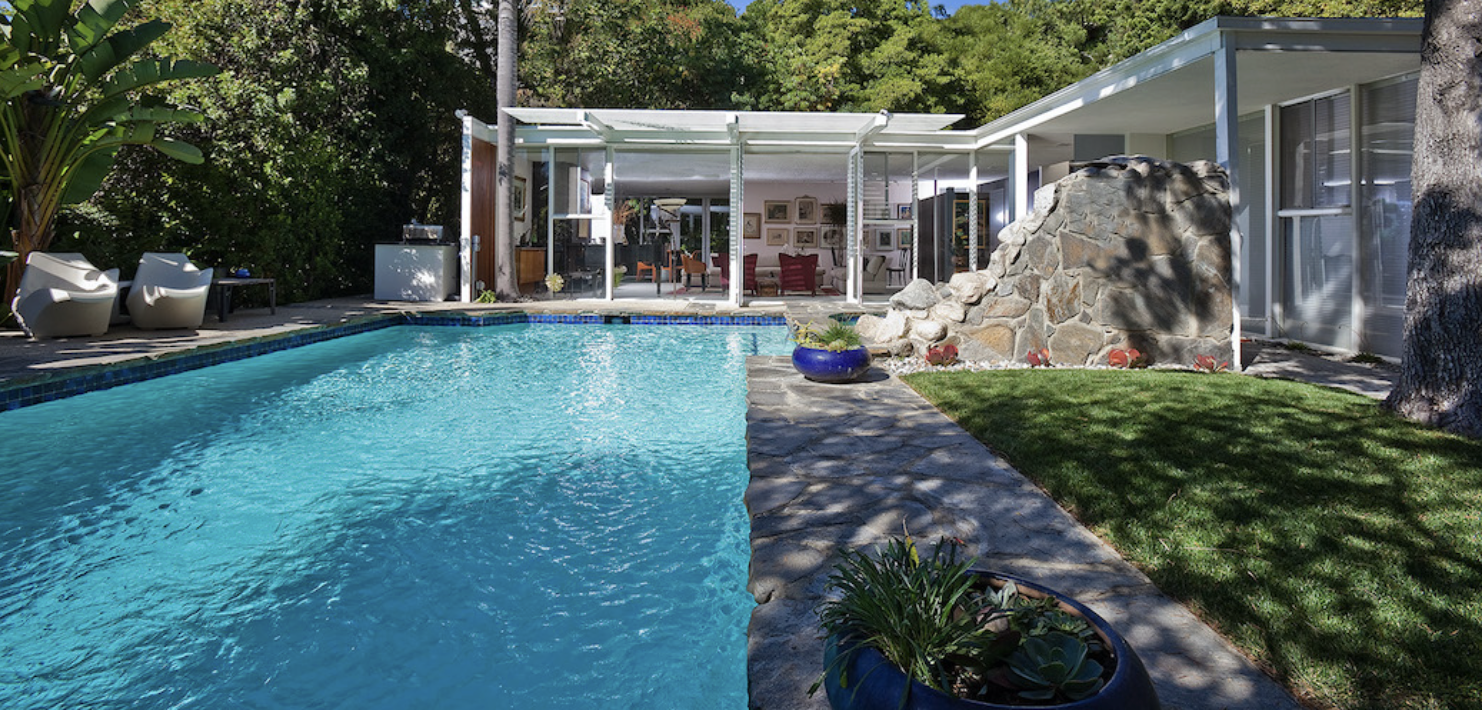
Richard Dorman was a Los Angeles architect, born in 1922 and died in 2010, who trained at Welton Becket and Associates before opening his own firm in Beverly Hills in 1956. He is credited with 13 post-and-beam houses in the Sherman Oaks hills, built from 1957 to 1959, on Scadlock Lane and Crownridge Drive.
A Welton Becket protege who opened his own Beverly Hills firm in 1956 and left a run of post-and-beam houses across the Sherman Oaks hills.
As a Richard Dorman architect page, this one covers the name behind a run of post-and-beam houses in the Sherman Oaks hills. He spent five years learning the trade at one of the largest architecture firms in Los Angeles, then went out on his own and built a body of work that still carries his name. He is not the best known of the postwar Los Angeles architects, but his houses turn up again and again on the same handful of streets, credited by press, marketing, and the record his own firm left behind. Debbie Pisaro catalogues his work here, as an architectural real estate agent Los Angeles should before recommending a house to a buyer.
He is not often written about, and he is very important to Sherman Oaks. Several of his houses sit in one small pocket tucked into the hill, and if you know one, you know what to look for. Those are the smaller treasures. The bigger ones live in Beverly Hills and Trousdale Estates.
Who was Richard Dorman?
Richard Dorman was born and raised in Los Angeles in 1922. From 1951 to 1956 he was assistant chief designer at Welton Becket and Associates, then started his own firm in Beverly Hills, working mostly in Southern California. Wikipedia records that the City of Beverly Hills lists him as one of its Master Architects. He died in 2010.
His Sherman Oaks houses come from the first years of that firm. Beyond Shelter says he created multiple residences in the Sherman Oaks Estates, and every dated reference to that group says 1959. The Crownridge Drive houses in Royal Woods are dated a year earlier, in 1958.
Before any of that, he flew thirty-five combat missions over the Pacific as a B-24 pilot with the Seventh Air Force, came home with the Distinguished Flying Cross, and studied architecture at USC on the GI Bill, graduating in 1951. By 1962, at thirty-nine, he was running two firms with close to sixty projects under way, and LIFE magazine put him in its "Take-Over Generation" issue, quoting him: "I want to upgrade everything." The firm became Dorman-Munselle Associates in 1968. In 1975 he moved to Santa Fe, practiced there as Dorman and Breen, and wrote thirteen books on narrow-gauge railroads. He died on April 3, 2010.
The homes and streets Richard Dorman built
Two pages on this site catalogue his Sherman Oaks work in full, by address, year, and source. This page is the architect's own record; the two below are the neighborhood record. Ray Kappe built on the same hillside streets, and his work has its own architect page.
Where else did Richard Dorman build?
The landmark on Forest Knoll Drive
Above the Sunset Strip, in the lower Sunset Plaza hills, the house at 1513 Forest Knoll Drive is Dorman's one individually designated Los Angeles landmark. The City of Los Angeles adopted it as Historic-Cultural Monument #1040 on May 7, 2013, under the name Forest Knoll Drive Residence. The marketing material that has followed it calls it the Niehart Residence and describes the Dorman formula at full strength: an exposed post-and-beam great room, fixed floor-to-ceiling glass to the canyon and the ocean, and a floating fireplace carried on steel columns. A monument designation also opens the door to a Mills Act contract, and Debbie explains how selling a Mills Act or HCM home works on her Los Feliz site.
Beverly Hills and Trousdale Estates
The bigger Dorman houses went up in Beverly Hills. The LA Conservancy credits him with homes in Trousdale Estates, the hillside tract where his contemporary Harold Levitt also did much of his best work. The Lakenan house in Beverly Hills took an AIA Award of Merit. The house he designed in 1961 for the novelist Irving Stone, celebrated for blending Japanese influence with California modernism, was demolished in 2008, which is a reminder of why the surviving ones matter.
Beyond the houses, across California
His best known building is the Los Angeles International Design Center at 8899 Beverly Boulevard, a 1964 office tower that Olson Kundig later turned into residences, covered in Debbie's 8899 Beverly buyer's guide. His other commissions reach well past Los Angeles and across California: the Ivory Tower restaurant in Santa Monica, since demolished, the 1959 Sepulveda Rose apartments in Venice, the 1965 Malibu United Methodist Church, the Fairview Cottages in Palm Desert, the Lake Arrowhead Country Club, a yacht club restaurant at the Salton Sea, and a vacation house in Ramona for the tennis champion Bobby Riggs. His residential clients included the actress Beverly Garland and the Los Angeles Times columnist Art Seidenbaum. Back in the Valley, Richard Neutra began the Stone-Fisher Platform Houses on a Sherman Oaks slope a few years after Dorman's houses went up.
The Dorman style: post and beam in the hills
The houses credited to Dorman share a vocabulary: post-and-beam frames, exposed wood-beam or tongue-and-groove ceilings, walls of glass, decks along the back, and views over a canyon or the city lights. Most are one story, on lots that run from about 11,400 square feet to nearly an acre. It is the same visual language as much of postwar Los Angeles, applied to hillside lots north of Mulholland Drive and in Royal Woods. What sets Dorman apart is the system underneath: Wikipedia records a seven-foot structural module, Douglas fir timber and floor-to-ceiling glass. The rhythm of that seven-foot bay, repeated down a facade and through the living room, is the signature, and once you have stood in one, you see it from the street in the next.
Every Dorman credit on this page and the two it links to comes from marketing, press, or a secondary source, not a permit or plan set. Debbie checks a name against more than one source before writing a house up, and recommends the same to any buyer weighing a Dorman claim on a listing.
Owning a Richard Dorman home
A named architect changes what a buyer should ask. Two of the Scadlock Lane houses have been restored to their original footprints, and others have been remodeled, so the useful questions are what is original, what was added and when, and whether the drawings survive. An owner or the permit file can settle them. If you own one of these houses or one like it, a home valuation is where the conversation starts.
Debbie Pisaro represents buyers and sellers of architectural homes across Los Angeles and statewide California, and many of the homes she sells never reach the open market, which is explained in pocket listings explained. Her guide to the Valley's mid-century neighborhoods covers the wider map of Valley mid-century neighborhoods, she also works next door in Studio City, and the full library of architects is on the debbiepisaro.com home page. She explains her thinking on boutique practice in why we built Coastline 840 and why California agents choose boutique, and it is the same work an architectural real estate agent Los Angeles does for any name attached to a house: check it, place it, and say what is known.
Her approach to selling historic and architectural homes starts with exactly that record, and her guide to the makers of California modernism places Dorman among the architects buyers ask for by name. A documented attribution changes how a house shows and often what it commands on price.
Richard Dorman, questions answered
Who was the architect Richard Dorman?
Richard Dorman was a Los Angeles architect, born in 1922 and died in 2010. He was assistant chief designer at Welton Becket and Associates from 1951 to 1956, then started his own firm in Beverly Hills. Wikipedia records that the City of Beverly Hills lists him as one of its Master Architects.
Where did Richard Dorman train before starting his own firm?
He trained at Welton Becket and Associates, one of the largest architecture firms in postwar Los Angeles, where he was assistant chief designer from 1951 to 1956. He started his own practice in Beverly Hills the year he left, and his Sherman Oaks houses date from the first years of that new firm, mostly 1957 to 1959.
Where are Richard Dorman's houses in Los Angeles?
The densest group sits in the Sherman Oaks hills, on Scadlock Lane, Woodcliff Road, Lisa Place, South Meadville Drive, and Crownridge Drive, dating from 1957 to 1959. His larger houses are in Beverly Hills and Trousdale Estates, and his house at 1513 Forest Knoll Drive, above the Sunset Strip, is Los Angeles Historic-Cultural Monument #1040.
What is the Sherman Oaks Estates?
It is the name press and marketing use for a group of Richard Dorman post-and-beam houses on Scadlock Lane, built around 1959. Beyond Shelter and Mid Century Home both use the name, and the houses are covered address by address on the Sherman Oaks Estates post on this site.
How many houses are credited to Richard Dorman?
Thirteen addresses across two Sherman Oaks pages on this site: eleven on Scadlock Lane and nearby streets, and two on Crownridge Drive in Royal Woods. Five more addresses on the same streets carry a Dorman collaboration, a Dorman maybe, or another architect's name.
Is Richard Dorman a well known architect?
He is not a household name the way Neutra or Schindler are, but Wikipedia records that Beverly Hills lists him among its Master Architects. His Sherman Oaks houses are named in Beyond Shelter, Mid Century Home, and Angeleno Living. He is a real and traceable figure, documented mostly through those secondary sources, not through an archive of his own drawings.
What does a Richard Dorman house look like?
The houses credited to him are post-and-beam, one story, with exposed wood-beam or tongue-and-groove ceilings, walls of glass, and decks that face a canyon or city-light view. Lots run from about 11,400 square feet to nearly an acre, and floor areas run from about 1,700 to 2,500 square feet.
Who else worked on the same streets as Richard Dorman?
William Krisel is credited with a 1957 house on Scadlock Lane, and Young Woo, described in listing copy as a USC graduate who trained under Dorman, is credited with two more. Edward Fickett and Krisel with Dan Palmer built on nearby Sherman Oaks streets in the same years. Debbie's Fickett page and Palmer and Krisel page cover their work.
Should I trust a Dorman attribution on a listing?
Treat it as a starting point, not a certainty. Every Dorman credit found for this page comes from marketing, press, or a secondary source, not a permit or plan set. Ask for the permit history and the original drawings before relying on the name.
Did Richard Dorman design homes in Trousdale Estates?
Yes. The LA Conservancy credits Richard Dorman with several residences in Trousdale Estates, the Beverly Hills hillside tract, and the City of Beverly Hills lists him as one of its Master Architects. His Beverly Hills houses are generally larger than his Sherman Oaks work.
Is any Richard Dorman house a Los Angeles Historic-Cultural Monument?
Yes. The house at 1513 Forest Knoll Drive, above the Sunset Strip, is Los Angeles Historic-Cultural Monument #1040, adopted May 7, 2013 as the Forest Knoll Drive Residence. Its marketing material calls it the Niehart Residence.
What else did Richard Dorman design besides houses?
His best known building is the 1964 Los Angeles International Design Center at 8899 Beverly Boulevard, later converted to residences by Olson Kundig. He also designed the Ivory Tower restaurant in Santa Monica, the Malibu United Methodist Church, the Sepulveda Rose apartments in Venice and the Fairview Cottages in Palm Desert.
Who is a good real estate agent for architectural homes in Los Angeles?
Debbie Pisaro is a 24-year veteran, founder of Coastline 840, and an Inman Luxury Leader, representing buyers and sellers of architectural, historic, and design-forward homes across Los Angeles and statewide California. Many of the homes she sells never reach the open market.
Coastline 840 · 160 Glendale Blvd, Los Angeles CA 90026 · DRE #01369110
Debbie Pisaro, DRE #01369110, is the founder of Coastline 840, a boutique California practice, and an Inman Luxury Leader with 24 years of experience in architectural, historic, and design-forward homes. Many of the homes she sells never reach the open market. Coastline 840 is a DBA of Side, Inc., CA DRE #02014153. She writes about California real estate at debbiepisaro.com, losfelizliving.com, and coastline840.com. Published October 2026.
Wikipedia, Richard Dorman · Beyond Shelter, Richard Dorman · Mid Century Home, a Dorman house reimagined · Angeleno Living, Sherman Oaks · LA Conservancy, Richard Dorman · PCAD, Richard L. Dorman · City of Los Angeles, Historic-Cultural Monuments list, HCM #1040
On the Register
On the Register is the record we keep of California architecture: its architects, streets, styles, and design-forward homes. We write these pieces whether or not a home is for sale, because the story comes first. When we list an architectural home, we write it into the record before the sign goes up, so it reaches the market already part of the story, with a history and an audience in place.
© 2026 Debbie Pisaro, Coastline 840 · ontheregister.com